Peter Higgs, Nobel laureate who predicted Higgs boson, dies at 94
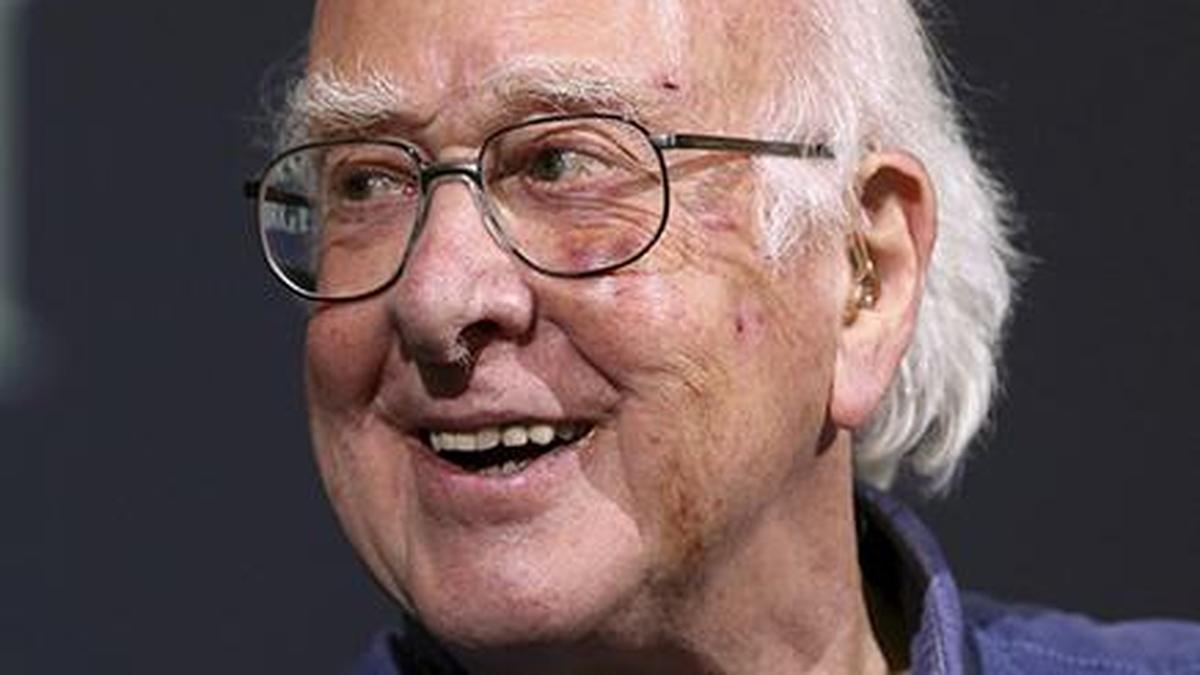
Nobel prize-winning physicist Peter Higgs, who proposed the existence of the Higgs boson particle that helped explain how matter formed after the Big Bang, died on Monday at age 94. He passed away peacefully at home following a short illness, the University of Edinburgh announced on Tuesday.
Higgs, an emeritus professor at the university, first predicted the existence of the particle now known as the Higgs boson in 1964. He theorized that a subatomic particle of a certain dimension must exist to explain how other particles—and therefore all the stars and planets in the universe—acquired mass. Without such a particle, the standard model of particle physics, which describes the fundamental forces and particles in the universe, would not hold together.
The work of Higgs addressed one of the most fundamental questions in cosmology: how the Big Bang created something out of nothing 13.8 billion years ago. Without mass, particles could not clump together into the matter we interact with daily.
It took nearly 50 years for the existence of the particle to be confirmed. In 2012, scientists at CERN, the European Organization for Nuclear Research, announced they had detected a Higgs boson using the Large Hadron Collider, a $10 billion atom smasher in a 27-kilometer tunnel under the Swiss-French border. The collider was designed in large part to find the particle, producing collisions with extraordinarily high energies to mimic conditions immediately after the Big Bang.
For his work, Higgs was awarded the 2013 Nobel Prize in Physics, sharing it with Francois Englert of Belgium, who independently came up with the same theory.
University of Edinburgh Vice Chancellor Peter Mathieson described Higgs as “a remarkable individual – a truly gifted scientist whose vision and imagination have enriched our knowledge of the world that surrounds us. His pioneering work has motivated thousands of scientists, and his legacy will continue to inspire many more for generations to come.”
Born in Newcastle, northeast England on May 29, 1929, Higgs studied at King’s College, University of London, and earned a Ph.D. in 1954. Much of his career was spent at the University of Edinburgh, where he became Personal Chair of Theoretical Physics in 1980 and retired in 1996.
One of the most memorable moments of Higgs’s career came in 2013 when scientists at CERN presented complex statistical confirmation of the boson. Higgs, attending the lecture, broke into tears. Fabiola Gianotti, CERN director-general, recalled: “There was an emotion — a kind of vibration — going around in the auditorium. That was just a unique moment, a unique experience in a professional life.” She described Higgs as “a very touching person… so sweet, so warm… always interested in what other people had to say.”
Joel Goldstein from the University of Bristol noted: “Peter Higgs was a quiet and modest man, who never seemed comfortable with the fame he achieved even though this work underpins the entire modern theoretical framework of particle physics.”
Gianotti also noted that Higgs often objected to the term “God particle,” a popularization he felt was inaccurate and sensationalized.