NavIC Revival: NVS-03 Ready for Launch, Four Satellites in Pipeline, Says Jitendra Singh
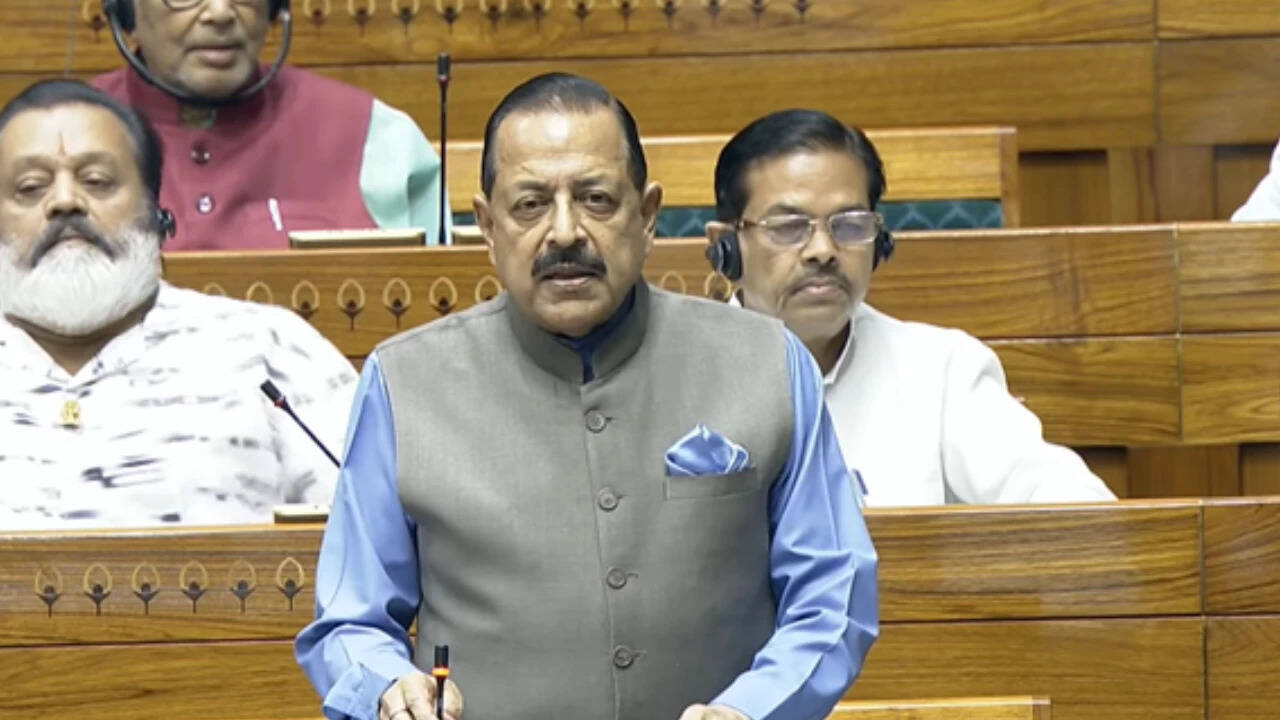
NEW DELHI: The government is moving to restore the Indian Regional Navigation Satellite System (NavIC) to full operational status, with plans to launch four satellites in the near future. Union Minister of State for Space Jitendra Singh informed the Lok Sabha on Wednesday that the NVS-03 satellite is ready for launch, incorporating all corrective measures following the anomaly in the NVS-02 satellite.
"NVS-03 is ready for launch after incorporation of all corrective measures arising from the NVS-02 anomaly. It will be followed by the launch of NVS-04 and NVS-05. One more satellite is planned thereafter to complete the seven-satellite NavIC base layer constellation," Singh said in a written reply.
The minister, however, did not provide a timeline for these launches. The announcement comes as the country seeks to address the failure of the NVS-02 satellite in 2025, which was intended as a replacement satellite for the NavIC constellation.
Singh noted that necessary corrective measures have been incorporated and successfully implemented and tested in the CMS-03 satellite. "The same will be followed in subsequent satellites, including the NavIC series of satellites carrying bi-propellant systems," he added.
Currently, only three satellites—IRNSS-1B, IRNSS-1L, and NVS-01—are capable of providing navigation services. For the NavIC system to be operationally effective, at least four satellites with working atomic clocks are required. Consequently, NavIC is no longer providing standalone positioning services.
In March 2025, the last atomic clock aboard the Indian Regional Navigational Satellite System-1F (IRNSS-1F) stopped functioning, further crippling the constellation. The first-generation NavIC satellites were launched between 2013 and 2018, but they soon began facing issues, with atomic clocks on several IRNSS series satellites repeatedly malfunctioning.
Atomic clocks are critical components for navigation satellites because they provide the precise timing needed for position calculations. The failure of these clocks on multiple satellites led to a degradation of NavIC's services.
The NVS series represents the second-generation satellites for NavIC, designed to replace and augment the aging first-generation IRNSS satellites. While ISRO successfully placed NVS-01 in its intended orbit in 2023, the 2025 launch of NVS-02 failed due to a technical anomaly. This failure has delayed the planned launches of NVS-03, NVS-04, and NVS-05.
NavIC is India's independent regional navigation satellite system, developed to provide accurate position, velocity, and timing information over India and a region extending about 1,500 km beyond its borders. The system is designed to offer two services: a standard positioning service for civilian use and a restricted service for strategic users. It is used in applications such as terrestrial and marine navigation, fleet management, disaster management, and geodesy.
The restoration of NavIC is seen as crucial for reducing India's dependence on foreign navigation systems like the United States' GPS, Russia's Glonass, the European Union's Galileo, and China's BeiDou. A fully functional NavIC also supports the government's push for self-reliance in critical space technologies.
Each NavIC satellite carries rubidium atomic clocks for precise timing. The second-generation NVS satellites are equipped with enhanced clock designs and additional features, including the L1, L5, and S band signals for interoperability with other global navigation systems.
According to ISRO, the NVS series aims to ensure continuity of services and improve the performance of the NavIC system. The successful launch of NVS-01 in 2023 had demonstrated the viability of the new design, but the NVS-02 anomaly raised concerns about the reliability of the propulsion systems.
Minister Singh's assurance in Parliament indicates that the technical issues have been addressed, and testing on the CMS-03 satellite has validated the corrective measures. This paves the way for the upcoming launches, which will gradually rebuild the constellation.