Indian Researchers Discover Rare 'Bow and Arrow' Radio Galaxy 2 Billion Light Years Away

Twelve Indian researchers across three countries have discovered a rare radio galaxy shaped like a bow and arrow. Located about 2 billion light years from Earth, the galaxy spans 1.8 million light years. A light year is approximately 9.46 trillion kilometres.
Radio galaxies are active galaxies that emit large amounts of energy as radio waves, powered by supermassive black holes at their cores. The newly discovered galaxy, named RAD-BAARG, has an unusual asymmetric structure unlike typical radio galaxies. RAD stands for RAD@home Astronomy Collaboratory, India's first citizen science research platform in astronomy, based in Navi Mumbai. BAARG expands to Bow And Arrow Radio Galaxy.
The team's findings were published in the journal Monthly Notices of the Royal Astronomical Society on June 22. The lead author is Ananda Hota of the University of Mumbai and founder-director of RAD@home. Other authors include Pratik Dabhade, Shubhrangshu Ghosh, Mitali Damle, Souvik Manik, Sabyasachi Pal, C. Konar, Sagar Sethi, Pranim Limbo, Aditya Sahasranshu, Sravani Vaddi, and Arundhati Purohit.
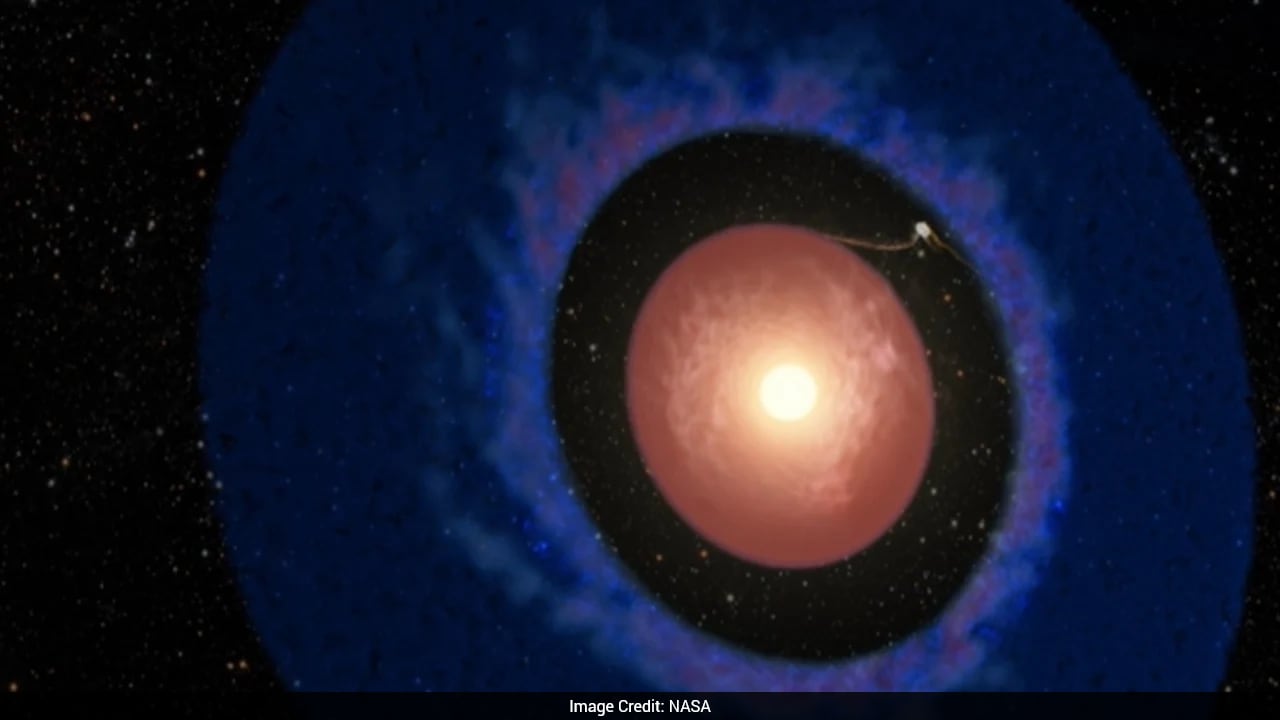
The discovery was made using ultra-sensitive images from the LOFAR (Low Frequency Array) Two-metre Sky Survey. According to Shubhrangshu Ghosh, the black hole in RAD-BAARG launches jets of relativistic plasma that interact with a large bow-shock-like structure. This structure forms as the host galaxy falls through hot gas toward a nearby cluster of galaxies, similar to a shock wave ahead of a supersonic aircraft.
The western side of the galaxy shows a narrow jet feeding a sector-shaped emission region and a giant arc extending nearly 560 kiloparsecs (1.8 million light years). The opposite side has a distorted S-shaped jet with a faint tail extending almost 600 kiloparsecs. The host galaxy is in a dynamically complex environment with nearby clusters, suggesting strong interaction between the radio plasma and its surroundings.