First-Ever Tiny Swirls Seen on Sun Offer Clues to Solar Magnetic Energy
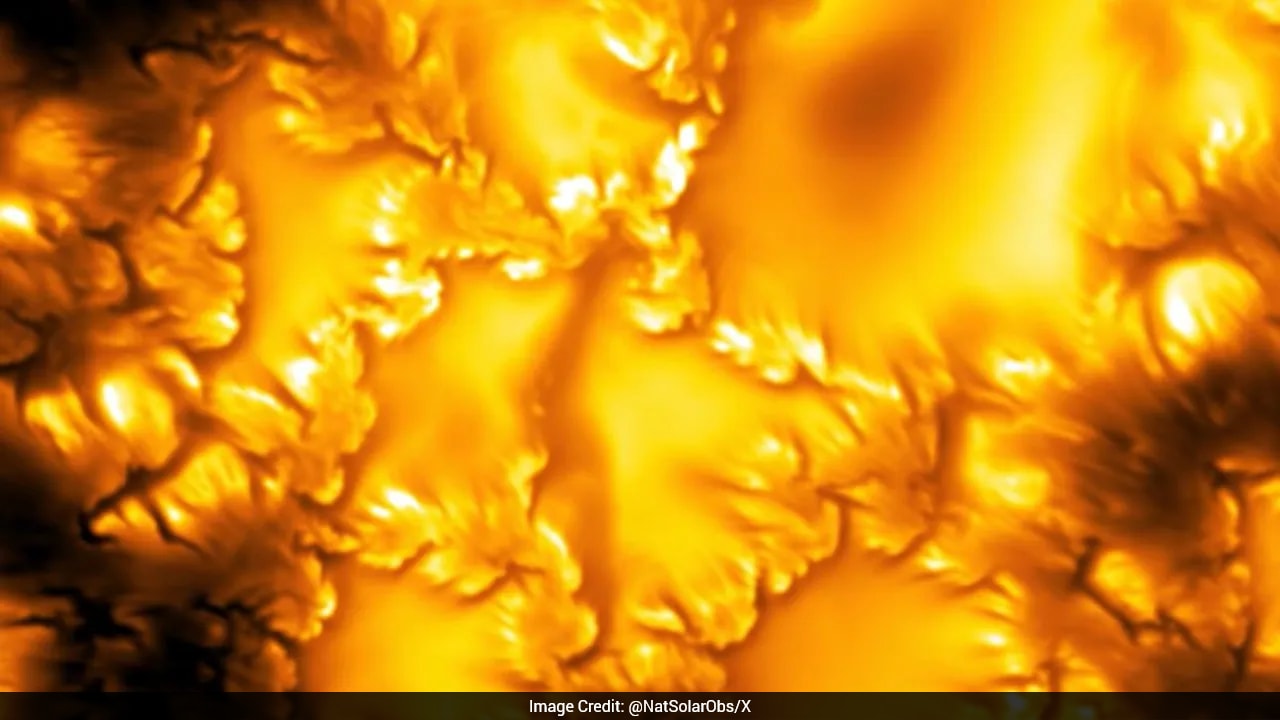
Scientists have for the first time captured tiny swirling patterns on the Sun's visible surface, a discovery that could help explain how solar activity develops and unfolds. The observations, made using the National Science Foundation's Daniel K Inouye Solar Telescope in Hawaii, provide an unprecedented close-up view of a magnetically active region near a sunspot.
The Sun's visible surface, known as the photosphere, is a thin layer of atmosphere shaped by complex interactions between magnetic fields and moving plasma. By combining high-resolution images and time-lapse videos with computer simulations, researchers identified the swirls as a phenomenon called Kelvin-Helmholtz instability. This occurs when two fluids moving at different speeds pass one another, creating small disturbances that spiral into vortices. While this instability has been observed in lake and ocean waves, cloud formations, and the atmospheres of planets like Jupiter and Saturn, it had never before been seen on the Sun.
The findings, published in the journal Nature, offer a potential explanation for a long-standing puzzle: how the Sun's magnetic energy accumulates before being released in dramatic events such as solar flares and coronal mass ejections. When directed toward Earth, these solar phenomena can send streams of particles that disrupt satellites, power grids, and communications infrastructure.
Scientists have long theorised that the Sun stores magnetic energy through a process called flux braiding, in which magnetic field lines twist and tangle together. As the tension builds, the tangled fields can suddenly snap and reconnect, unleashing a burst of energy. However, the mechanism behind this twisting was not fully understood. The newly observed swirls, which appear along the edges of magnetic regions on the solar surface, may be responsible for twisting these magnetic fields together.
The Daniel K Inouye Solar Telescope, situated near the summit of Haleakala on the Hawaiian island of Maui, is designed to capture the finest details of the Sun's activity. Its observations of the photosphere are helping scientists map the magnetic forces that drive solar behaviour. The study's authors note that the swirls could directly affect processes connected to solar activity, though further research is needed to confirm their exact role.
This discovery marks a significant step forward in solar physics, bringing researchers closer to understanding the intricate dynamics of our star. While the practical implications for Earth's technology may not be immediate, every new piece of knowledge about the Sun improves our ability to forecast space weather and protect vulnerable infrastructure.