NASA Plans Unprecedented Rescue Mission to Save Swift Observatory from Orbital Decay
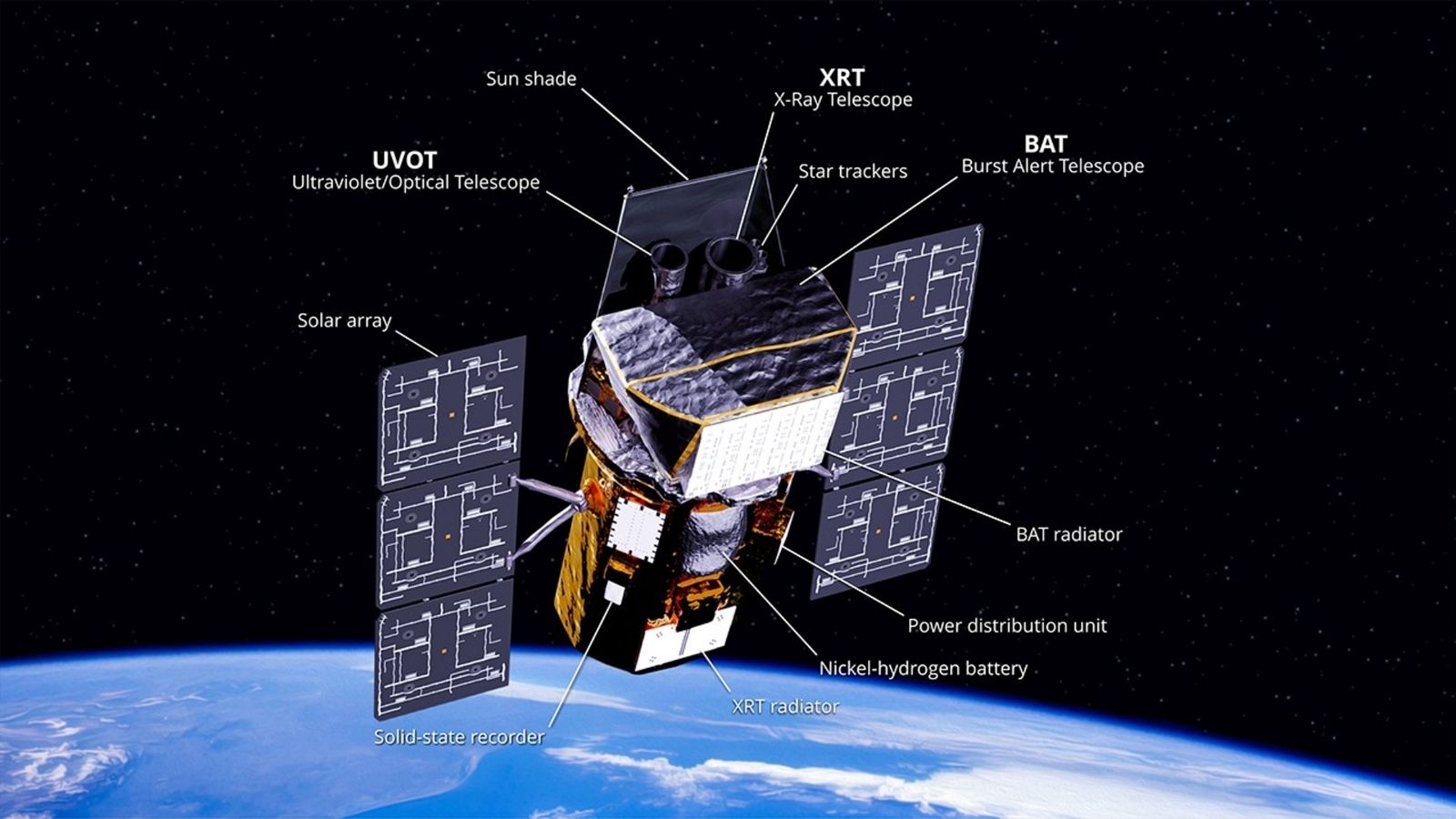
The Neil Gehrels Swift Observatory, a NASA space telescope launched in 2004 to study gamma-ray bursts, is facing a critical challenge: atmospheric drag is gradually lowering its orbit, and without intervention, the spacecraft could re-enter Earth's atmosphere and be destroyed before the end of 2026.
In response, NASA is developing a mission to rendezvous with the aging observatory, capture it, and boost it into a higher orbit. This would be the first time a commercial spacecraft is used to extend the life of a NASA science mission in this manner.
The Swift Observatory has been instrumental in detecting and localizing gamma-ray bursts, the most powerful explosions in the universe, and has also observed comets, supernovae, and other cosmic phenomena. Its contributions to astrophysics over more than two decades have been significant.
NASA's plan involves partnering with a commercial provider to launch a servicing spacecraft that can match orbits with Swift, safely dock or capture it, and then fire its thrusters to raise the telescope's altitude. The agency is currently evaluating proposals and aims to select a contractor soon.
The rescue mission is not without risks. Swift was not designed for servicing, and its condition after nearly 20 years in space presents unknowns. However, NASA engineers believe the observatory still has valuable science to offer if its orbit can be stabilized.
This effort underscores NASA's commitment to maximizing the return on investment from its space assets and exploring innovative ways to sustain scientific operations beyond planned lifetimes.