Garnet mineral discovered in Martian meteorite, offering clues to planet's geological past
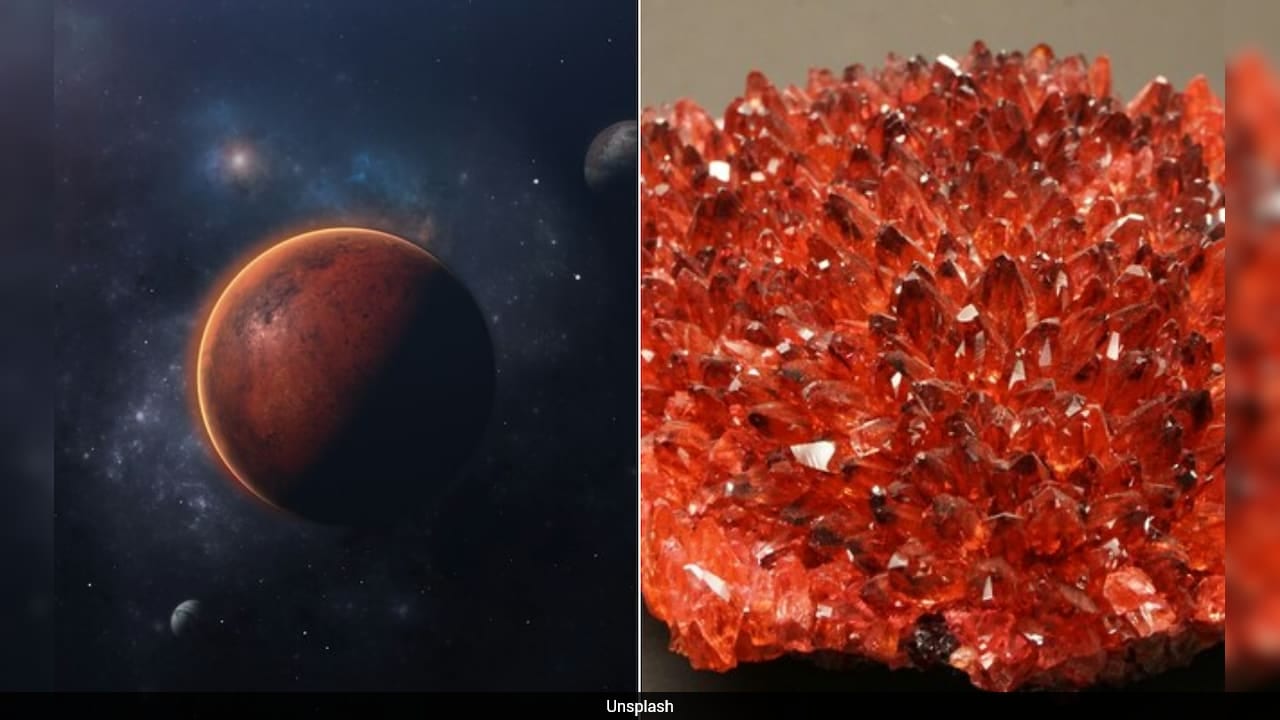
An international team of scientists has identified a new type of rock on Mars and, for the first time, detected the mineral garnet within a Martian sample. The findings provide fresh insights into the Red Planet's geological history.
The discovery was made during analysis of a fragment of the Martian meteorite NWA 8171, held at the Royal Ontario Museum in Canada. Initial chemical tests showed unusual results, prompting researchers to use specialised laser equipment and electron microscopy for closer examination.
Garnet, a dark-red gem prized by ancient Egyptians, Romans and the Victorian elite, is commonly found on Earth. Geologists use it to study tectonic activity, extreme temperatures, pressures and fluid-rock interactions deep within the Earth's crust.
According to the study, the garnet-bearing rock acts as a geological time capsule, preserving conditions from billions of years ago. Professor James Darling from the University of Portsmouth, a co-author of the study, said the discovery adds a new dimension to understanding Martian geology.
However, scientists remain cautious about the gem's origin. Lead researcher Tanya Kizovski from Brock University explained that garnet typically forms under intense heat and pressure during metamorphism. On Mars, this could have been triggered by a large meteorite impact or by magma rising through the crust. There is also a small possibility that the rock originated elsewhere and was transported to Mars by another collision before eventually reaching Earth.
Further tests, including analysis of oxygen isotopes, will be needed to confirm the rock's origins. The study has been published in the journal Geochemical Perspectives Letters.