Webb Telescope Spots Ancient Black Hole Shrouded in Dense Gas, Not Dust

When the James Webb Space Telescope peers deep into the universe, it sometimes finds small, red objects that have puzzled astronomers. Known as 'little red dots' (LRDs), these objects have become one of the telescope's most intriguing discoveries. Now, an international team of researchers has found an unusual example that may shed light on what some of these red dots truly are.
The object in question existed when the universe was just 660 million years old. Its light has travelled for more than 13 billion years to reach Earth, where the Webb telescope orbits. The team's observations, published in Nature on August 12, suggest that nearly all of the light from this object comes from a supermassive black hole actively feeding on surrounding matter.
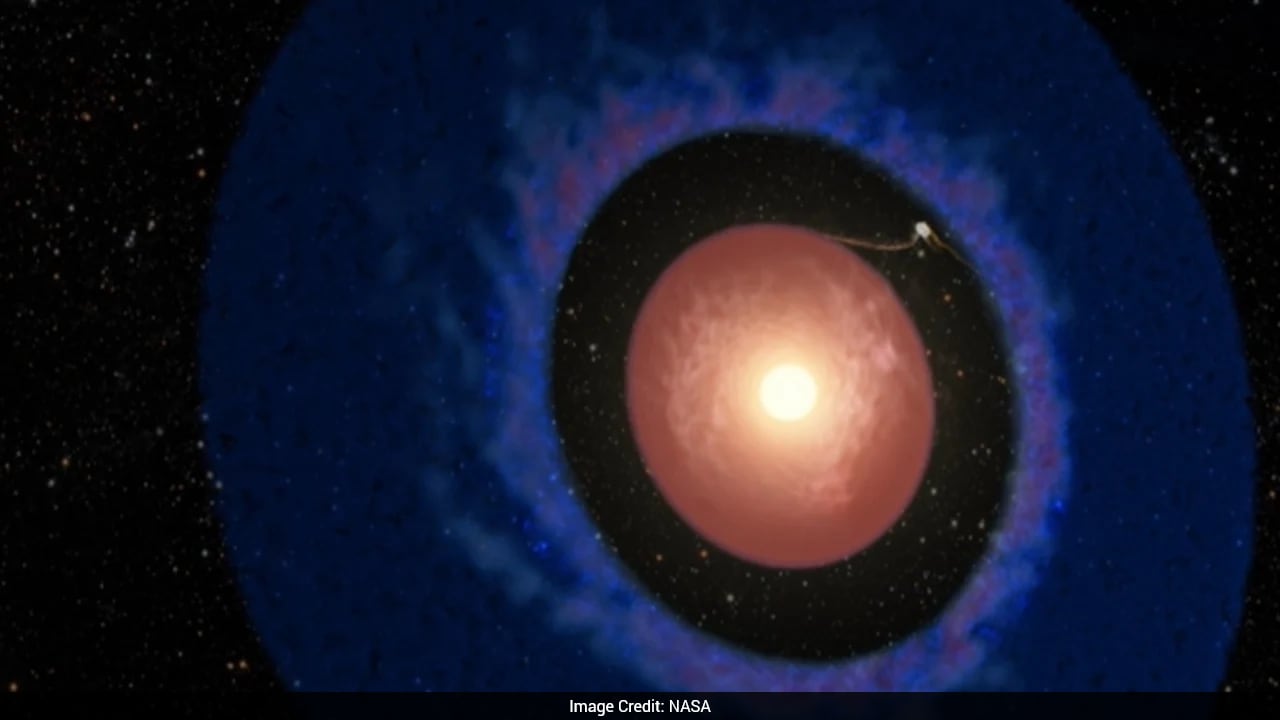
Astronomers had previously assumed that the red colour of LRDs was caused by dust, because dust absorbs blue light more readily than red light. However, this new study tells a different story. The object's colour, the researchers found, can be explained by a colossal cocoon of dense gas surrounding the black hole.
An Unexpected Break in the Spectrum
The team first noticed the object in Webb images because of its exceptionally red colour. It appeared in certain infrared filters but vanished at shorter wavelengths. To understand why, the researchers used one of Webb's instruments to split the light into its spectrum. What they found was a very large Balmer break — a gap in the spectrum caused by hydrogen absorbing light at specific wavelengths. While Balmer breaks are common in starlight, this one was unusually large.
According to the astronomers' model, the light had to pass through a turbulent cloud of hydrogen gas with around 100 billion particles per cubic centimetre. This cloud extends millions of kilometres around the black hole and moves at hundreds of kilometres per second. To put that in perspective, the air at sea level on Earth contains roughly 25 billion particles per cubic centimetre. So the hydrogen cocoon is actually about 250 million times less dense than ordinary air. Nevertheless, it is exceptional because this relatively thin gas is spread over a vast distance while remaining concentrated enough to distort the light passing through it.
As matter falls towards the black hole, it forms a hot, bright accretion disk that releases enormous amounts of radiation. This radiation escapes after travelling through the surrounding gas, and by the time it reaches Earth, it appears redder.
Implications for Black Hole Mass Estimates
In an independent commentary accompanying the paper, astronomers Dominik Schleicher of Sapienza University of Rome and Rodrigo Herrera-Camus of the University of Concepción in Chile noted that this discovery could help scientists understand other LRDs. One key implication is that if some black holes appear red because of gas rather than dust, their masses could be up to 100 times lower than previously estimated.
A separate study, published in Nature on May 27, provided a different piece of the puzzle. Astronomers studied another LRD from when the universe was around 700 million years old. By measuring how gas rotated around the object, they estimated its mass to be about 50 million times that of the Sun — surprisingly high. But the host galaxy had less stellar mass than the black hole's own mass, suggesting that the black hole grew very rapidly in the early universe.
Together, these findings challenge existing models of how supermassive black holes formed in the universe's first billion years. They also demonstrate the power of the James Webb Space Telescope to uncover objects that were previously beyond our view. As astronomers continue to study LRDs, they may reveal whether gas cocoons are common around early black holes, and how these cosmic giants grew so fast.