Private Investment in India's Space Sector Surpasses $618 Million; 17 Startups Approved for Space Activities
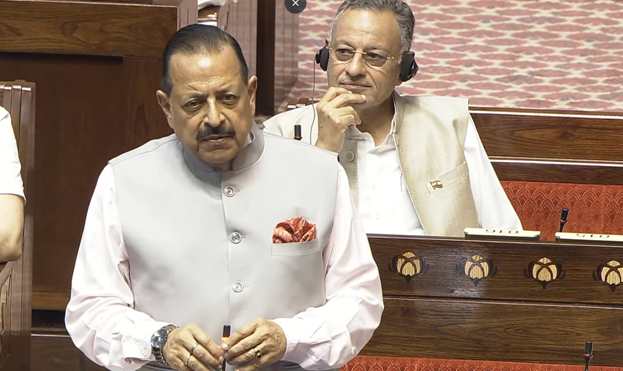
India's space sector has witnessed a significant surge in private investment, crossing the $618 million mark, Union Minister Jitendra Singh informed the Rajya Sabha on Thursday. The minister also stated that 17 startups have been granted approval to undertake space activities, reflecting the growing role of private enterprises in the country's space programme.
Responding to a query in the upper house of Parliament, Singh, who holds the portfolios of Science and Technology and Space, highlighted the government's efforts to promote private participation in the space sector. He credited the landmark space sector reforms initiated in 2020, which opened up the sector to private players and established the Indian National Space Promotion and Authorization Centre (IN-SPACe) as a single-window agency for authorizing space activities.
'The cumulative private investment in the space sector has now exceeded $618 million (approximately ₹5,100 crore),' Singh said. 'This includes investments from both domestic and international sources, and we expect this figure to grow as more startups and companies enter the field.'
The minister further noted that 17 startups have received authorizations from IN-SPACe to undertake a range of space activities, including building satellites, launch vehicles, and providing space-based services. Among these are companies like Skyroot Aerospace, Agnikul Cosmos, Pixxel, and Dhruva Space, which are working on innovative solutions in satellite manufacturing, launch services, and earth observation.
Singh emphasized that the government's policy of 'ease of doing business' in space has encouraged entrepreneurial ventures. 'The reforms have enabled a level playing field for private players, allowing them to use ISRO's facilities and expertise. This has not only attracted investment but also fostered a vibrant startup ecosystem,' he added.
The minister also provided data on the economic impact of the space sector, stating that it contributes approximately 2-3% to India's GDP and supports over 1.5 lakh jobs. He expressed confidence that the sector's growth trajectory would accelerate further, with private investment expected to double in the next few years.
In response to a separate question on the potential for space tourism, Singh said that while it is still at a nascent stage in India, the government is open to exploring opportunities. 'Several startups have shown interest in space tourism, and we are evaluating the regulatory framework required to ensure safety and compliance,' he noted.
The minister's remarks come amid increasing global interest in India's space programme, which has gained recognition for its cost-effective missions. The Chandrayaan-3 lunar landing and the Aditya-L1 solar mission have showcased India's capabilities, attracting attention from international investors and collaborators.
Industry experts have welcomed the developments, stating that the private sector's involvement is crucial for the sustainable growth of the space economy. 'The approval of 17 startups is a testament to the success of the reforms. It will drive innovation, reduce costs, and create new opportunities in satellite communication, remote sensing, and launch services,' said a spokesperson for the Indian Space Association.
The government has set a target of increasing India's share of the global space economy from the current 2% to 10% by 2030. With private investment on the rise and a growing number of startups entering the fray, the sector appears poised for robust expansion.