US Threatens Tariffs on Canada Over Cross-Border Wildfire Smoke Crisis
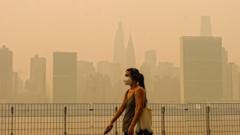
US President Donald Trump has threatened to impose new tariffs on Canada, citing the smoke from hundreds of wildfires that has choked many northern US cities. The threat comes after US lawmakers complained about the blazes and Ontario Premier Doug Ford asked for American assistance in fighting them.
'The United States is being unnecessarily invaded by filthy, polluted, and unhealthy air,' Trump said on Truth Social, accusing Canada of 'willful negligence' and 'not properly maintaining' its forests. He said he would call Canadian Prime Minister Mark Carney to demand an explanation.
As of Friday, about 888 fires were burning in Canada, according to the Canadian Wildland Fire Information System, with most out of control. Over 190 of those fires are in Ontario, some of which are also out of control.
Canada has not formally responded to the tariff threat. However, Prime Minister Carney earlier noted that both countries share responsibility for fighting climate change, which scientists say is exacerbating wildfire seasons.
The smoke has triggered 'hazardous' air quality alerts across several US states, including Minnesota, Michigan, Ohio, Pennsylvania, and New York. Outdoor events have been cancelled. IQAir ranked Detroit's air quality as the worst in the world on Friday, followed by Chicago, Washington DC, and New York.
In an open letter, US lawmakers John James, John Moolenaar, Jack Bergman, and Lisa McClain said their 'patience has run out' and warned that the US could explore direct involvement in cross-border wildfire protection if Canada fails to act. They cited 'chronic under-investment in forest thinning, fuel reduction, and prescribed burns' as contributing factors.
However, scientists interviewed by BBC Verify caution that the situation is more complex. Dr Patrick James of the University of Toronto noted that 'weather doesn't care about international borders' and that smoke from US wildfires has also affected Canada. Many fires are burning in remote, vast forests where detection and containment are difficult before fires become large.
Dr Anabela Bonada of the University of Waterloo added: 'Climate change is a global issue, and it would be inaccurate to suggest that Canada alone caused or could have prevented these wildfires.' Better forest management can reduce risk near communities but cannot prevent fires across entire ecosystems.
Nearly 3 million hectares of land in Canada has been destroyed by wildfires this year, according to the Canadian Wildland Fire Information System.