US Sanctions ICC President and Senior Lawyer Amid Escalating Campaign
The United States has announced sanctions against the President of the International Criminal Court (ICC) and a senior trial lawyer, in the latest move of the Trump administration's campaign against the war crimes tribunal.
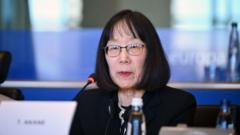
US Secretary of State Marco Rubio said on Tuesday that the administration was sanctioning ICC President Tomoko Akane of Japan and Senior Trial Lawyer Abdoulaye Seye of Senegal. The action follows an executive order issued by President Donald Trump last year targeting the court.
Rubio accused the two officials of directly engaging in ICC efforts to investigate, arrest, detain, or prosecute officials from countries that have not consented to the court's jurisdiction. He described the ICC as a “corrupt and fatally politicized supranational court” that had “maliciously abused its authority” and called its actions an “assault on state sovereignty.”
The ICC has not yet responded to a request for comment. Neither President Trump nor the White House has publicly commented on the latest sanctions.
These sanctions mark an expansion of the administration's measures against ICC personnel. At least 11 ICC officials, including nine judges and the chief prosecutor, have already been sanctioned. The measures include asset freezes, travel bans, and restrictions on services from US companies.
The earlier sanctions were imposed in response to ICC investigations into US personnel in Afghanistan and the court's issuance of arrest warrants for top Israeli officials, including Prime Minister Benjamin Netanyahu, for alleged war crimes in Gaza. Netanyahu has denied the allegations and accused the court of antisemitism. Neither the US nor Israel is a member of the ICC.
Trump's opposition to the ICC dates back to his first term. In 2018, he called the court a “threat” and told the United Nations General Assembly that it had “no jurisdiction, no legitimacy, and no authority” as far as the US was concerned.
Last month, Rubio called on the ICC's 125 member countries to withdraw from the court, as part of an administration campaign to dismantle it “brick by brick.” A US official said Washington would “watch with interest” which countries heeded the call.
The ICC, established in 2002, has international jurisdiction to prosecute genocide, crimes against humanity, and war crimes in member states or when a situation is referred by the UN Security Council.
Rights organisations have criticised the Trump administration's actions, arguing they undermine international law and efforts to combat impunity. Liz Evenson, international justice director at Human Rights Watch, said the administration “seeks a get-out-of-jail-free card for whomever it chooses.”
Her comments came as four US human rights groups—Human Rights Watch, the Open Society Institute, the American Friends Service Committee, and the Center for Constitutional Rights—filed a lawsuit in New York challenging the sanctions as unconstitutional. The groups said the measures prevented them from working with the ICC to seek justice for genocide, war crimes, and crimes against humanity worldwide.
In June, three ICC judges—Kimberly Prost of Canada, Solomy Balungi Bossa of Uganda, and Reine Alapini-Gansou of Benin—also sued the administration over sanctions imposed on them, arguing the measures were unlawful and designed to exert extrajudicial pressure.
A White House official said at the time that Trump had lawfully exercised his authority under the International Emergency Economic Powers Act (IEEPA) in imposing the sanctions.