UN Adopts New World Map Showing Africa's True Size; US Votes Against
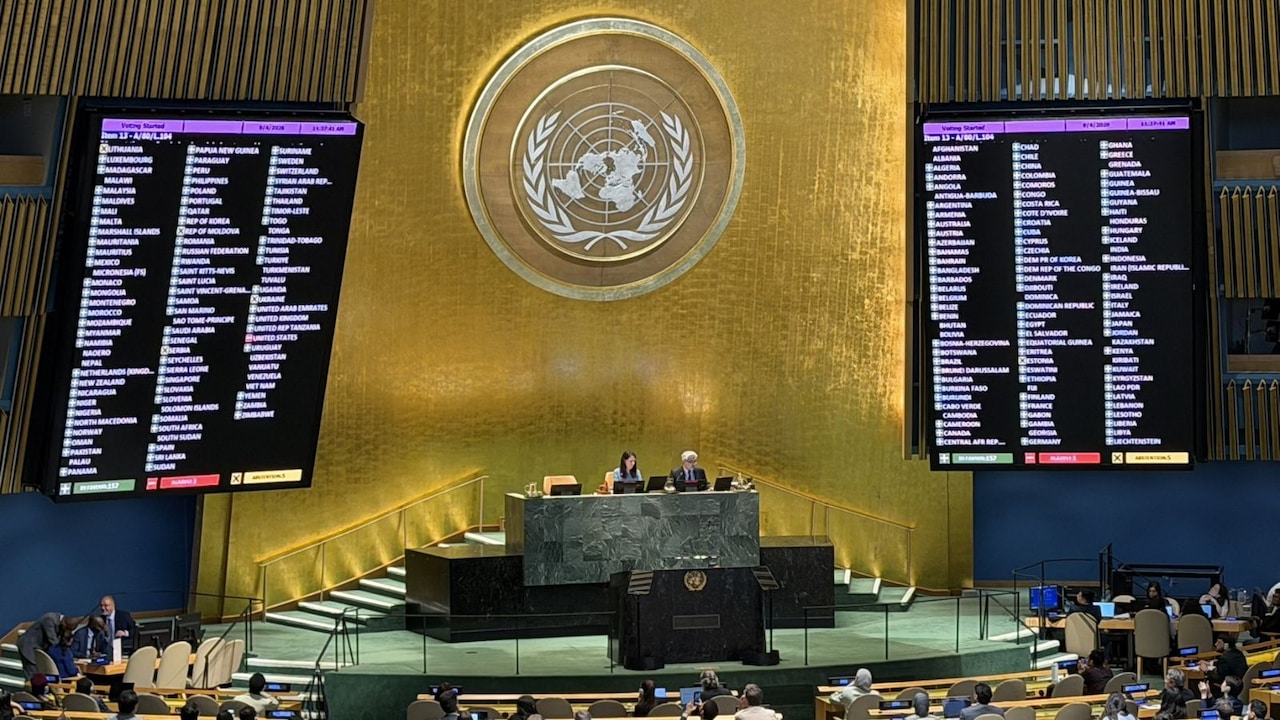
The United Nations General Assembly on Friday adopted a resolution encouraging member states to use a new world map that more accurately represents the relative sizes of continents, making Africa appear larger and Europe and North America smaller than in the traditional Mercator projection. The resolution — titled "Equal Earth cartographic projection" — was approved by 164 countries, with the United States as the sole nation voting against. Six countries abstained.
The measure is non-binding and urges states to adopt the Equal Earth projection in official communications, educational materials, and public information. The resolution says the map improves "the accuracy of the cartographic representation of the world" and aims to correct a persistent visual distortion that has shaped perceptions of global geography for centuries.
The Mercator projection, created by Flemish cartographer Gerardus Mercator in 1569, was developed for maritime navigation. It preserves angles and shapes, which helps sailors plot straight courses, but it severely distorts land area. Regions near the poles appear far larger than they are, while equatorial areas appear smaller. As a result, Africa — which is actually the second-largest continent — is often depicted as roughly the same size as Greenland, though Africa is about 14 times larger.
The Equal Earth projection, developed in 2018 by a group of cartographers, retains the relative surface areas of continents and oceans while minimising shape distortion. Its creators designed it as an alternative to the Mercator map, whose biases have long been criticised by geographers, historians, and leaders from the Global South.
Togo, which sponsored the resolution, argued that map projections carry political and cultural weight. Foreign Minister Robert Dussey said: "Maps guide education, nourish the imagination, and influence collective perceptions. They are therefore never neutral; when they present a distorted image of our planet, they risk perpetuating inaccurate representation that is passed down through generations."
The United States opposed the initiative. In a statement before the vote, US representative Yaryna Ferencevych said: "Instead of focusing on genuine problems... this body is debating map projects from the 16th century and their role in promoting reparations and cognitive justice." She added that such debates are eroding the credibility of the United Nations.
France, which co-sponsored the resolution, said it would abandon the Mercator projection in official communications. Foreign Minister Jean-Noel Barrot said the traditional map gives "disproportionate visual prominence" to the United States, Russia, and China while shrinking Africa, Latin America, and Southeast Asia. He pointed out that "Greenland appears almost as big as Africa" in the old projection. "Changing maps obviously doesn't change the world," he said. "But correcting a distorted representation is already an act of truth."
The French position is widely seen as part of its broader effort to reset relations with African nations, many of which were former colonies and have expressed frustration with European-centric depictions of their continent. The resolution also comes amid growing calls for 'cognitive justice' — a term that refers to the recognition of different forms of knowledge and perspective in global institutions.
Cartographers have welcomed the UN endorsement. Bojan Savric, one of the creators of Equal Earth, said the projection "preserves the relative surface areas of continents and, as much as possible, shows their shapes as they appear on a globe." He described the vote as a significant step forward for geographic accuracy.
However, some experts point out that changing the map projection is not a legal mandate. The UN cannot compel its members to use any particular map, and the Mercator projection will remain in wide use in many industries, including navigation, online mapping, and classroom textbooks. The vote, therefore, carries primarily symbolic weight — but for many nations, symbolism matters.