Trump-Xi Summit: Trade Truce Extended as Taiwan and AI Differences Surface
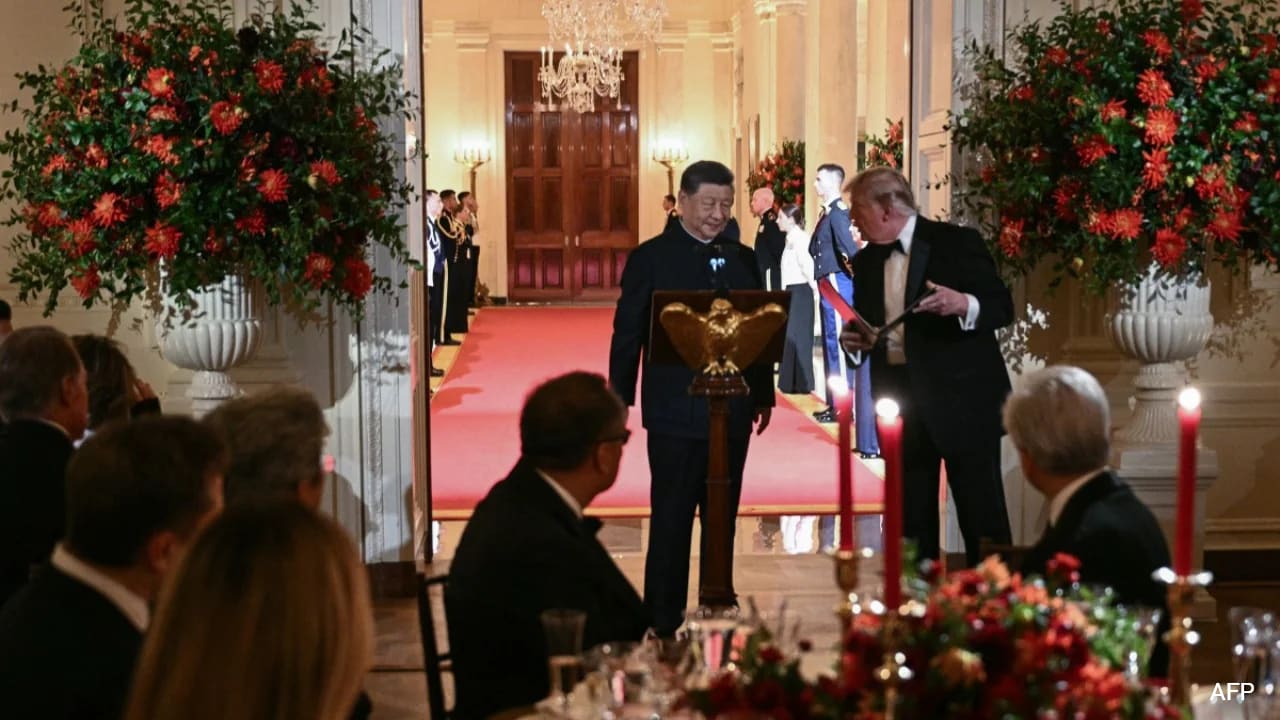
US President Donald Trump hosted Chinese President Xi Jinping at the White House for a state dinner and a day of ceremonial events, even as significant differences over trade, Taiwan and artificial intelligence remained unresolved between the two nuclear-armed powers.
Business leaders including Elon Musk of Tesla, Tim Cook of Apple, Jensen Huang of Nvidia and Sam Altman of OpenAI attended the events, underlining that commerce and technology were central to the visit.
"President Xi and I both understand we represent different systems, but the ties between our people endure, and we've never gotten along better," Trump said in his toast, adding that the two countries could "continue to build a relationship that promotes prosperity and security for future generations".
Xi, in his own toast, noted that Trump had pledged to make America great again and that China was committed to achieving great national rejuvenation. "These two goals are both ambitious and can surely be mutually reinforcing," he said.
Trade
The two sides announced a short extension of their trade truce. US Treasury Secretary Scott Bessent said they had agreed to extend by two months the agreement that ended last year's trade war and was due to expire in November. The extension, he said, would give Washington and Beijing "more time to see what we can do on the economic front".
That leaves the central questions — tariffs, Chinese purchases, rare-earth supplies and technology restrictions — for the next round of negotiations.
Bessent said Beijing was meeting its commitment under the earlier agreement to buy 25 million tonnes of soybeans, but was behind on a pledge to purchase 17 billion dollars in other agricultural goods. US officials have also said rare-earth deliveries were falling short, another indication that gaps remain.
Taiwan
Xi pressed Trump on Taiwan, saying Beijing hoped Washington would "handle the Taiwan question with prudence", China's official news agency reported. Its English-language service also said Xi hoped the United States would oppose Taiwan independence.
There is no indication that the Trump administration plans to change Washington's long-standing formulation that it does not "support" Taiwanese independence. The White House has not issued a readout of the exchange, and US officials have for years avoided stating explicit opposition to independence.
Artificial intelligence
The two leaders set out differing views on artificial intelligence. Trump, who has said AI should be called super intelligence, wrote in a social media post that he wants to "leave it exactly where it is" and rely on the Department of Justice rather than impose new guardrails. He said China held the same position.
Xi said that as leading nations in AI, China and the United States must manage its growth. "We have both the capability and responsibility to develop and manage AI for good, and ensure that the development of AI is always under human control and serves the well-being of the people," he said.
Strategic risk
Xi repeated his warning that the two countries must avoid the "Thucydides trap" — the idea that when a rising power threatens to displace an established one, the outcome is often war. He had offered a similar warning when Trump visited Beijing in May.
"It should be a race of catching up with one another, not a wrestle in which one either wins or loses," Xi said.
The visit produced no announced breakthrough on the issues that have defined the relationship in recent years. The two-month extension of the trade truce sets a fresh deadline for progress on tariffs, agricultural purchases and export controls, matters that both sides have said they will continue to discuss.