Trump warns nations aiding Iran face 'tremendous economic consequences'
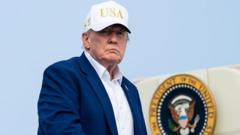
President Donald Trump has warned that any country providing assistance to Iran will face "tremendous economic consequences", in a social media post that extends his administration's pressure campaign against Tehran. The warning came a day after a 60-day ceasefire between the US, Israel, and Iran expired on Monday, with no visible progress towards a diplomatic resolution to the conflict that began in late February.
In a post on Truth Social on Wednesday evening, Trump wrote in capital letters that the United States would inflict "tremendous economic consequences" on any country that allows its financial institutions, businesses, airports, or government entities to provide any kind of lifeline to Iran. He described the initiative as "the most crushing economic operation ever taken against any country" and an "economic D-Day", but provided no further details and did not name any specific nation.
Trump listed activities that he said must stop immediately, including oil smuggling, swap lines, cash transfers, exchange houses, ship registries, and front companies. "You know who you are," he added.
The conflict began at the end of February, when the US and Israel launched military strikes against Iranian targets. The campaign has been accompanied by a series of economic measures designed to cut off Iran's oil revenues. The 60-day ceasefire, which lapsed on Monday, had briefly raised hopes of reducing hostilities, but there has been no indication that either side is willing to extend it.
The post expands on Operation Economic Fury, a sanctions and naval blockade campaign launched in April by the US Treasury Department and the Pentagon. The operation is designed to dismantle Iran's revenue streams by penalising foreign financial institutions and companies that engage in business with Tehran.
On the same day as Trump's post, the United Arab Emirates, a US ally, announced it would sever all financial and economic ties with Iran. The decision followed a statement from the UAE's defence ministry that two ballistic missiles launched from Iran had targeted maritime traffic, with both landing in the sea. Iranian entities have long used Dubai's financial system to transfer money through exchange houses and shell companies.
In response, Iran's armed forces warned neighbouring Gulf countries against providing support to the US military, saying that any assistance to US forces would be considered collusion.
Although Trump's post did not mention China, Chinese businesses are the largest buyers of Iranian oil, a key source of Tehran's funding. Since the start of the conflict, Washington has imposed sanctions on several privately owned oil refineries, mostly based in Shandong province in eastern China. The BBC has contacted the Chinese embassy in Washington for comment.
Last week, US Treasury Secretary Scott Bessent said the US would soon impose economic isolation on Iran "like the world has never seen before". The White House and the US Treasury Department have been asked for comment.
Earlier this week, Trump reportedly threatened to bomb Oman, a US ally, if it "gets in the way" of his administration's talks with Iran, during a telephone interview with a Fox News reporter. The US and Oman have been negotiating separately with Tehran to reopen the Strait of Hormuz, a waterway vital to the global economy.
The conflict has significantly disrupted traffic through the Strait of Hormuz, through which about 20% of the world's crude oil and liquefied natural gas normally passes, pushing up global energy prices. Ahead of the US midterm elections in November, Trump faces scrutiny over how much the war is costing American consumers.