Trump says US to substantially reduce drills with South Korea after Seoul declines Iran request
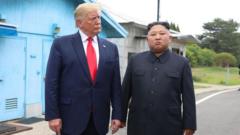
President Donald Trump has announced that the United States will "substantially reduce" joint military exercises with South Korea, citing his "very good relationship" with North Korean leader Kim Jong Un and Seoul's recent refusal to participate in a US-led denuclearisation initiative involving Iran.
In a post on Truth Social on Sunday, Trump said the exercises were not only costly but also "send a signal that is totally inappropriate and hostile." He noted that it was "too late to cancel" because the annual Ulchi Freedom Shield drills were due to begin on Monday.
The announcement came less than 24 hours after Trump shared an old photograph of himself with Kim, describing the two as "great friends" despite the "unfriendly look" in the image.
Speaking to reporters in the Oval Office on Monday, Trump explicitly linked his decision to South Korea's refusal to support US military action in Iran. "We have 39,000 soldiers over there guarding you from Kim Jong Un, your next door neighbour, and you're not going to help us on a very easy military operation in Iran," he said. "All I want is fairness."
According to the US military, approximately 28,500 American personnel are currently stationed in South Korea. Trump's figure of 39,000 did not match the official count.
The South Korean presidential Blue House said it was reviewing Trump's comments and expressed hope that the favourable relationship between Washington and Pyongyang could lead to meaningful talks. It also stated that consultations on US-Korea military cooperation related to the Strait of Hormuz would continue, and that details of the joint drills would be discussed with the United States.
Earlier, South Korean officials had said the exercises would proceed "as scheduled." North Korea has not yet issued a public response to Trump's announcement.
The decision comes after North Korea conducted ballistic missile tests this month that were banned under United Nations resolutions. The drills, which began on Monday, are designed to test the allies' ability to respond to potential threats from North Korea, and have historically drawn strong objections from Pyongyang, which has described them as preparations for an invasion.
Last week, US and South Korean military leaders held a joint press conference to announce the details of Ulchi Freedom Shield. They said the 11-day exercise would be similar in scale to previous years, with around 18,000 South Korean soldiers participating. The leaders also mentioned North Korea's deployment of troops to support Russia's war in Ukraine, with US military spokesperson Ryan Donald saying "our training accounts for that threat."
Experts have cautioned that reducing the scale of joint exercises could have significant strategic consequences. Leif-Eric Easley, a professor at Ewha University in Seoul, said: "US-South Korea combined defence exercises are essential for military forces to be ready and capable of doing their jobs. Scaling them back can damage alliance coordination, slow the process of South Korea taking on greater responsibility for its own defence, and weaken deterrence against possible conflicts in Asia. The cost savings from downsizing drills are marginal, while the diplomatic benefits for relations with North Korea are doubtful."
The decision marks a potential shift in the US approach to its alliance with South Korea, and comes at a time of heightened regional tension. North Korea's missile tests and its growing military cooperation with Russia have raised concerns in Washington and Seoul. Meanwhile, South Korea has historically been cautious about involving itself in Middle East conflicts, and its refusal to join the US in Iran-related operations reflects that stance.
Analysts suggest that the reduction in military drills may be seen as a concession to North Korea, which has long demanded the cessation of joint exercises as a precondition for denuclearisation talks. However, previous attempts to scale back exercises in exchange for diplomatic engagement have not resulted in lasting progress.
As the Ulchi Freedom Shield drills currently proceed, the future of US-South Korea military cooperation remains uncertain. The two countries are likely to engage in further consultations to determine the scope of future joint training activities.