India's School Shift: 86 Lakh Students Leave Govt Schools, Private Enrolment Surges
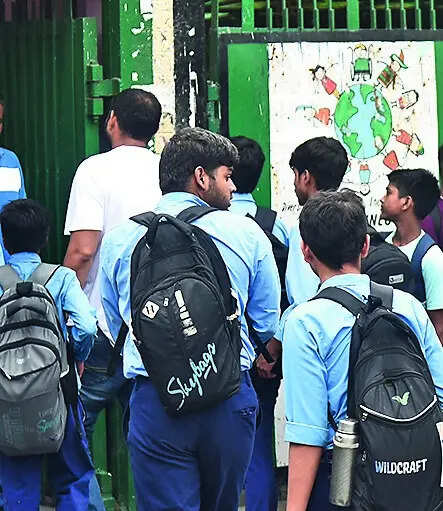
New data from the Unified District Information System for Education (UDISE+) reveals a significant shift in India's school enrolment patterns over the past two years. Between the academic years 2023-24 and 2025-26, government schools lost approximately 86 lakh (8.6 million) students, while private unaided recognised schools gained over 88 lakh (8.8 million) students during the same period.
Overall school enrolment remained nearly stable, declining marginally from 24.8 crore (248 million) in 2023-24 to 24.7 crore (247 million) in 2025-26—a drop of about 8.3 lakh (0.83 million). However, the composition changed drastically: government school enrolment fell from 12.8 crore to 11.9 crore, whereas private unaided recognised school enrolment rose from 9 crore to 9.9 crore.
The UDISE+ reports also highlight improvements in several access and infrastructure indicators. The number of schools remained roughly constant at 14.7 lakh, but the teacher count increased from 98 lakh to 1 crore (10 million), improving the overall pupil-teacher ratio from 25:1 to 24:1. Schools with zero enrolment declined sharply from 12,954 to 5,663, and single-teacher schools reduced from 1.1 lakh to 1 lakh.
Academic access improved notably at the secondary level. The Gross Enrolment Ratio (GER) for secondary education rose from 66.5% in 2023-24 to 71.7% in 2025-26. The dropout rate at the secondary level fell from 10.9% to 7%. Transition rates from middle to secondary school improved from 83.3% to 88.3%, and secondary-level retention rose from 45.6% to 51.9%.
Girls continued to outperform boys at the secondary stage. In 2025-26, girls had a higher GER (74% vs 69.6%), lower dropout rates (5.7% vs 8.3%), and better retention (55% vs 49.2%).
Enrolment patterns by level also shifted. Secondary enrolment increased by about 31.5 lakh (3.15 million) between 2023-24 and 2025-26, while preparatory level enrolment (classes 3-5) fell by over 42 lakh (4.2 million). Foundational level enrolment (pre-primary to class 2) rose only slightly. The UDISE+ foundational data does not include Anganwadi enrolment, limiting the completeness of early childhood education figures.
Infrastructure showed significant improvement in digital access. The percentage of schools with computer facilities rose from 57.2% to 69.9%, and those with internet access increased from 53.9% to 67.4%. Basic amenities remain near saturation: drinking water reached 99.5% of schools, toilets 99.1%, girls' toilets 98.5%, and electricity 95%. However, inclusive and climate-resilient infrastructure still lags: only 40.1% of schools had toilets accessible for children with special needs (CWSN), 58.2% had ramps with handrails, 29.9% had functional rainwater harvesting, and 11.5% had solar panels.
State-wise, Uttar Pradesh recorded the largest overall enrolment gain over two years, followed by Telangana and Jharkhand. Rajasthan, Bihar, and Tamil Nadu saw the steepest enrolment declines. Jharkhand and Haryana posted the biggest gains in secondary GER, while Bihar, Meghalaya, and West Bengal recorded the sharpest reductions in secondary dropout rates.







