ISRO's Gaganyaan Milestone: Parachute Test Success Brings Human Spaceflight Closer
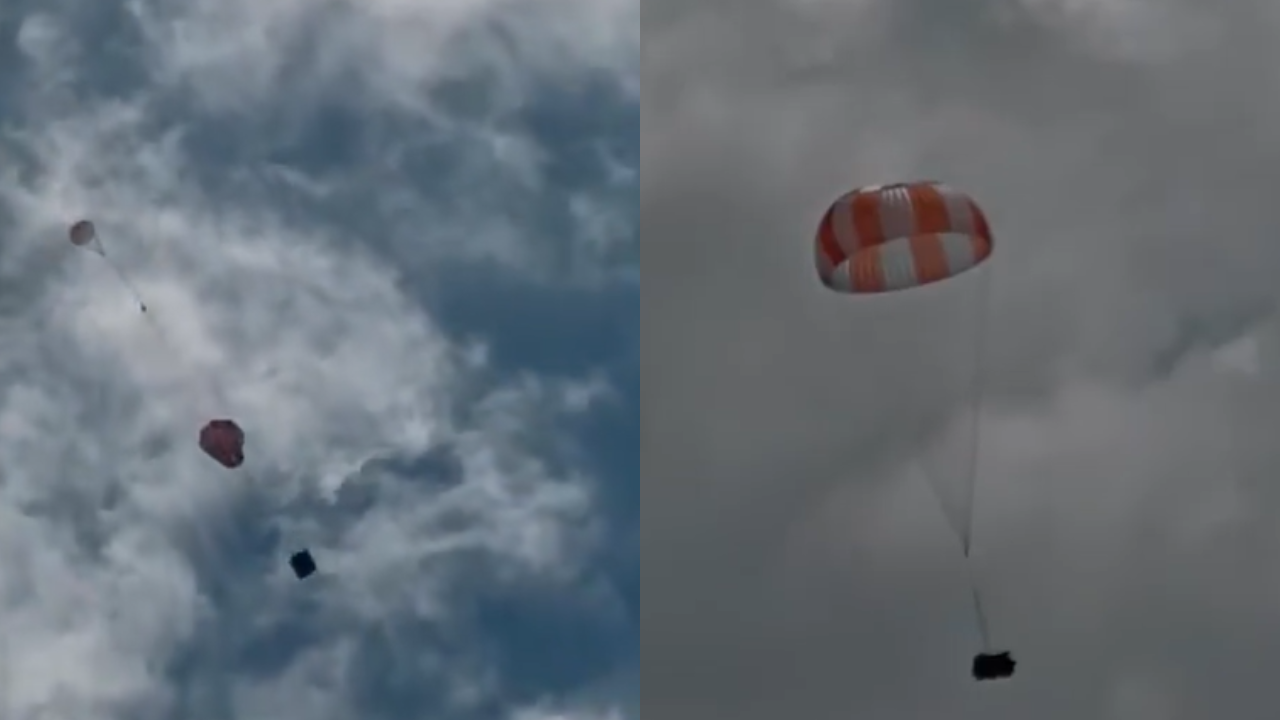
The Indian Space Research Organisation (ISRO) has achieved a significant milestone in its ambitious Gaganyaan programme, successfully testing the main parachutes designed for the crew module. The test, conducted on Tuesday at the Aerial Delivery Research and Development Establishment (ADRDE) drop zone in Madhya Pradesh's Sheopur district, marks a crucial step toward India's first human spaceflight mission.
According to ISRO, the objective of the test was to qualify the main parachute for its structural integrity and design margins under the maximum expected load conditions during the first uncrewed Gaganyaan G1 mission. The test involved dropping a simulated assembly of a single main parachute and a dummy mass from an altitude of 2.5 kilometres using an Indian Air Force IL-76 aircraft.
Upon release, a drogue parachute was deployed to stabilise the crew module and significantly reduce its velocity. Subsequently, the main parachute was deployed, slowing the payload to a safe terminal speed. ISRO confirmed that this was the fifth test in a series of integrated main parachute airdrop tests (IMAT) to qualify the critical main parachute for the Gaganyaan mission.
'The successful completion of IMAT-05 provides necessary confidence in the performance and reliability of the main parachute system for the first uncrewed Gaganyaan mission (G1),' ISRO stated.
The deceleration system of the Gaganyaan crew module comprises a total of 10 parachutes of four types. The descent sequence begins with two apex cover separation parachutes that remove the protective cover of the parachute compartment. This is followed by two drogue parachutes that stabilise and decelerate the module. Upon release of the drogues, three pilot parachutes are deployed to extract three main parachutes, which further slow down the crew module to ensure a safe splashdown in the sea.
The Gaganyaan programme aims to demonstrate human spaceflight capability by sending a crew of three members into an orbit of 400 kilometres for a three-day mission and bringing them safely back to Earth. The uncrewed G1 mission, expected to launch later this year or early next year, will test the crew module and its systems without astronauts on board.
ISRO has been conducting a series of tests to validate various technologies required for the mission. Earlier this year, the space agency successfully tested the crew escape system and the service module propulsion system. The parachute test is a critical component, as it ensures that the crew module can land safely in the sea after re-entry.
With this successful test, ISRO moves closer to achieving its goal of becoming the fourth country after the United States, Russia, and China to launch a human spaceflight mission. The Gaganyaan programme is a flagship project of the Indian government, with significant investments in space technology and infrastructure.







