Engine Failure Caused Ryanair Window Shatter, Injuring Passenger: NTSB
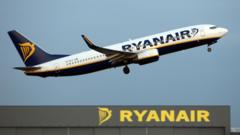
The United States National Transportation Safety Board (NTSB) has released a preliminary report on a serious incident aboard a Ryanair flight, detailing how engine fragments shattered a cabin window and led to a passenger being injured.
The incident took place on 10 July on a flight from Thessaloniki, Greece, to Memmingen, Germany. The aircraft, operated by Malta Air, a wholly owned subsidiary of Ryanair, experienced a fan-blade-out failure in its right engine during climb out. According to the report, broken fan blade fragments penetrated the fuselage and caused the window damage.
The report outlines the sequence of events from the flight crew's perspective. After takeoff, they received a high vibration engine alert. They reduced engine power and carried out a series of checks. Once the vibrations stopped, the crew continued to climb on autopilot. However, the vibrations soon increased, and a loud bang was heard. The crew declared an emergency and immediately began a descent, returning to Thessaloniki International Airport.
Inside the cabin, flight attendants felt and heard the vibrations. They observed a small amount of smoke before deploying the oxygen masks. One flight attendant reported seeing passengers calling for help. A passenger, identified as Serbian national Ljubisa Karović, had become "partially lodged in a damaged cabin window," according to the report. The entire window was missing. His head and right shoulder had been drawn through the opening, causing serious injuries. His wife, Svetlana Grković Maksimović, later told BBC Serbia that she and two other passengers held onto his legs for several minutes to prevent him from being pulled out further. The report described the passenger as "seriously injured and in shock."
A fan-blade-out failure occurs when a fan blade separates from the engine's rotating assembly. Such failures can have various causes, including fatigue, foreign object damage, or manufacturing defects. The NTSB report noted that the engine had undergone ultrasonic inspections in May, with no findings of fault. Ultrasonic inspections are used to detect hidden cracks in engine components. Ryanair's chief executive, Michael O'Leary, had earlier suggested that the incident may have been caused by foreign object damage to an engine. The report does not confirm this, and the investigation is ongoing.
The crew elected to return to SKG, as Thessaloniki International Airport is designated, and made an uneventful landing. The aircraft was evacuated, and the injured passenger received medical attention. The Greek authorities delegated the investigation in full to the NTSB, which will continue its analysis of the engine, the window, and the aircraft's maintenance history. As part of the investigation, the NTSB will also examine flight data recorder information and other operational data.
The NTSB issues preliminary reports to provide initial factual information and to assist the investigation. These reports are subject to revision as more data is analysed. The NTSB is expected to issue a final report in due course, which may include safety recommendations.
Aviation safety experts say such engine failures are rare, and the investigation will provide valuable insights into the integrity of engine components and the effectiveness of inspection procedures. The findings are likely to be reviewed by aviation regulators and industry bodies to ensure continued safety in air travel. This incident also underscores the importance of rigorous maintenance and monitoring systems in preventing and managing in-flight failures.