Unmanned Sea Drones Tested in Indo-Pacific Amid Rising Maritime Tensions
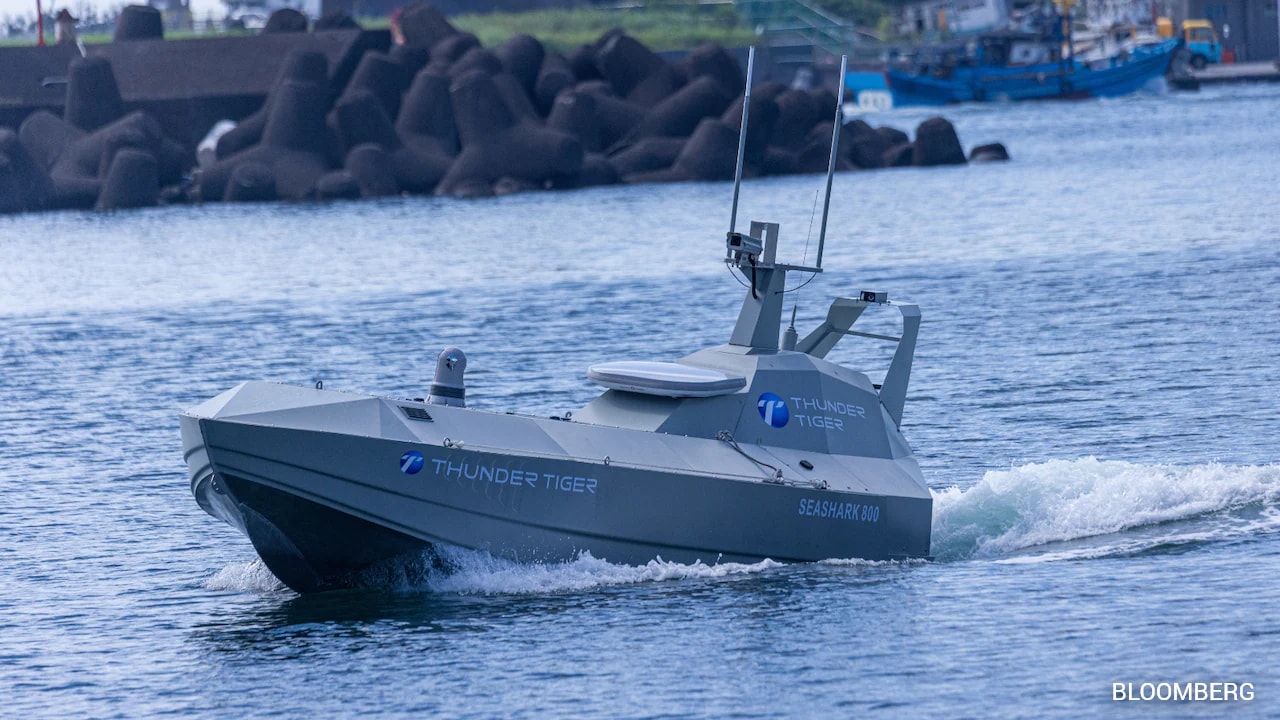
Recent military exercises in the Philippines have highlighted the growing role of unmanned surface vessels (USVs) in naval strategy. In a demonstration attended by Bloomberg News, US special forces guided Magura-class sea drones—developed in Ukraine and used effectively against Russian ships—to sink a decommissioned target vessel. This marked the first Indo-Pacific trial of these drones, underscoring their potential in a region spanning vast waters.
The conflicts in Ukraine and the Middle East have already shown the value of cheap airborne drones. Now, sea drones are being viewed as critical for the Indo-Pacific, an area 30 times larger than the continental United States. Militaries worldwide, from the US to China, are racing to develop and deploy such systems.
Thomas Shugart, a former US submarine captain and senior fellow at the Center for a New American Security, said, 'They're the kind of thing we need more of—distributed, survivable, relatively affordable systems that can help deny China the ability to use the seas around Taiwan and the First Island Chain.' The First Island Chain refers to the archipelago from Japan through Taiwan to Southeast Asia.
Despite their promise, building and operating large fleets of sea drones poses challenges. Undersea vehicles are more costly and complex, and communicating with submerged drones is difficult. However, they can operate in high-risk areas, perform intelligence collection, mine-laying, and even launch missiles, adding depth to naval forces while preserving crewed ships for extended conflicts.
Rintaro Inoue, a defence expert at the Tokyo-based Institute of Geoeconomics, noted, 'They allow navies to keep their most valuable crews and platforms out of the enemy's kill zone.' Real-world examples include a 24-foot Corsair autonomous surface vehicle used in June to rescue a US Army helicopter crew off Oman, and Ukrainian Maguras striking Russian ships in Crimea in May.
Their relatively low cost—a few hundred thousand dollars each—offers smaller militaries a way to punch above their weight. Taiwan, for instance, is developing its own Kaui-Chi attack USV as part of its defence strategy, planning to procure 1,320 such vessels at an estimated cost of NT$28 billion ($888 million). The US 'Hellscape' concept for defending Taiwan relies on choking the Taiwan Strait with cheap anti-ship weapons, including USVs.
Captain Garrett Miller, head of the US Navy's unmanned surface vessel squadron, said in April he expects thousands of small USVs in the Indo-Pacific by 2030. Dozens of US companies, such as Anduril Industries, Saildrone, and Saronic Technologies, already produce these systems. Japan has allocated about $600 million for coastal defence drones this fiscal year, with contracts to IHI Corp. and Mitsubishi Heavy Industries.
The US has also increased uncrewed system deployments to the Philippines, which faces Chinese pressure in the South China Sea. On Tuesday, the US provided four underwater vehicles to the Filipino military. Australian Defence Minister Richard Marles, speaking at the Shangri-La Dialogue, said, 'Within our region, the area where the strategic environment is most complex, where the strategic contest is greatest, is the maritime domain.'
These developments reflect a broader shift toward unmanned systems, though challenges remain in communication, cost, and integration into existing naval doctrines.