NHSRCL Invites Design Bids for Two New Bullet Train Corridors
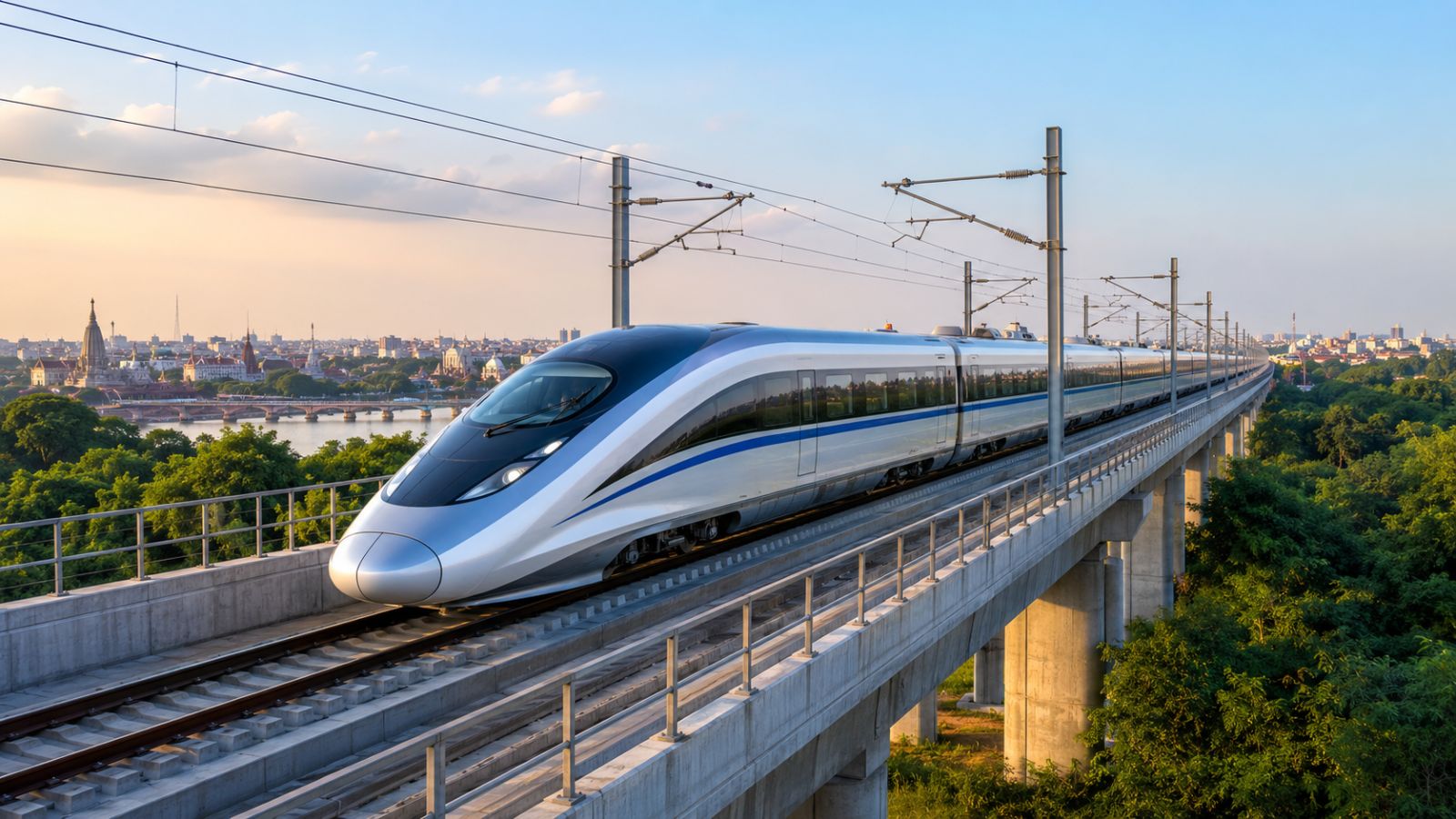
The National High Speed Rail Corporation Limited (NHSRCL) has invited bids for the development of civil structure designs for the proposed Bengaluru-Chennai and Delhi-Varanasi high-speed rail corridors. These two corridors were announced in the Union Budget 2026-27 as part of the next phase of high-speed rail expansion, alongside five other proposed routes: Mumbai-Pune, Pune-Hyderabad, Hyderabad-Bengaluru, Hyderabad-Chennai, and Varanasi-Siliguri.
In a statement, NHSRCL said that Detailed Project Reports (DPRs) for four of the seven corridors have already been sanctioned, while surveys are underway for the remaining three. Alignment validation and pre-tender Geotechnical Investigation (GTI) works are also in progress.
The seven proposed corridors will together span approximately 4,000 route kilometres. NHSRCL stated: “To take up such a large volume of work in fast pace, it is envisaged to adopt the best Design & Construction practices as adopted in MAHSR (Mumbai-Ahmedabad High-Speed Rail) corridor with further advancement. Keeping in view of this, NHSRCL decided to take up the work of standardisation of designs of various structures.”
Bengaluru-Chennai corridor
The proposed Bengaluru-Chennai bullet train is expected to reduce travel time between the two cities to 1 hour and 13 minutes. According to NHSRCL’s bid document, the corridor will feature three underground stations: Chennai, Whitefield, and Baiyappanahalli. Chennai and Baiyappanahalli are planned as terminal stations, each with two platforms and six railway lines. Whitefield station will have two side platforms and one island platform, along with two railway lines.
The selected consultancy will also design three major tunnels: a 3.87-km Chennai Terminal approach tunnel, a 14.79-km mountain tunnel through the Kaundinya Wildlife Sanctuary, and a 15.92-km Bengaluru Terminal approach tunnel.
Delhi-Varanasi corridor
The proposed Delhi-Varanasi bullet train is expected to reduce travel time to 3 hours and 50 minutes. The corridor will have one underground station at Jewar, featuring two island platforms and four railway lines.
The consultant will prepare specifications, standards, and structural designs for underground stations, shafts, cut-and-cover sections, tunnels, and ancillary structures. The scope also includes planning earth structures for the high-speed network. NHSRCL noted: “The Design shall be safe, reliable, comfortable and cost-effective for operation of double track High-Speed Rail (HSR) at 320 kmph (design speed 350 kmph) with due consideration to site conditions including environmental, ground, materials etc.”







