India ranks 13th in AI-Economy readiness, but skills gap poses risk
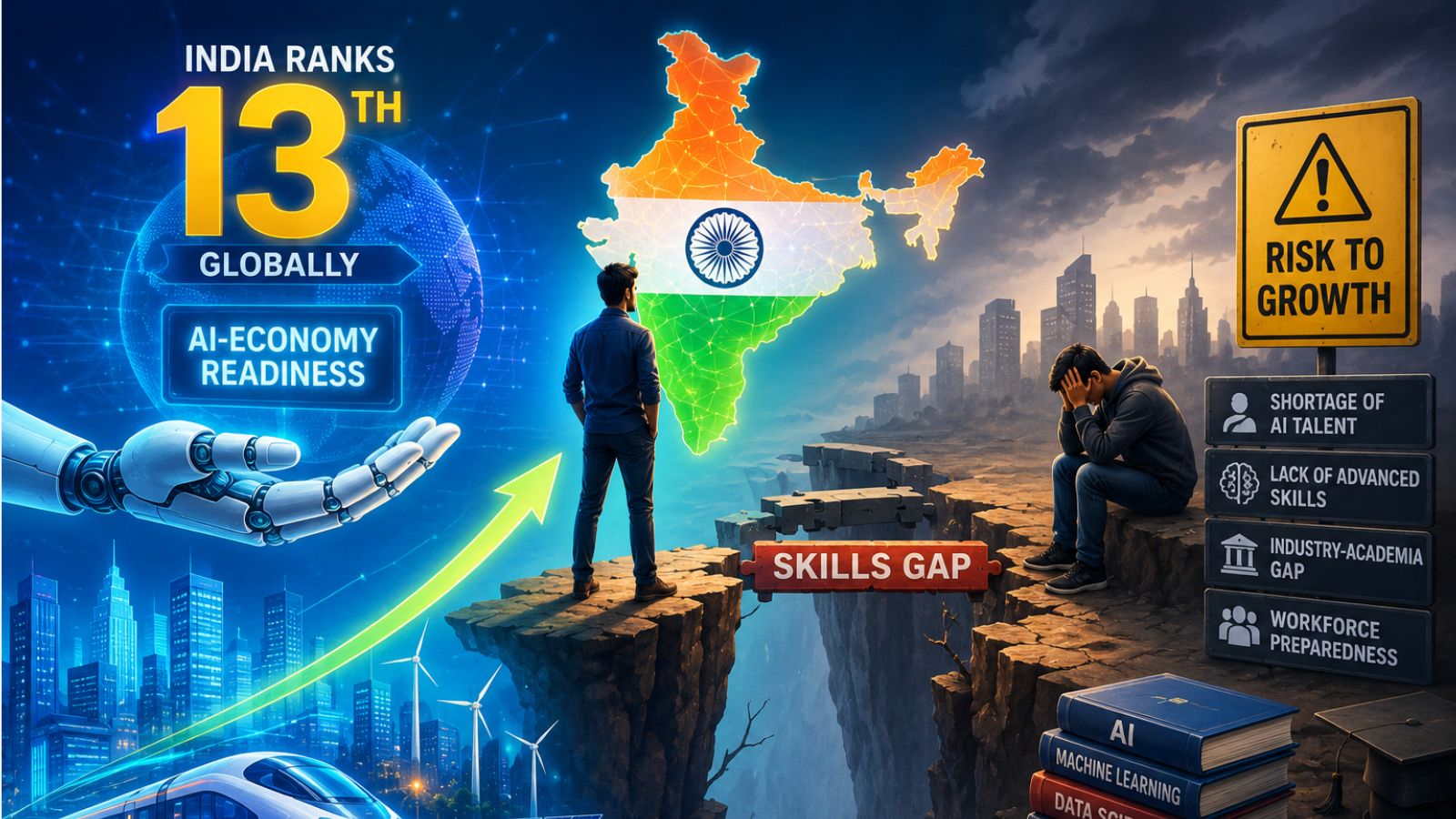
India has secured the 13th position globally in AI-economy readiness, according to the QS World Future Skills Index 2027 released by QS Quacquarelli Symonds. While the ranking makes India the leader among South Asian and lower-middle-income nations, the report highlights a growing mismatch between the country's labour market demands and the quality of skills produced by its universities.
India achieved a perfect score of 100 on the Economic Capacity sub-indicator—the highest in the world—driven by consistent GDP growth, labour market investment, and infrastructure spending. India has been the fastest-growing economy in the G20 for three consecutive years, and AI-related investments have reached $90 billion as of February 2026.
The top 15 economies in the index are led by the United States (99.2), Australia (97.5), and the United Kingdom (96.6). India ranks 13th with an overall score of 89.4, with its primary strength in 'Future of Work'.
However, the report also notes that India ranks only 73rd on the Human Capital Index, which measures graduate quality and institutional output. India produces the largest number of tertiary-educated individuals globally, but the median quality of talent is not keeping pace with employer demands, particularly in AI, digital, and green sectors.
The report cites IBM's 2026 research, projecting that successful AI adoption could add $500 billion in economic value to India by 2030. India also has the world's largest IT services workforce—5.8 million professionals—contributing $300 billion annually, according to Nasscom's 2026 Technology Sector Review.
Yet, the report warns that India's large Business Process Outsourcing (BPO) and call centre industry is vulnerable to automation, and the agricultural sector offers fewer opportunities for AI augmentation compared to knowledge-intensive industries.
Nunzio Quacquarelli, President of QS, said: 'The size of India's digital workforce is rapidly attaining a scale that few other countries can match. It already possesses the world's largest IT workforce and the largest number of tertiary-educated individuals in the world. These ingredients give India the potential to be the fastest-growing economy in the world over the next decade.'
He stressed the need to raise the median quality of talent produced by institutions and address capacity hurdles. Quacquarelli pointed to India's National Education Policy (NEP) 2020 as an ambitious structural response but cautioned that implementation must be scaled evenly across regions. He also called for greater uptake of transnational education partnerships to close skills gaps faster.
Despite internal challenges, India leads its peer groups by a wide margin in the index, which groups nations by income level.