Agra Summit 2001: A Missed Opportunity That Still Holds Lessons for India-Pakistan Relations
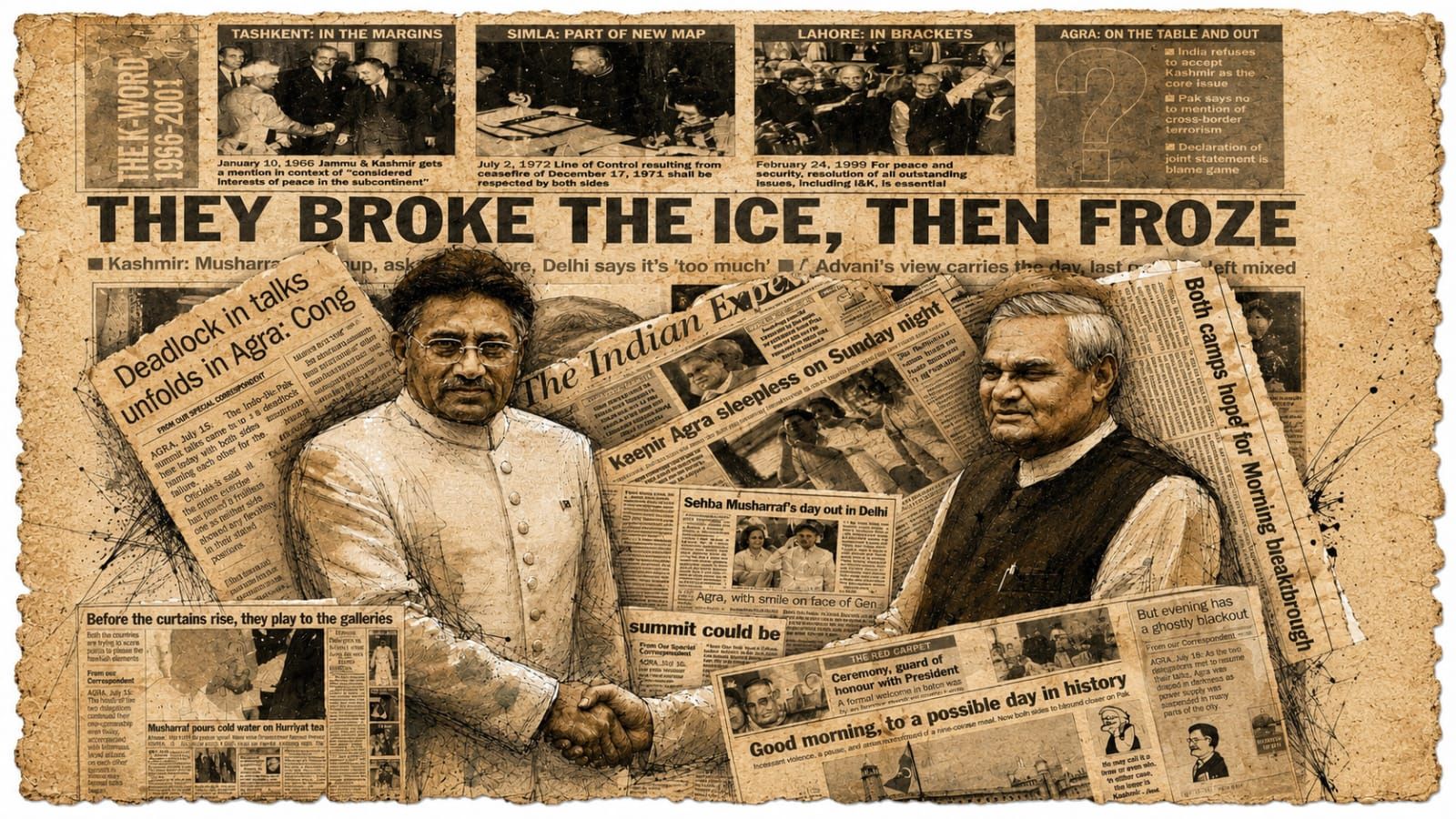
Twenty-five years ago, in July 2001, the Indian city of Agra hosted a summit that briefly raised hopes for a breakthrough in India-Pakistan relations. The Agra Summit, which brought together Prime Minister Atal Bihari Vajpayee and Pakistan's military ruler General Pervez Musharraf, ended in failure. Today, with official dialogue suspended and mistrust running deep, the summit offers valuable lessons on both the possibilities and pitfalls of engagement between the two nuclear-armed neighbours.
The summit was the result of a bold initiative by Vajpayee. On May 23, 2001, during a lunch with Home Minister L K Advani and External Affairs and Defence Minister Jaswant Singh, Vajpayee asked, 'Ab aage kya karna chahiye?' (What should we do next?) The question was about Pakistan. It had been two years since the Kargil War, and General Musharraf, who had orchestrated the conflict, was now in power. Advani and Singh supported engagement, and a Cabinet Committee on Security meeting that same day led to an invitation to Musharraf.
The summit, held from July 14 to 16, was ambitious in its scope. Both sides aimed to address core issues, including Kashmir and cross-border terrorism. However, from the outset, the summit was underprepared. Ajay Bisaria, who served as Vajpayee's private secretary at the time, later noted, 'In hindsight, the error at Agra was clearly insufficient preparation. They should have prepped the Summit properly – sent teams back and forth. Instead, the approach was, “Let’s see what the General does.” The failure was implicit in that.' T C A Raghavan, then a director in Jaswant Singh's office, agreed, calling it an 'echo chamber' where detailed work was done but without breaking out of internal consensus.
The summit unravelled spectacularly. Musharraf cut short his visit after a joint press conference was cancelled due to disagreements over the wording of a joint statement. The Indian side objected to language that seemed to downplay cross-border terrorism, while Pakistan insisted on a stronger reference to Kashmir. The collapse was followed by a sharp deterioration in ties, culminating in the 2001-2002 military standoff after the attack on the Indian Parliament in December 2001.
Despite the failure, the summit remains significant. Raghavan described it as 'extraordinary' that such a step could be taken in the aftermath of the Kargil War and the Kandahar hijacking of IC-814 in 1999. Vivek Katju, a key Indian official at the summit, highlighted the contrast between Vajpayee's statesmanship and Musharraf's 'obsessions.' He told The Indian Express, 'Prior to and during the Agra Summit, PM Vajpayee showed that he was a true statesman who looked to the future, while Musharraf demonstrated all the obsessions of his institution.'
Twenty-five years on, official talks remain suspended except for occasional Track-II exchanges. The political risk involved in such high-level meetings is now considered too high. Yet, the Agra Summit serves as a reminder that dialogue, even when it fails, can clarify positions and build understanding. As Bisaria wrote in his book, 'The failure was implicit in that approach.' The question remains: will future leaders learn from the mistakes of 2001?