Tamil Nadu moves Supreme Court over Cauvery shortfall, says Karnataka ignoring CWMA orders
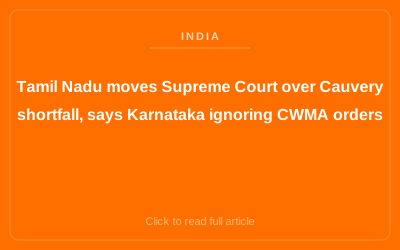
Tamil Nadu has told the Supreme Court that Karnataka has shown "scant respect" for the directions of the Cauvery Water Management Authority (CWMA), as a growing water deficit in the river basin threatens farmers in the delta region with an agricultural crisis.
In an affidavit filed on Friday, the State — represented by senior advocate G. Umapathy and advocate B. Karunakaran — said that Karnataka's non-compliance and the CWMA's failure to enforce its own decisions had "seriously affected" farmers in Tamil Nadu's Cauvery Basin, who depend almost entirely on the river for irrigation.
Tamil Nadu said storage in the Mettur reservoir stood at only 29.60 TMC (thousand million cubic feet) as on October 9. After setting aside water for drinking needs, environmental requirements and evaporation losses, the State argued that what remains would be grossly insufficient to sustain irrigation for a prolonged period.
According to the affidavit, Tamil Nadu had asked the CWMA to direct Karnataka to clear an accumulated deficit of 14.981 TMC. It said Karnataka was required to supply 22.519 TMC by early October, which would have meant a daily flow of about 1.50 TMC, or roughly 17,360 cusecs, at the Biligundlu measuring station on the inter-State border.
Instead, the Cauvery Water Regulation Committee (CWRC) reduced the recommended releases from 6,000 cusecs to 4,000 cusecs per day for a 15-day period beginning September 24. The CWMA ratified that recommendation. Tamil Nadu contended that the allocation was inadequate, noting that irrigation in the delta alone requires close to 12,000 cusecs a day from the Mettur reservoir.
The State further submitted that Karnataka had not met even the reduced allocation. "The releases made by Karnataka did not adhere to the directions of CWMA," the affidavit said, adding that flows realised were short by 0.987 TMC, or 11,416 cusecs, of what was directed. It said the backlog was mounting and that the CWMA's failure to take remedial action had caused serious prejudice to Tamil Nadu.
The State described Karnataka's reservoir position as hoarding of resources. It said Karnataka held a combined storage of roughly 49 TMC, which, in Tamil Nadu's submission, was more than enough to meet its commitments to the lower riparian State. The affidavit stated that of the water released from Karnataka's Krishna Raja Sagara dam between June 1 and September 22, Karnataka used nearly 19 TMC for drinking water and local anicut irrigation, so that effectively no water from that dam reached Tamil Nadu. Inflows at Biligundlu, it said, came almost entirely from the Kabini river and intermediate catchments.
Tamil Nadu also alleged that Karnataka was diverting basin water through 14 lift irrigation schemes and pumping flows into around 390 local storage tanks spread across the intermediate catchment. These are allegations made in the State's affidavit; Karnataka's response to the latest filing was not immediately available.
The dispute is governed by the CWMA and the CWRC, both constituted in 2018 to implement the Supreme Court's 2018 verdict apportioning Cauvery waters among the riparian States. The authority is tasked with ensuring that scheduled releases are actually made, while crop and water schedules are drawn up for each irrigation season.
Karnataka has argued in earlier proceedings that in years of deficient rainfall it cannot spare water beyond what is needed for drinking supply and its own irrigation. A distress-sharing formula that would govern how shortfalls are borne in weak monsoon years has remained unresolved.
With the Southwest monsoon now waning, the dispute has returned to the court, with Tamil Nadu seeking directions for the release of water it says is due. The Supreme Court is expected to consider the affidavit in the coming hearings.