Ladakh's safari plan sparks debate over snow leopard conservation
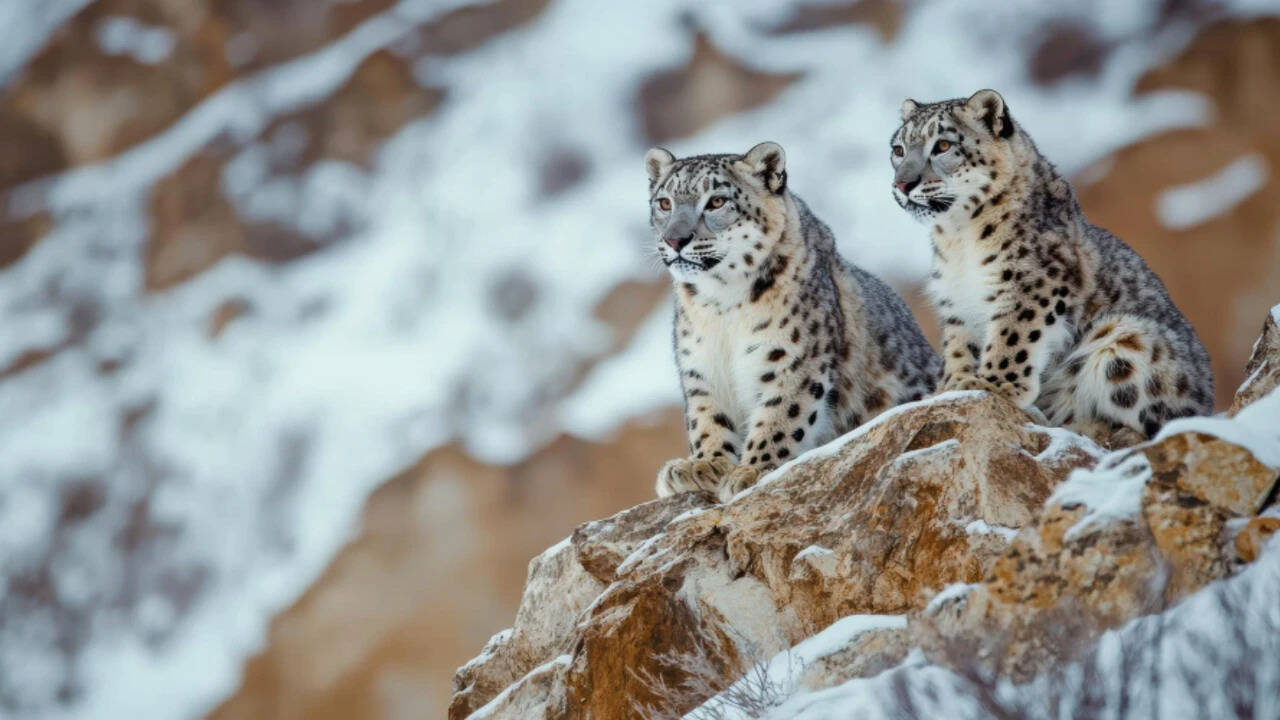
The Ladakh government has announced plans to introduce guided wildlife safaris on popular snow leopard and bird-watching trails, a move that has triggered caution from conservationists who warn that the region's fragile high-altitude ecosystem cannot be compared to India's better-known national parks.
The proposal, modelled on safari systems at Kaziranga National Park and Ranthambore National Park, would use specially designed open-back vehicles operated by trained local drivers and guides. Authorities say the initiative aims to regulate tourism, curb illegal off-roading, and prevent disturbance to wildlife in protected areas.
However, wildlife experts argue that the approach is fundamentally ill-suited to Ladakh's landscape. Dr M.K. Ranjitsinh, emeritus member of the Wildlife Trust of India and a key architect of the Wildlife (Protection) Act of 1972, said that snow leopards are not easily visible from vehicles. “You cannot see a snow leopard from a jeep unless you do something illegal like placing bait or a sheep to lure it,” he said.
Ranjitsinh, who has nearly five decades of experience in conservation policy, emphasised that the ecological conditions in Ladakh are entirely different from those in Kaziranga or Ranthambore. “Kaziranga is not Ladakh and Ranthambore is not Ladakh. The ecology is completely different,” he added. In Ladakh's open valleys, vehicles can be seen from miles away, and vegetation is concentrated along valley bottoms where animals gather to feed and drink. “Are you taking a safari there?” he asked.
Ladakh is home to 477 of India's estimated 718 snow leopards, the largest population in the country. The region also supports more than 38 mammal species, 340 bird species, and 1,800 vascular plant species. But spotting a snow leopard is extremely difficult. Its thick, mottled coat blends perfectly into rocky slopes, and the steep, remote terrain gives the animal a vast natural advantage.
The Ladakh government spokesperson said Lieutenant Governor Vinai Kumar Saxena has directed the forest department to explore safari routes across Hemis National Park, Changthang Wildlife Sanctuary, Karakoram Wildlife Sanctuary, and areas including Nubra, Zanskar, Sham, Kargil and Drass. The plan was cleared at the first governing body meeting of the Snow Leopard and High-Altitude Nature Conservation Society, chaired by Saxena. Officials argue that guided safaris will provide a controlled way for tourists to experience the region while protecting wildlife from unregulated activity.
But Ranjitsinh expressed fears about the long-term consequences. “Wildlife safari may be good in principle but in practice it could be a disaster,” he said. He warned that tourism and hotel lobbies could eventually overwhelm government controls. “There will be demands for more roads, eating places and other infrastructure. Eventually, the whole landscape could turn into a festival.”
A wildlife official, speaking on condition of anonymity, pointed out that safaris work best where animals occur in large concentrations or herds, unlike the Himalayan and Trans-Himalayan terrain of Ladakh. The official noted that Ladakh already has roads crossing its protected areas, and tourist vehicles already access most zones except restricted border regions. “What they actually plan is to regularise and commercialise off-roading,” the official said, warning that vehicles could be allowed into fragile meadows for a price.
The proposed safaris would enter a landscape unlike any other in India's safari circuit. While Kaziranga offers rhino sightings and Ranthambore offers tiger tracking, Ladakh's snow leopards are scattered across an unforgiving terrain where survival depends on staying unseen. The debate now centres on whether tourism can be managed in a way that allows people to experience this wilderness without destroying the very environment that sustains it.