India-EU Free Trade Agreement to Boost Labour-Intensive Sectors, Says Chief Negotiator
India's chief negotiator for the India-European Union free trade agreement (FTA), Darpan Jain, said on Wednesday that the pact will place India on a level playing field with competitors in several labour-intensive sectors, including textiles, apparel, leather goods, footwear, engineering goods, and marine products.
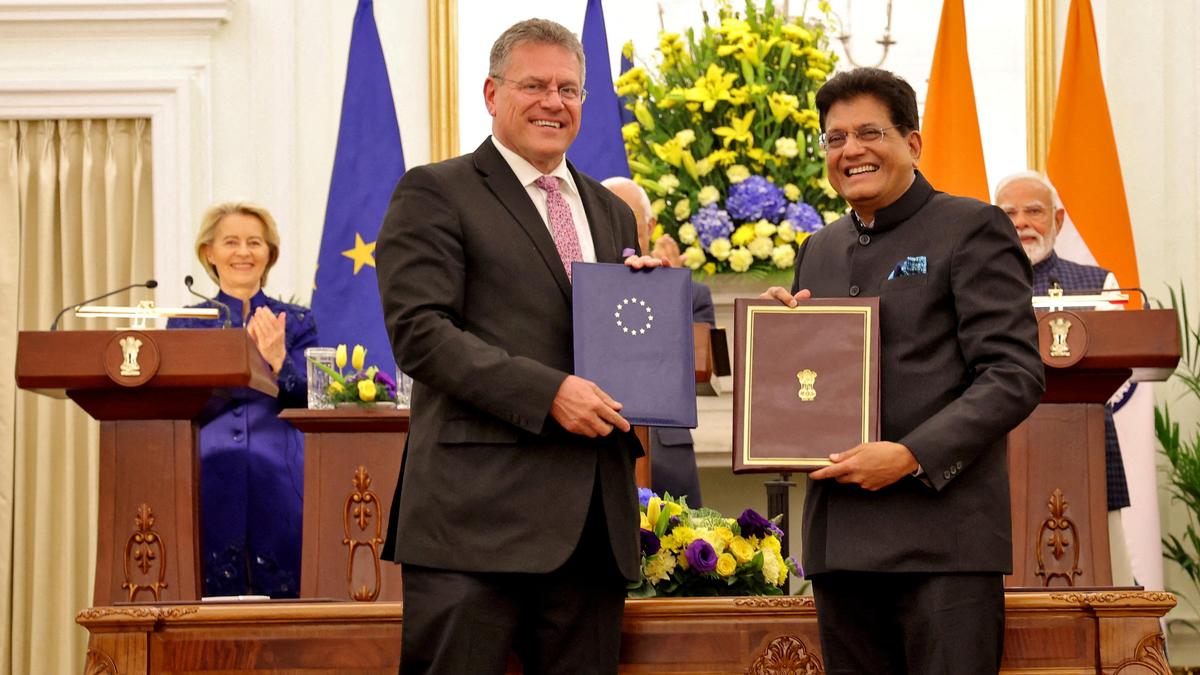
Mr. Jain made these remarks a day after India and the EU signed a document marking the conclusion of negotiations on an FTA, which both sides have referred to as the 'mother of all deals'. The agreement is expected to be signed by December and implemented from February or March next year, according to Union Minister Piyush Goyal.
Highlighting sectoral benefits, Mr. Jain said the FTA would benefit states such as Tamil Nadu, Andhra Pradesh, Karnataka, Kerala, Gujarat, Maharashtra, Rajasthan, Uttar Pradesh, Bihar, Odisha, and West Bengal.
Textiles sector to benefit
Mr. Jain pointed out that Indian exporters will gain duty-free access to the EU market for textiles, apparel, and clothing, which previously faced duties of up to 12%. This, he said, provides a level playing field against competitors such as Bangladesh, Vietnam, and Turkey, which currently enjoy duty-free or preferential access under their own EU trade agreements. Duties on leather goods, footwear, textiles, apparel, and clothing will be eliminated entirely once the FTA comes into force.
“Key clusters in Tamil Nadu, Gujarat, Maharashtra, Rajasthan, Uttar Pradesh, Bihar, and West Bengal are set to see capacity expansion and development,” Mr. Jain stated.
Engineering gains an edge
In the engineering sector, Mr. Jain said India will gain a competitive edge over rivals like China, the United Kingdom, the United States, Vietnam, and Turkey due to preferential access and reduced tariffs secured under the FTA. This is expected to help states like Maharashtra, Tamil Nadu, Gujarat, Karnataka, and Andhra Pradesh adopt advanced technologies, scale up operations, and strengthen micro, small, and medium enterprise (MSME) networks.
The electronics sector will similarly benefit, with tariffs of up to 14% being reduced and 99.6% of India-EU electronics trade opened up, creating a level playing field against global competitors like China, the US, Taiwan, and Vietnam. Mr. Jain said this will benefit hubs in Bengaluru, Pune, Noida, Chennai, and Hyderabad.
Coastal states get advantage
For the marine sector, 94.4% of marine exports to the EU will see duties eliminated as soon as the FTA comes into force, down from current rates of up to 26%. Another 1.9% of exports will see tariffs phased out. Mr. Jain noted that the FTA removes the duty disadvantage faced by Indian marine exports compared to countries like Morocco, Ecuador, and Vietnam, which enjoy duty-free or preferential access. States with strong coastal clusters such as Tamil Nadu, Andhra Pradesh, Kerala, Gujarat, Odisha, and West Bengal are expected to benefit.
Mr. Jain further said the FTA will improve India's competitiveness in pharmaceuticals and medical devices against competitors such as the US, China, and Japan, benefiting MedTech hubs in Telangana, Karnataka, Andhra Pradesh, Maharashtra, and Gujarat.