Haryana and Rajasthan Sign Landmark Water Deal After 32 Years
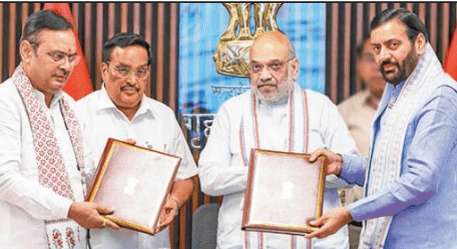
New Delhi: Haryana and Rajasthan on Monday signed an agreement that will allow Rajasthan to receive water from the Yamuna Canal through three underground pipelines, from July to October every year, under a 1994 memorandum of understanding (MoU) on sharing the utilisable surface waters of the Upper Yamuna Basin.
The agreement, signed in the presence of Union Home and Cooperation Minister Amit Shah and Jal Shakti Minister C R Patil, will facilitate the supply of drinking water to the districts of Sikar, Churu and Jhunjhunu in Rajasthan, as well as Bhiwani and Fatehabad in Haryana. The 32-year-old agreement could not be implemented earlier due to the absence of a canal system to supply water to Rajasthan. The move will now allow the implementation of the Yamuna Water Project.
Addressing the media, Amit Shah said the agreement resolved a three-decade-old water-related problem faced by people of Haryana and Rajasthan. He described it as an example of the 'Solution Through Dialogue' approach advocated by Prime Minister Narendra Modi. "This agreement demonstrates that if states move forward with the spirit of cooperative federalism, even a problem persisting for three decades can be resolved easily... It’s a win-win situation for both the states," Shah said. Rajasthan Chief Minister Bhajan Lal Sharma and Haryana Chief Minister Nayab Singh Saini were also present on the occasion.
Shah noted that water that went to waste earlier will now be used to quench people’s thirst and will be stored in large ponds to recharge groundwater levels. Approximately 580 million cubic metres of water will be supplied from the Yamuna Canal to Rajasthan through three underground pipelines, each with a diameter of more than 3.6 metres.
The project aims to convey Rajasthan’s allocated share of Yamuna waters through an underground pipeline system from the Western Yamuna Canal. This will enable the state to effectively utilise the water allocated to it under the 1994 MoU by the Yamuna Basin states — Uttar Pradesh, Haryana, Rajasthan, Himachal Pradesh, Delhi, and later Uttarakhand — regarding allocation of the surface flow of the river.







