Centre ready to launch comprehensive sex education in schools, tells Supreme Court
The Central Government has informed the Supreme Court that it is prepared to implement comprehensive sex education in schools and colleges across the country. In a submission made on Monday, the government stated that it has accepted the proposals of the national expert committee on adolescent education and will roll out the programme once the apex court gives its approval.
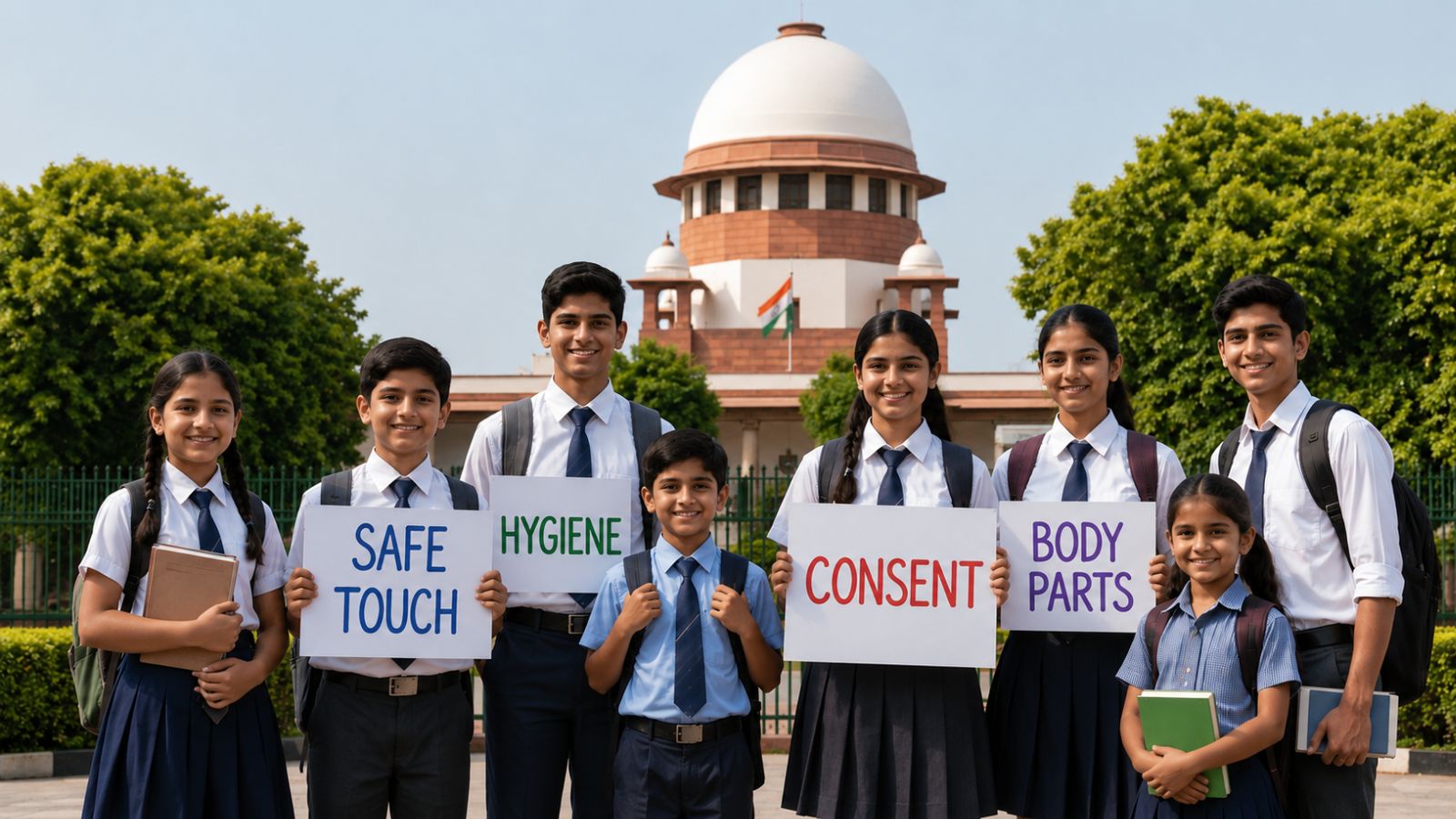
The expert committee, formed following a Supreme Court directive, has recommended introducing adolescent education from Class 6 through a graded approach. The curriculum will include age-appropriate lessons on personal safety, body awareness, hygiene, and safe and unsafe touch, starting from the foundational stage. The recommendations aim to address the growing criminalisation of consensual adolescent relationships and minor pregnancies under the Protection of Children from Sexual Offences (POCSO) Act, 2012.
The submission was made before a bench of Justices B V Nagarathna and R Mahadevan. The 26-member committee examined the right to privacy of adolescents engaged in consensual sexual relationships in the context of the POCSO Act and the broader child protection framework.
The proposals are part of a broader framework for introducing adolescent education in alignment with the National Education Policy (NEP) 2020. The current programmes, which integrate safety and security concerns with age-appropriate awareness, may be reviewed and supplemented to fulfil the NEP’s core principles of holistic development, critical thinking, and building life skills, or Jeevan Kaushal, for the 21st century.
The Adolescent Education curriculum, to be developed by the National Council of Educational Research and Training (NCERT), will include concepts such as gender equality, health and hygiene, cyber safety, emotional well-being, age-appropriate components of sex education, and awareness about the POCSO Act. On the specific issue of consent, the committee has recommended that the concept may be excluded for younger groups and introduced sensitively at the secondary stage within a medico-legal framework. A progressive, age-specific framework will apply across grade bands of 6-8, 9-10, and 11-12, with each theme explicitly defined as it is introduced, built upon, and deepened.
The committee has also recommended organising regular dialogues and workshops with parents on the importance of adolescent education, incorporating discussions on the POCSO Act and the Prohibition of Child Marriage into parent-teacher meetings, and creating community ambassadors to advocate for the programme. Additionally, the Ministry of Education has been directed to design and publish parent guidebooks outlining age-appropriate approaches for responding to children’s queries in an informed and sensitive manner.
In 2024, the Ministry of Education informed the Rajya Sabha that about seven lakh health and wellness ambassadors have been trained and oriented in 446 districts of 28 states and eight Union Territories. The committee has recommended that the Ministry of Social Justice and Empowerment, the Ministry of Tribal Affairs, and the Department of Empowerment of Persons with Disabilities ensure that their welfare schemes and programmes are tailored to reach marginalised groups, including tribal communities, children with disabilities, and LGBTQ+ youth. Training modules should incorporate trauma-informed approaches, gender sensitivity, and digital safety to equip frontline workers with the necessary competencies to address the complex challenges faced by young people today.
Before implementing the programme with students, teachers will undergo training to effectively deliver the curriculum. The government’s submission to the Supreme Court marks a significant step towards formalising sex education in Indian schools, a move that has been debated for years.