BRICS Foreign Ministers Meet in New Delhi as Internal Divisions, Iran War Test Bloc's Unity
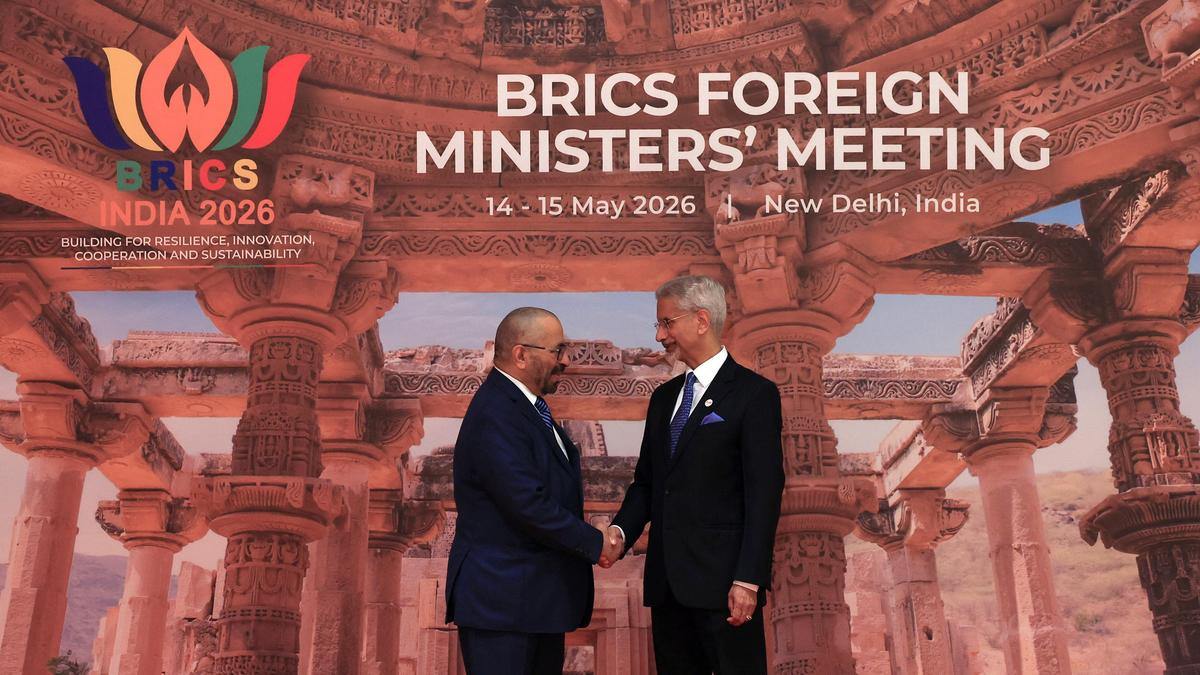
Foreign ministers from BRICS nations — Brazil, Russia, India, China, and South Africa — along with newer member countries, began a two-day meeting in New Delhi on Thursday (May 14, 2026). The meeting comes as the bloc faces divisions over the war in Iran, rising energy prices, and global economic uncertainty.
The gathering coincides with U.S. President Donald Trump's meeting with Chinese leader Xi Jinping in Beijing, underscoring the complex geopolitical landscape. Iranian Foreign Minister Abbas Araqchi and Russian Foreign Minister Sergey Lavrov are attending. China is represented by Ambassador Xu Feihong, while Foreign Minister Wang Yi remains in Beijing during the Trump-Xi talks.
Indian External Affairs Minister Subrahmanyam Jaishankar said the talks would focus on global and regional challenges and ways to deepen cooperation among member nations. In his opening remarks, Mr. Jaishankar noted that BRICS could help developing countries respond more effectively to health and financing challenges, as well as high prices for energy, food, and fertilizer.
“We meet at a time of considerable flux in international relations,” Mr. Jaishankar said, adding that emerging and developing countries increasingly expect BRICS to play a “constructive and stabilising role.”
BRICS was founded by Brazil, Russia, India, and China as a grouping of major emerging economies, seen as a counterbalance to Western-led institutions such as the G7. South Africa joined in 2010, and the bloc expanded further in 2024 with the addition of Egypt, Ethiopia, Iran, and the United Arab Emirates. Indonesia became a full member in 2025.
The group has sought to expand its influence by pushing for a bigger role in a global order long dominated by the United States and its Western allies. It has gained support across parts of the Global South, where many countries have criticised Western-led financial institutions. However, BRICS nations remain divided on key issues.
India and China continue to compete for regional influence, while member countries often differ in their ties with the West. Russia’s war in Ukraine has further exposed those differences. The bloc’s expansion has also added strains, as competing regional interests have increased the difficulty of presenting a unified position. Divisions have sharpened further during the growing conflict in West Asia, particularly as Iran and the UAE — both BRICS members — pursue competing interests in the region.
On Wednesday (May 13, 2026), Iran’s Deputy Foreign Minister Kazem Gharibabadi acknowledged that disagreements within BRICS over the conflict have prevented the bloc from reaching a unified position. He told Press Trust of India that “one member country” had pushed for language condemning Iran, complicating efforts to build consensus.
“We want India’s BRICS chairship to be successful. It is not a good approach to send a signal to the world that the BRICS is divided. One country is insisting on condemning Iran,” Mr. Gharibabadi said.
The meeting in New Delhi highlights both the potential and the challenges of the BRICS grouping as it seeks to navigate a rapidly changing global landscape.