ABVP Alleges 'Free Umar Khalid', 'Long Live Naxalbari' Slogans Painted on JNU Walls, Demands Action
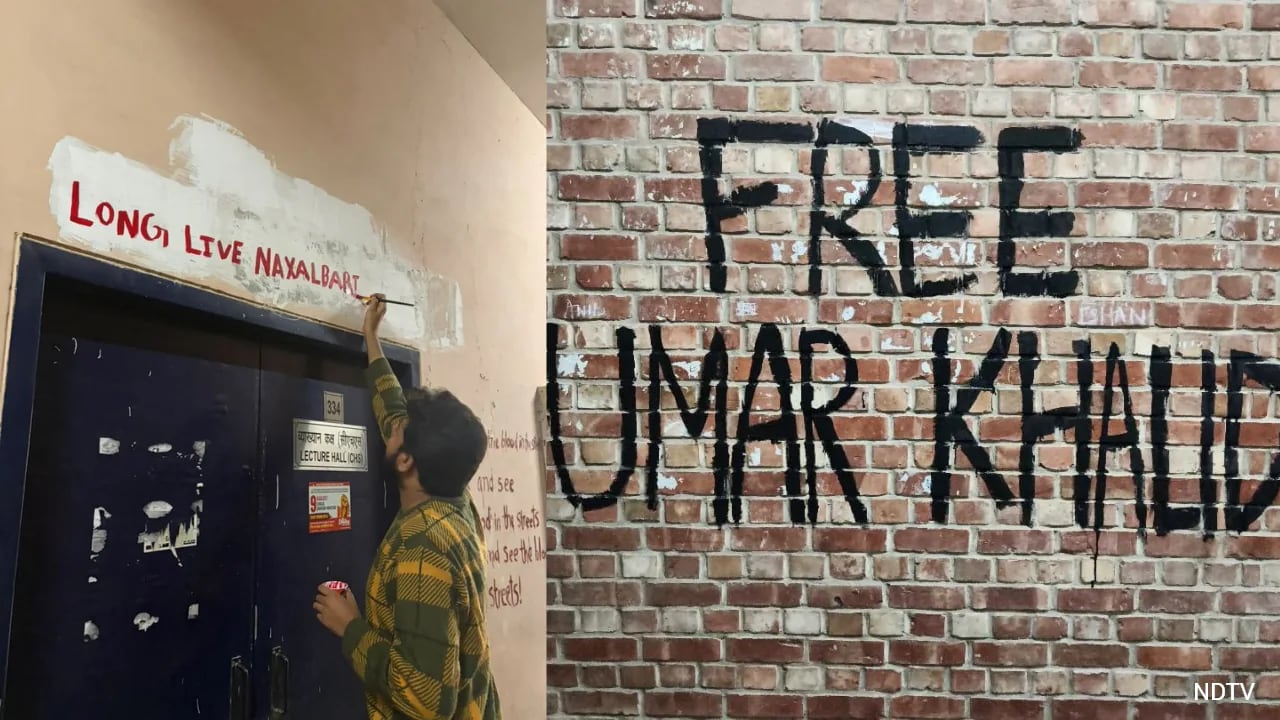
New Delhi: The Akhil Bharatiya Vidyarthi Parishad (ABVP) has alleged that slogans it described as threatening the peace of the campus have appeared on the walls of Jawaharlal Nehru University (JNU) in Delhi. According to the Rashtriya Swayamsevak Sangh (RSS)-linked student organisation, writings reading "Free Umar Khalid" and "Long Live Naxalbari" were painted on campus walls.
The ABVP has also claimed that Neha Bora, national president of the All India Students' Association (AISA), raised slogans in support of Khalid, and accused Left-leaning student groups of vitiating the atmosphere on campus. The allegations were made publicly by the outfit's JNU unit and have not been independently verified. AISA and the JNU administration did not immediately respond to requests for comment.
Khalid, a former JNU scholar and Left activist, was arrested in 2020 under the Unlawful Activities (Prevention) Act and has been in custody since, awaiting trial in a case relating to the 2020 Delhi riots. He has denied the charges against him.
The ABVP further alleged that offensive remarks had been inscribed alongside a portrait of Hindutva ideologue V.D. Savarkar on the campus. The outfit said such incidents were detrimental to JNU's peaceful and academic environment, and questioned the politics of the Leftist student groups and the Left-led students' union.
It alleged that controversial political slogans were being promoted in place of issues concerning students' interests, and demanded that the university administration take cognisance of the matter, identify those responsible and initiate action.
Mayank Panchal, president of the ABVP's JNU unit, said national figures cannot be insulted using freedom of expression as a shield. Writing offensive remarks alongside Savarkar's portrait and scrawling radical political slogans on walls did not amount to freedom of expression, he asserted.
Praveen Piyush, secretary of the unit, said the university is not the fiefdom of any single ideology, and that damaging public property is not in the interest of students.
The developments at JNU follow unrest at another Delhi university. At Jamia Millia Islamia, slogans linked to Jammu and Kashmir recently appeared on campus walls amid protests over a demand to reintroduce student union elections. The university closed two libraries on campus citing security concerns, and classes were moved online after students and security guards clashed during a protest.
Abin Basil, a Jamia student associated with the protest, claimed that the contentious slogans were planted at the behest of the university authorities. "We strongly condemn those slogans. Our demand remains simple and clear: hold student union elections," he said.
He alleged that the administration was putting on a "dramatic show" to persuade students to call off their strike, and said professors and security personnel had tried to dismantle and remove the protest tent. Student union elections at Jamia have not been held for several years, and students have repeatedly demanded their revival.
The Jamia administration has cited security concerns for its measures. The two episodes have revived a wider debate on Delhi's campuses over the balance between students' right to protest and expression, and the responsibility to protect public property and a calm academic environment. Under the Constitution, the right to free speech under Article 19(1)(a) is subject to reasonable restrictions, including those relating to public order and the incitement of an offence.
The ABVP has said it will pursue the matter with the JNU administration, while student groups at Jamia have said their agitation will continue until elections are announced. Independent confirmation of who painted the slogans at either campus is yet to emerge, and no arrests had been reported at the time of filing this report.