US watchdog finds errors, missing evidence in Doge’s $110bn savings claims
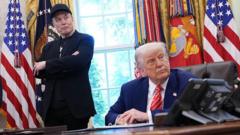
The US Government Accountability Office (GAO) has found that several savings figures reported by the Department of Government Efficiency (Doge) — the now-defunct body spearheaded by Elon Musk — were either incorrect or lacked supporting evidence.
In a report released on Thursday, the watchdog examined Doge’s “Wall of Receipts”, an online dashboard that claimed to show $110bn in savings from cancelled contracts, grants, and leases. The GAO said that “several issues limit the transparency and reliability of these reported savings”.
The report highlighted that Doge did not provide enough information to verify how it calculated 96% of its reported savings. It also gave specific examples of inaccuracies. Of 264 leases Doge said it terminated, 108 were already in the process of ending before Doge was established. Those leases accounted for $15.3m of the $53.5m in claimed lease savings.
Another claim involved a $1.7bn saving from terminating a Department of Defence contract for IT services. The GAO noted that the contract was never terminated, so no such saving was achieved.
The audit was requested by Democratic Senators Gary Peters and Richard Blumenthal. It covered savings data reported from 20 January 2025 to 7 July 2026.
Responding to the report, Senator Peters said: “Everyone supports rooting out waste, fraud, and abuse in the federal government, but Doge was a slapdash and deceptive effort that misled the American people while doing real damage to the government’s ability to serve them.”
A White House official, asked for comment, said the administration had told the GAO that all employees had completed ethics training and followed financial disclosure requirements.
Doge was launched at the start of President Donald Trump’s second term in January 2025 and closed in July 2025, according to its own announcement. It was not an official government department, but operated with White House backing. Musk, who led Doge until May 2025, had originally promised to save up to $2tn a year by cutting federal jobs and eliminating programmes. Even by Doge’s own estimates, it fell short of that goal, claiming $214bn in total savings on its website.
Under Musk, Doge pushed for large-scale reductions in the federal workforce and the closure of agencies, including the US Agency for International Development (USAID). Some of its actions were contested in court or reversed. For instance, after Doge fired bird flu officials at the Department of Agriculture, the administration later sought to rehire them.
In a social media post announcing its closure, Doge said: “While the formal mission of Doge has come to an end, the mission to eliminate waste, fraud, and abuse will continue. Good stewardship of taxpayer dollars and accountable government are not temporary initiatives.”
The GAO’s findings raise questions about the accuracy of the administration’s public claims regarding cost-cutting, but the report does not assess the broader impact of Doge’s actions on the federal workforce or government services.