UN halts evacuation of stranded sailors in Strait of Hormuz after ship attack
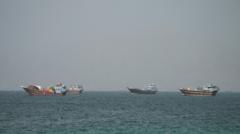
The United Nations International Maritime Organization (IMO) has paused its plan to evacuate over 11,000 sailors stranded in the Strait of Hormuz following an attack on a cargo ship transiting the waterway.
IMO Secretary-General Arsenio Dominguez stated on Thursday that while several vessels had already been evacuated, the agency is seeking to ensure that 'necessary safety guarantees' remain in place before proceeding further.
The British maritime security agency UKMTO reported that a ship was struck by 'an unknown projectile' approximately 7.5 nautical miles southeast of Oman's port of Dahit. No casualties were reported. The targeted vessel, the Singapore-flagged Ever Lovely, continued its passage through the strait despite the incident, according to maritime risk management firm Vanguard.
Hundreds of ships and thousands of seafarers have been stranded in the Gulf since February due to the ongoing conflict between the United States and Israel against Iran. The UN evacuation effort was announced on Tuesday following the reopening of the strait, with Dominguez noting that the 'large-scale operation' had the cooperation of Iran, Oman, the United States, and other coastal states, as well as the maritime industry.
Dominguez clarified that the attacked vessel 'did not transit under IMO's evacuation framework.' He added, 'I have always reiterated that the safety of the seafarers remains paramount. Therefore, to ensure a coordinated approach and navigational safety, the evacuation plan will be paused until further clarity is obtained.'
According to ship-tracking website MarineTraffic, the Ever Lovely entered the strait via the southern route on Thursday morning and exited on the eastern side at around 15:30 local time (16:30 BST). Vanguard reported that no assistance was required.
Last week, the United States and Iran agreed to end hostilities under a 14-point memorandum of understanding (MOU), which also called for Iran to use its 'best efforts for the safe passage of commercial vessels with no charge for 60 days.' However, Tehran has repeatedly stated its intention to levy what it calls 'maritime service fees' for crossing the strait, as opposed to tolls. The plan is strongly opposed by the United States; Secretary of State Marco Rubio warned on Tuesday that no country is permitted to impose tolls on the Strait of Hormuz, which he described as 'an international waterway.' Rubio is currently in Bahrain as part of a tour of Gulf states to discuss the agreement with Tehran.
After military strikes against Iran began in late February, Tehran effectively closed the strait—a crucial waterway for oil and gas shipments—causing a spike in global oil prices and disrupting the supply of other essential commodities such as fertiliser. However, crude oil prices have declined sharply since the US and Iran signed the MOU on 17 June, which established a 60-day period for negotiations on Iran's nuclear programme and other measures to end the conflict. On Thursday, the price of oil briefly fell below $72.48 a barrel—the level it was at the day before the US and Israel launched attacks on Iran—before edging up to $73.23.