Trump asks Supreme Court to let White House ballroom work proceed
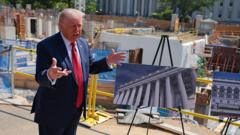
Washington: US President Donald Trump has filed an emergency application with the Supreme Court, seeking to continue construction of a $400 million ballroom at the White House without congressional approval. The move comes a week after an appeals court ordered a halt to construction until Congress grants permission, upholding a ruling in favour of the National Trust for Historic Preservation.
The Trust had sued the administration last year, arguing that demolition of the White House East Wing and subsequent construction violated federal law because the project had not undergone legally required review, including public comment and approval from bodies such as the National Capital Planning Commission.
In Friday's filing, Solicitor General D. John Sauer asked the court to allow work to proceed while the administration appeals the stop-work order. He described the injunction as "dangerous" and said that with the project already about 65 per cent complete, stopping work would amount to "construction-by-injunction".
"With the dangerous injunction poised to take effect for the first time on August 21, its stop-work mandate is even more flagrantly inequitable, if not impossible," Sauer wrote. He added that "forcing the president to come hat-in-hand to Congress so the people's house is safe gives the legislature dangerous leverage".
The appeals court decision is scheduled to take effect on 21 August unless the Supreme Court grants the emergency application. Chief Justice John Roberts has ordered the National Trust for Historic Preservation to respond by noon on Tuesday.
The administration has maintained that the ballroom is essential for national security, citing the need for a large event space. Officials have also argued that the project is fully funded by private corporate donations, meaning congressional approval is not required. In addition to hosting events, the complex is said to include military facilities such as bomb shelters and medical treatment centres.
The National Trust responded sharply to the emergency application, accusing the administration of "refusing to listen" to previous rulings and "actively attempting to outrun the courts by accelerating construction of the ballroom". In a statement, the Trust said: "The administration's transparent efforts to evade the rule of law, frustrate judicial review and limit the availability of meaningful relief in the courts must stop here."
The ballroom project is part of a broader effort by President Trump to reshape Washington's cityscape. Similar legal challenges have been mounted against other initiatives, including renovations to the Lincoln Memorial Reflecting Pool and a proposed "Arc de Trump" inspired by Paris's Arc de Triomphe. In all these cases, the administration has faced allegations of bypassing required review and public-comment processes, charges the president has denied.
The Supreme Court's decision on the emergency application will determine whether construction continues while the legal battle proceeds. The case raises broader questions about executive authority, historic preservation, and the role of Congress in overseeing presidential projects.