Punjab's remote border villages: BLOs row boats to update voter rolls amid floods
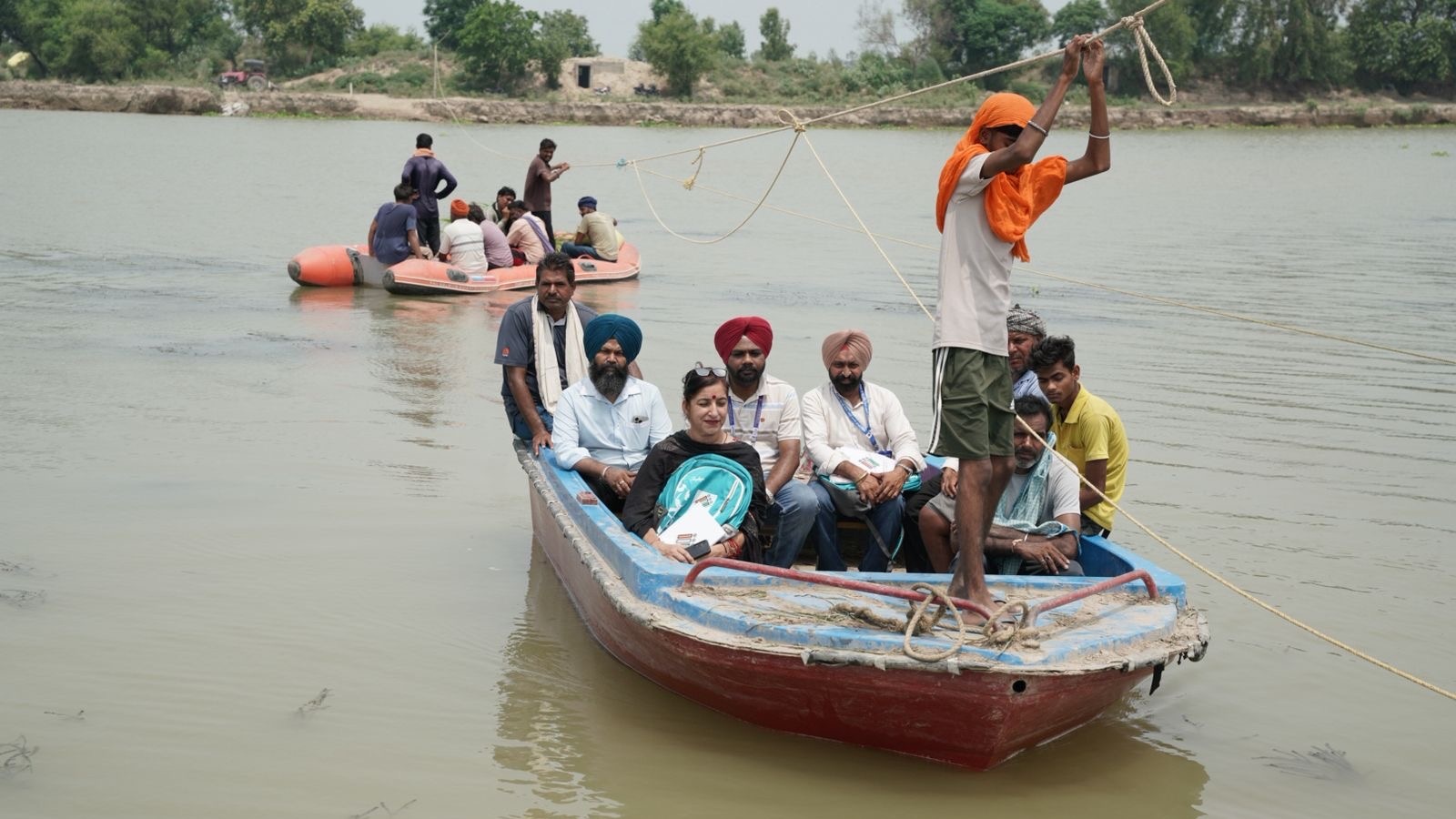
For most Booth Level Officers (BLOs), updating electoral rolls involves walking from house to house with forms. But for those in Punjab's remote border belt, the task means rowing across rivers, waiting out floodwaters, and sometimes relying on Army boats to return home.
As the Special Intensive Revision (SIR) of electoral rolls continues, BLOs in some of Punjab's most inaccessible villages are navigating swollen rivers and flood-prone terrain to ensure that voters living along the India-Pakistan border are not left out.
In Gurdaspur district, Vikram Singh begins his workday not on a road but on the Ravi river. To reach Bharyal village, he takes a small country boat at Makaura Pattan, near the confluence of the Ravi and Ujh rivers. Villagers ferry him across to a settlement that remains cut off from the mainland for months every year.
“With rains lashing Jammu and Kashmir and the river swelling, it becomes difficult. I had to go daily. I wanted to finish my work before the monsoon. I have identified 60 percent of the voters. It was not an easy task,” Singh told The Indian Express. The SIR is still underway.
Bharyal, which has 369 voters, is flooded almost every year. Many residents temporarily move to 15 neighbouring villages during the flood season. “I had to map each one of them. Like today, it is raining and I cannot go,” Singh said.
Bharyal and neighbouring Toor village, covered under Polling Station Nos. 1 and 2 of the Dinanagar (SC) Assembly constituency, are among Punjab's most isolated habitations. Pakistan lies on one side, the Ravi on the other, while the international border is barely 8 kilometres away.
Among Punjab's 12,500 villages, 50 are considered remote because they are located along the international border and have poor road connectivity. For part of the year, a temporary pontoon bridge connects these villages with the mainland. During monsoon, the bridge is dismantled as the river swells, leaving boats as the only means of transport.
Gurdaspur alone has 15 such villages. Congress MLA Tript Rajinder Singh Bajwa from Fatehgarh Churian said the Ajnala, Dharamkot and Bhoa Assembly segments also have remote villages.
For BLOs, the exercise involves crossing the river multiple times for house-to-house enumeration, mapping, follow-up visits, and processing forms. Singh recalled a day when a routine visit nearly turned into a rescue operation. “The water level was manageable when I went to Bharyal. But by the time I had to return, flash floods in Rajouri had affected the river. The Army boat helped us come back,” he said.
“When the river is in spate, village boats stop operating because it becomes risky. The Army takes over with boats, life jackets and all necessary arrangements.” Residents had urged authorities to keep the pontoon bridge in place this year, but rising water levels made that impossible.
Nearly 150 km away in Ferozepur district, Kaluwala village—often called Punjab's island village—is encircled by the Sutlej on three sides and the India-Pakistan border fence on the fourth, lying barely a kilometre from the international border. The village, around 10 km from Ferozepur town, has little permanent infrastructure and is accessible largely by boat. Temporary Army pontoon bridges are erected only during emergencies.