PM Modi delivers 13th straight I-Day address, emulating Nehru's record
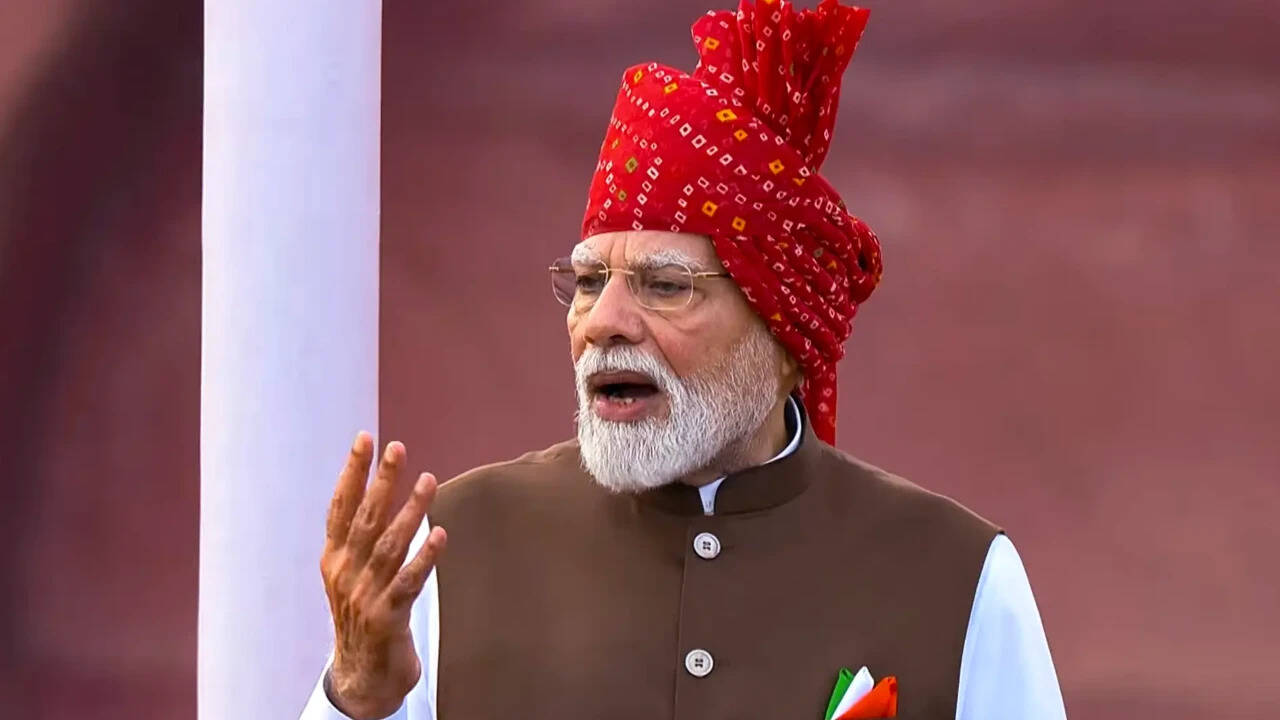
Prime Minister Narendra Modi on Saturday addressed the nation from the ramparts of the Red Fort for the 13th consecutive year, becoming only the second prime minister to achieve this feat. The first was Jawaharlal Nehru, India's first prime minister, who set the benchmark with an unbroken run of 17 Independence Day addresses between 1947 and 1963.
The 80th Independence Day celebrations began with Modi hoisting the national flag, followed by the national anthem and a 21-gun salute. The prime minister then delivered his customary address to the nation, a tradition that has been an integral part of India's Independence Day observance since 1947.
Nehru's record of 17 consecutive speeches remains the longest, but Modi's 13 straight addresses place him second on the list of longest unbroken streaks. No other prime minister, including Indira Gandhi and Manmohan Singh, has delivered 13 consecutive Independence Day speeches. Indira Gandhi gave a total of 16 addresses over two non-consecutive terms, while Manmohan Singh gave 10 consecutive speeches from 2004 to 2013.
The Red Fort ceremony, which is broadcast live across the country, is one of the most watched annual national events. Security around the historic fort was heightened, with thousands of personnel deployed and multi-layered arrangements in place. The event was attended by senior government officials, dignitaries, and a large gathering of citizens who had been invited to witness the proceedings.
In his speech, Modi reflected on the country's journey since independence and outlined the government's priorities for the coming year. According to the live telecast, he highlighted themes of national unity, economic progress, and social harmony, while also paying tribute to freedom fighters and security forces. The full text of the speech was made available on the Prime Minister's Office website shortly after the event.
The milestone is significant not just as a personal achievement for Modi, but as a reminder of the democratic tradition of addressing the nation on this solemn occasion. Independence Day speeches have historically been used by prime ministers to outline their vision, take stock of challenges, and salute the spirit of the nation. Analysts note that the continuity of this practice reinforces the constitutional framework that binds the country together.
Political leaders across parties extended Independence Day greetings to citizens. Many also took to social media to congratulate the prime minister on the milestone, though some opposition leaders offered measured responses, focusing instead on issues of governance and accountability. The occasion, however, remained one of national observance rather than partisan debate.
As India moves forward, the 80th Independence Day will be remembered for this record—a moment that places Modi alongside Nehru in the annals of Indian political history. The event concluded with the prime minister's speech, followed by a display of cultural performances and tableaux representing the country's diverse heritage.