PM Modi at ET Forum: India a 'bright spot' amid global uncertainty, pledges trust-based reforms
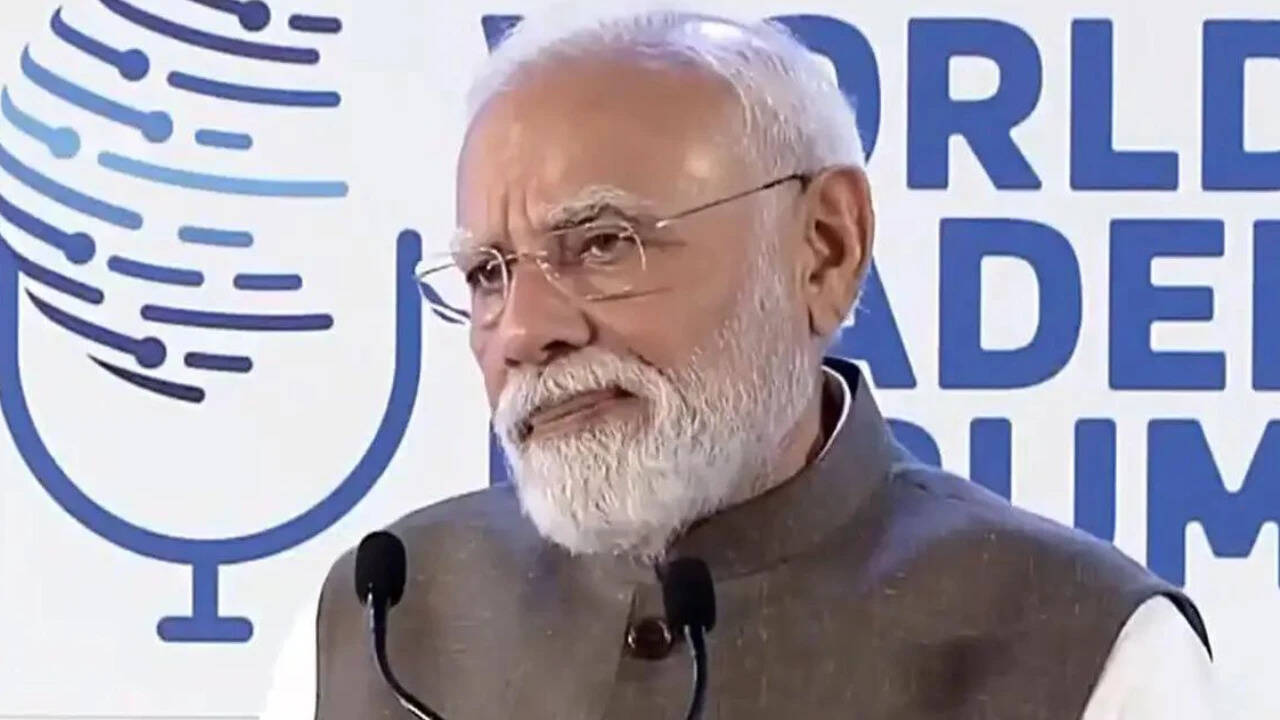
NEW DELHI: Prime Minister Narendra Modi said on Friday that the world viewed India as a “bright spot of growth and hope,” while outlining his government’s efforts to overhaul the country’s regulatory framework from a restrictive to a facilitative approach. Speaking at the Economic Times World Leaders Forum 2026, Modi acknowledged recent global turbulence and stressed that nations could not prosper in isolation.
“The world has witnessed many ups and downs over the past few years,” Modi said. “These experiences have made one thing abundantly clear: whether one likes it or not, the futures of all nations are interconnected. Nothing is possible in isolation.” He cited India’s G20 presidency motto, “One Earth, One Family, One Future,” as a guiding principle for addressing 21st-century challenges.
The Prime Minister criticised the regulatory environment of earlier decades, which he described as a “Production Linked Punishment” (PLP) model. Under this system, he said, companies were penalised for exceeding production limits. He contrasted this with current policies such as the Production Linked Incentive (PLI) scheme, which rewards output.
“Today’s younger generation will be surprised to hear that there was a time in our country when if a company produced more than the prescribed limit, it was punished,” Modi said. He also defended the ‘Make in India’ and ‘Atmanirbhar Bharat’ campaigns against critics, saying they were rooted in a new thinking that encouraged enterprise.
Modi announced a shift in regulatory philosophy from “prohibited unless permitted” to “permitted unless prohibited.” He argued that the old approach required citizens and businesses to seek government permission for every activity, fostering suspicion. The new approach, he said, would allow anything not explicitly barred by law, with the government acting as a facilitator.
“The relationship between the government and citizens should be based not on suspicion, but on trust,” he added. He also highlighted legislative work completed during Parliament’s Monsoon Session, including the passage of the Bankers’ Books Evidence Bill, despite opposition disruptions. “We did not allow the work of serving the country to stop,” he said.
Addressing the forum ahead of Modi’s keynote, Times Internet Chairman Satyan Gajwani described the Prime Minister as a source of stability in a world “lurching from one crisis to the next.” Gajwani pointed to overlapping challenges—two ongoing wars, an energy crisis, disrupted shipping routes, trade tensions, and the rapid advancement of artificial intelligence—as sources of global uncertainty. He said India’s political and economic stability stood out in this context.
The Prime Minister’s remarks come at a time when global institutions are revising growth forecasts and major economies face inflationary and geopolitical pressures. India has maintained relatively high growth rates, and the government has positioned itself as a reliable partner for investment and manufacturing.
Analysts note that the regulatory reforms Modi described are part of a broader effort to improve the ease of doing business, though implementation remains a challenge. The government has taken steps to decriminalise minor corporate offences, streamline compliance, and reduce the compliance burden on small enterprises. However, critics argue that more needs to be done to address issues such as land acquisition, labour laws, and judicial delays.
Modi concluded by emphasising that the country’s reform journey was ongoing. “We are not just changing regulations; we are changing the entire policy of regulations,” he said.