Parliament's Monsoon Session Concludes: Low Productivity, NEET Protests, and Key Bills
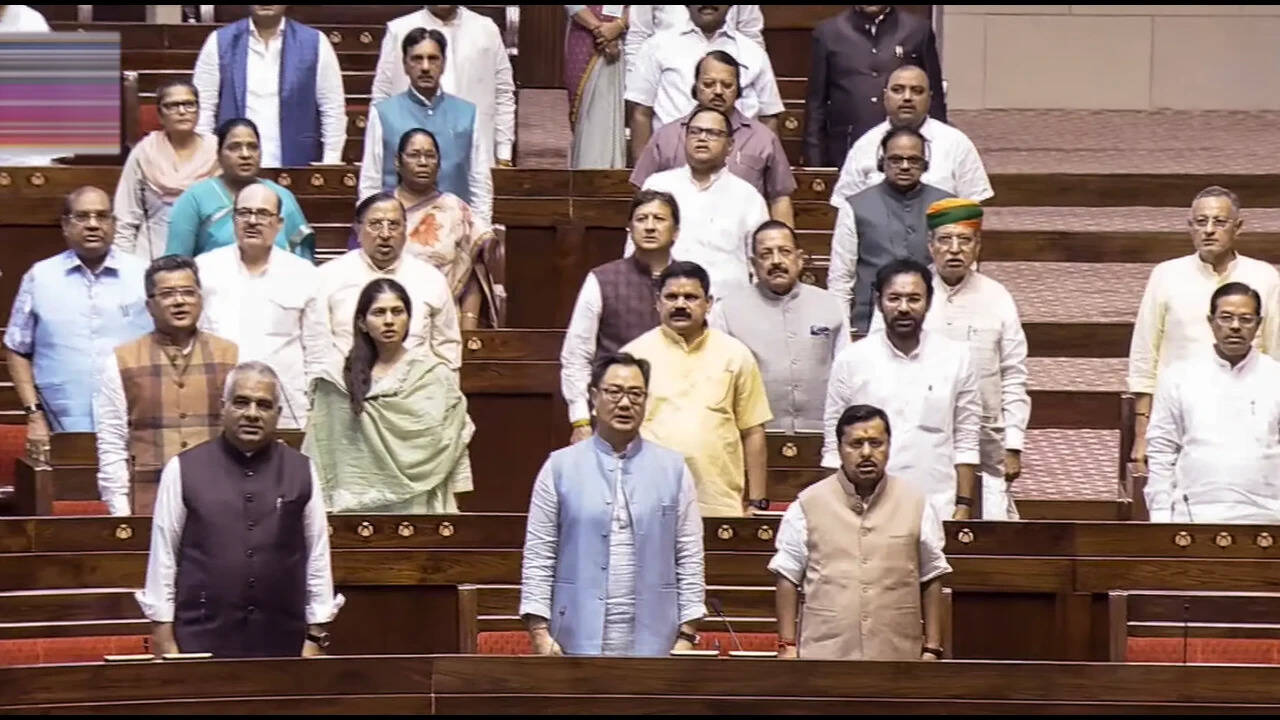
The Monsoon Session of Parliament concluded on Thursday, with both the Lok Sabha and Rajya Sabha being adjourned sine die. The session, which spanned several weeks, was marked by a mix of legislative business and political turbulence. The adjournment sine die signifies the formal end of the session, allowing committees and members to resume their regular work.
The session witnessed several confrontations between the ruling dispensation and the Opposition, with issues ranging from examination irregularities to contentious statements dominating the discourse. Union Parliamentary Affairs Minister Kiren Rijiju flagged the low productivity of the session, a remark that underscores the challenges of running parliamentary business amid frequent disruptions.
In keeping with tradition, six stanzas of Vande Mataram were played in the Lok Sabha on the final day, a symbolic gesture that marks the conclusion of parliamentary sittings.
The Rajya Sabha witnessed a heated exchange when Leader of the Opposition Mallikarjun Kharge raised the 'purification' row. The issue, which had been an undercurrent during the session, came to the fore on the last day, leading to sharp exchanges between members across the aisle. The details of the controversy were not immediately elaborated, but it added to the charged atmosphere in the Upper House.
Prime Minister Narendra Modi and Union Home Minister Amit Shah were present in Parliament as the session closed, indicating the importance the government attached to the final day's proceedings. Their presence also served as a signal of the administration's focus on legislative priorities.
On the legislative front, the session saw the introduction of 12 bills, with 11 being passed by both Houses. This includes a range of measures that touch upon governance and public life. The passage of these bills reflects the government's ability to push through its agenda, albeit amidst prolonged debates and opposition protests.
A significant portion of the session's time was consumed by turmoil over the NEET issue. The National Eligibility cum Entrance Test, a key medical entrance examination, became a flashpoint after allegations of paper leaks and other irregularities surfaced. Student protests erupted in various parts of the country, and the opposition parties used the issue to target the government in Parliament. The controversy led to repeated disruptions in both Houses, and the opposition's persistence ensured that it remained a central theme of the session. The government and the opposition differed sharply on the handling of the examination, contributing to the heated environment.
As the session ended, its legislative and political legacy is being assessed. The productivity concern raised by Rijiju, the contentious NEET debate, and the overall charged political climate are likely to define public perception. However, the completion of a substantial number of bills offers a counterpoint to the narrative of parliamentary paralysis.
The session also highlighted the deepening fault lines between the government and the opposition, with procedural wrangling and walkouts becoming commonplace. The 'purification' row in Rajya Sabha and the ongoing NEET protests underscored the fraught relationship between the two sides.
Observers note that the success of the session will be measured not only in the quantum of legislation but also in the quality of deliberations. As members leave the chamber, the battle lines for future sessions are already drawn, with both sides likely to continue their confrontations over key issues.