Parliament Tussle Over Amit Shah's Statement: Government Says 'Not Your Call'
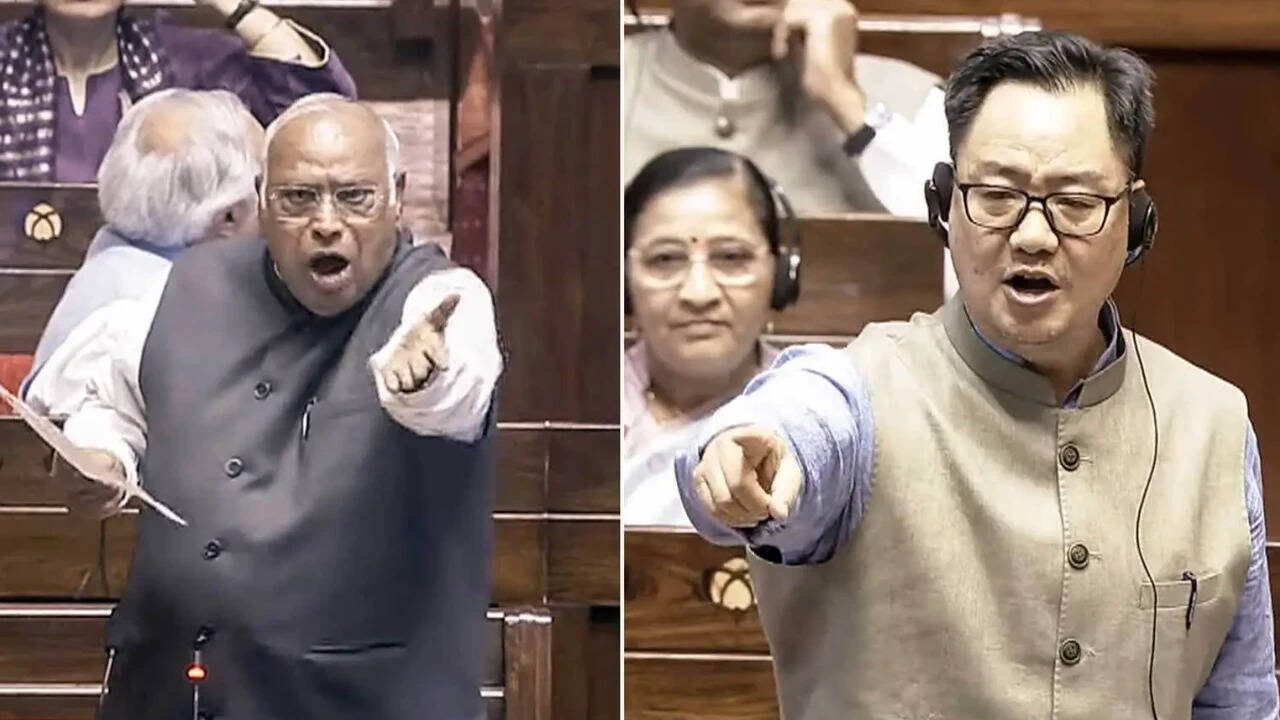
The Rajya Sabha witnessed a sharp exchange on Tuesday as Leader of Opposition Mallikarjun Kharge demanded a statement from Union Home Minister Amit Shah on a matter of national significance. The government, however, firmly rejected the demand, asserting that the choice of which minister speaks in the House rests with the executive, not the opposition.
Responding to the opposition's insistence, Parliamentary Affairs Minister Kiren Rijiju stated, "The opposition does not get to decide which minister comes to the House. That is the government's prerogative." His remarks drew strong reactions from opposition benches, leading to a brief adjournment.
The confrontation highlights the recurring friction between the ruling party and the opposition over parliamentary protocol and accountability. Opposition leaders argue that on certain sensitive issues, the presence of the concerned minister is vital for transparency and democratic scrutiny. They contend that the Home Minister, being in charge of internal security, must address the House directly when questions are raised about his portfolio.
Government sources, however, maintain that the allocation of business in Parliament is governed by established rules and that ministers are designated to respond based on the subject and administrative jurisdiction. They also noted that the Home Minister has addressed the House on multiple occasions in the past, and there is no deliberate avoidance.
Political analysts point out that such standoffs often stem from a lack of trust between the ruling and opposition parties. The opposition frequently seeks to corner the government by demanding that senior ministers defend policies, while the government views such tactics as obstructionist. Parliamentary procedure does not obligate any specific minister to speak; it is the government's collective responsibility to answer questions.
The Rajya Sabha has its own rules, and the Chairman's role becomes crucial in resolving such deadlocks. In this case, the Deputy Chairman presided over the session. He urged both sides to maintain decorum and suggested that the issue could be raised during the Zero Hour or through a notice under relevant rules. The opposition, however, insisted on an immediate statement, leading to disruption.
This incident is part of a larger pattern in recent sessions, where the opposition has repeatedly used the Rajya Sabha to demand statements from senior ministers, including the Prime Minister, on issues ranging from economic policy to law and order. The government has often responded by pointing to constitutional provisions that allow ministers to decide their speaking schedule.
Experts on parliamentary affairs note that while the opposition has the right to seek clarity, the government's authority to decide its representation is also well-established. The balance lies in ensuring that the House functions smoothly without undermining its authority. Prolonged disruptions, they caution, erode public confidence in the democratic process.
As the session continues, both sides appear unwilling to yield. The opposition has hinted at moving privilege motions if the demand is not met, while the government has accused the opposition of misusing parliamentary time. The Chairman's intervention may be required to break the impasse, with a possible reference to the Rules Committee.
For now, the question remains: will the government relent and send Amit Shah to the Rajya Sabha, or will it stand firm on its stand that the opposition cannot dictate the agenda? The outcome could set a precedent for how similar demands are handled in the future.