Owaisi calls Allahabad HC hijab ruling 'attack on Islam'
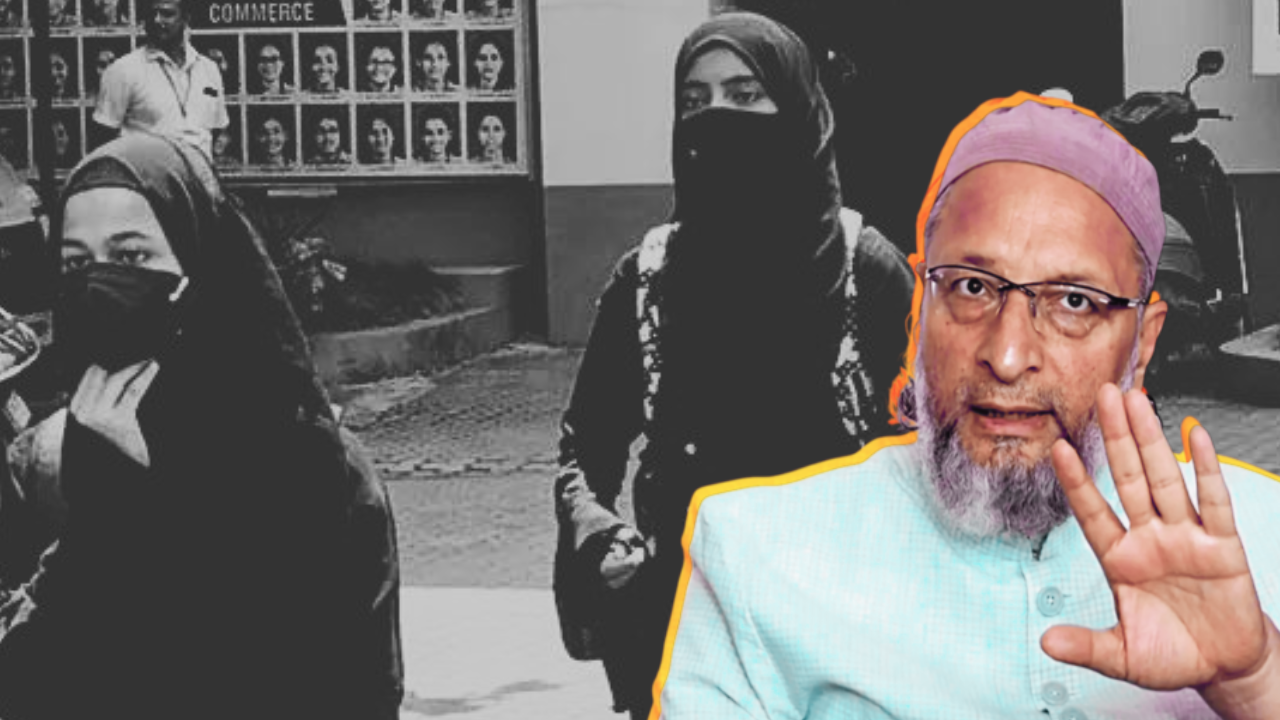
All India Majlis-e-Ittehad-ul-Muslimeen (AIMIM) chief Asaduddin Owaisi has criticised the Allahabad High Court's decision to dismiss a student's petition seeking permission to wear a hijab over her school uniform. He described the ruling as an "attack on Islam", adding that the court had ignored the fact that "hijab is on their heads, not in their minds".
The division bench of Justices JJ Munir and Indrajit Shukla dismissed the petition filed by a student who had been refused permission by her school to wear a scarf over her uniform. The court's order, which was passed recently, has reignited the debate over religious attire in educational institutions across India.
Owaisi's remarks came in a series of posts on social media, where he accused the judiciary of selectively targeting Muslim practices. "When a Sikh can carry a kirpan (ceremonial dagger) and a Hindu can wear a tilak (religious mark), why is the hijab seen as a threat?" he asked. He also said that the verdict was a violation of the constitutional right to freedom of religion under Article 25.
The case is the latest in a string of legal battles over the wearing of hijab in schools and colleges. In 2022, the Karnataka High Court upheld a ban on hijab in pre-university colleges, ruling that it was not an essential religious practice. That decision was later challenged in the Supreme Court, where a split verdict left the matter unresolved. The Supreme Court has since referred the issue to a larger bench, but no final hearing has taken place yet.
The Allahabad High Court's reasoning in the current case is not yet available in full. However, legal experts point out that the dismissal of the petition suggests that the bench accepted the school's dress code as a reasonable restriction. The school had argued that the uniform was mandatory for all students to maintain discipline and equality.
Owaisi, however, maintained that the ruling would have a chilling effect on Muslim students. "This is not about a piece of cloth; it is about the identity and dignity of Muslim women," he wrote. He called on the Supreme Court to intervene and clarify the legal position on religious symbols in educational institutions.
The controversy has also drawn reactions from other political leaders and civil society groups. While some have supported the court's decision as upholding institutional discipline, others have expressed concern over religious freedom. The matter underscores the ongoing tension between uniform dress codes and individual religious expression in India's pluralistic society.
As the legal debate continues, students across the country are watching closely. For now, the Allahabad High Court's order stands, but the issue is likely to reach the Supreme Court for final adjudication. The bench did not specify whether the student has the option to appeal, but under Indian law, a special leave petition can be filed before the Supreme Court.