NCERT Adds 1975 Emergency to Class 9 Textbook, Highlighting Democratic Resilience
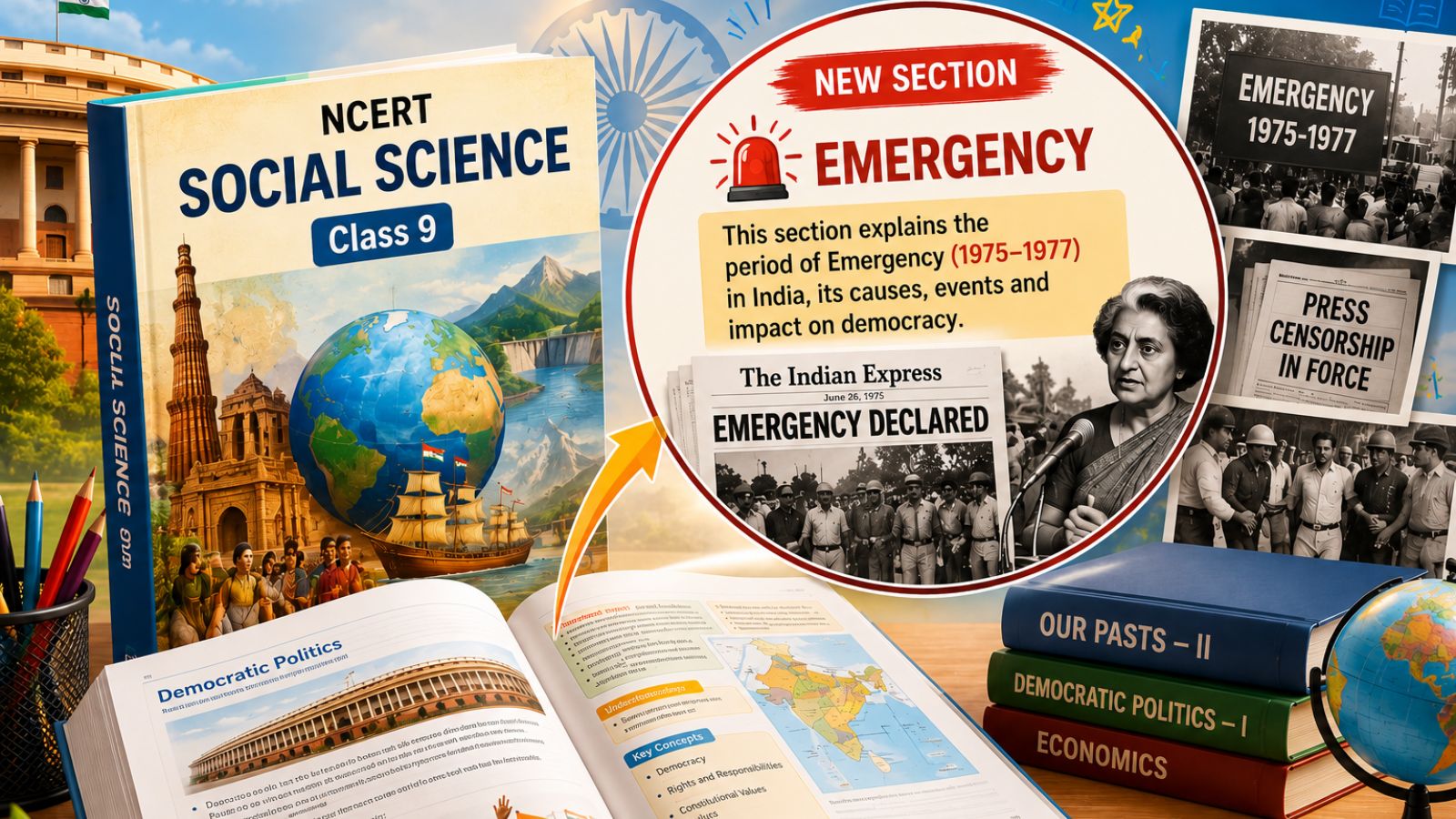
For the first time, the 1975-77 Emergency—a turbulent period in Indian history—has been included in a Class 9 Social Science textbook by the National Council of Educational Research and Training (NCERT). The new textbook, 'Understanding Society: India and Beyond', presents the Emergency as one of the major challenges Indian democracy faced and survived.
NCERT confirmed the addition to the news agency ANI, stating that the previous Class 9 textbook had no mention of the Emergency. The revised curriculum now includes a dedicated section on this period, coinciding with India crossing the 50-year mark since the Emergency was declared in 1975.
The chapter places the Emergency within a broader discussion of democratic strengths and vulnerabilities, treating it not as an isolated event but as a test of India's constitutional framework. It connects the political discontent of the early 1970s—marked by economic hardship, joblessness, and growing disillusionment with the Indira Gandhi-led government—to the events that followed.
The section reads: 'One of the major challenges to democracy in India was recorded when an Emergency was imposed in 1975-77. In the early 1970s, public dissatisfaction with the government led by Indira Gandhi was growing. Rising unemployment, inflation, and allegations of misgovernance led to widespread protests. In June 1975, a National Emergency was imposed by the government on the grounds of internal disturbance. During this period, a majority of Fundamental Rights were suspended, the press was censored, and numerous political leaders and activists were arrested. Democratic institutions came under severe strain, and citizens’ freedom was restricted.'
The chapter notably highlights Jayaprakash Narayan, the veteran socialist leader known as Lok Nayak. It states: 'Mass movements led by Jayaprakash Narayan mobilised students and citizens, especially in Bihar and Gujarat. The Emergency was lifted in 1977, and general elections were held, allowing people to express their will through the ballot. The defeat of the ruling government demonstrated the strength of Indian democracy and highlighted the importance of democracy.'
Rather than focusing solely on the Emergency, NCERT has integrated it into a wider conversation about threats to democratic systems, including fake news, misinformation, destruction of public property, poverty, regionalism, caste discrimination, and gender inequality.
A new section, 'Democracy and You', aims to help students connect abstract constitutional principles with their lived experiences. The textbook also traces the roots of democratic practice in India to ancient periods and discusses the media as the 'fourth pillar of democracy', emphasising its role in holding power accountable.