Kharge counters BJP: Gandhi, Nehru, Patel all sang Vande Mataram
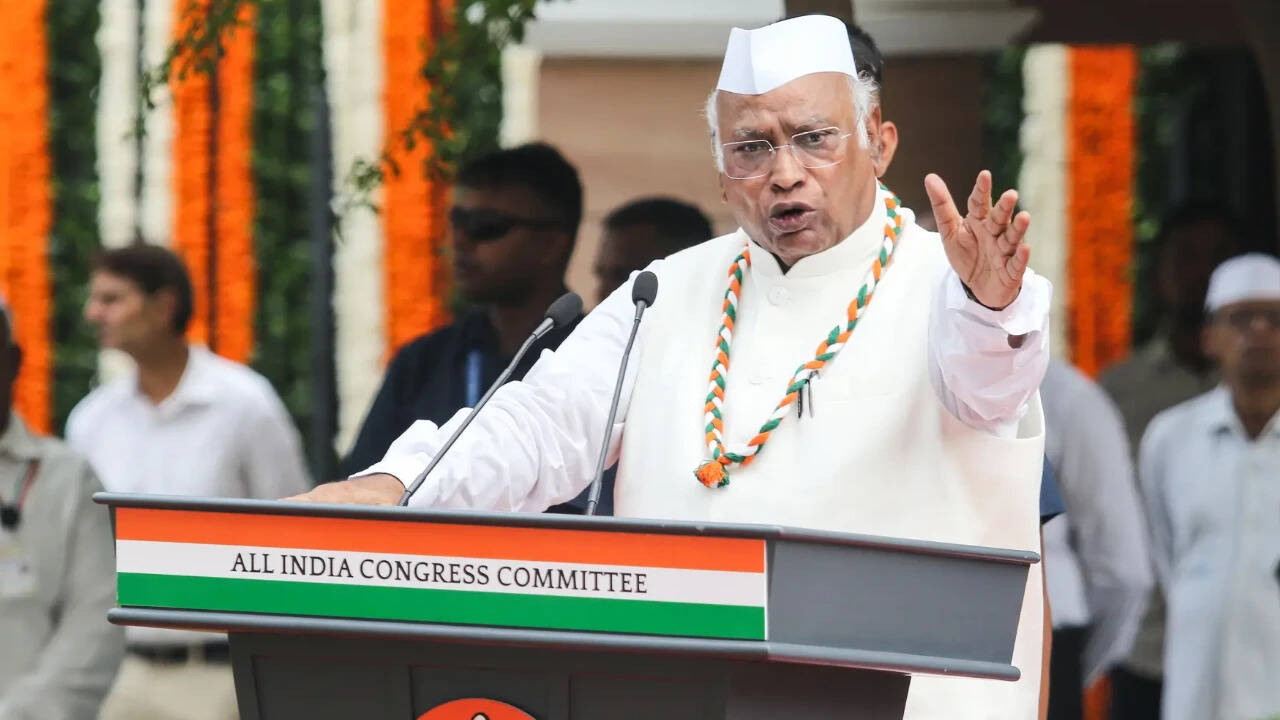
Congress president Mallikarjun Kharge has hit back at the Bharatiya Janata Party (BJP) amid a fresh row over the national song 'Vande Mataram', asserting that leaders like Mahatma Gandhi, Jawaharlal Nehru and Sardar Vallabhbhai Patel all sang the same Vande Mataram.
Kharge also referred to the Congress's historical role in deciding which national songs would be adopted, a role that the party has often cited to underline its contribution to India's freedom struggle and nation-building.
The dispute arose after recent remarks by political leaders over the importance of the national song. The BJP accused the Congress of showing disrespect towards the song, while the Congress countered by pointing to its leaders' role in the independence movement.
Vande Mataram, written by Bankim Chandra Chatterjee in the 1870s, became a central rallying cry in India's fight against British rule. It was widely recited at nationalist meetings and protests.
The song was formally recognised during the freedom struggle when the Congress Working Committee, in 1937, adopted the first two stanzas as the national song. After Independence, the Constituent Assembly continued the arrangement, designating 'Jana Gana Mana' as the national anthem and retaining the special status of Vande Mataram.
Historians note that the choice of national symbols was a carefully considered decision. The leaders of the freedom movement, including those from different political backgrounds, ultimately found a way to honour both songs, reflecting the diverse streams of the national movement.
During the Constituent Assembly debates in 1948-49, members discussed the status of Vande Mataram and Jana Gana Mana. The assembly eventually decided that both songs would hold a special place, with Jana Gana Mana as the national anthem and Vande Mataram as the national song. This decision was influenced by the fact that Vande Mataram's early verses were considered to have a martial and devotional character, while Jana Gana Mana had a more secular and inclusive tone.
Kharge's statement is part of a broader political argument over nationalist credentials. The BJP has frequently sought to position itself as the custodian of national symbols, while the Congress has pushed back by highlighting the historical contributions of its leaders.
The BJP has yet to respond to Kharge's latest remarks. Earlier, some BJP leaders had criticised the Congress for its past stance on the song, with allegations that the party had shown ambiguity.
This is not the first time Vande Mataram has become a point of contention in Indian politics. In 2002, there was a debate over whether the song should be sung alongside the national anthem at official events. At the time, leaders from both major parties expressed their respect for the song, while also acknowledging the distinct importance of both compositions.
Political observers say the current controversy is an example of how national symbols are used to assert ideological claims. However, they also caution that repeated disputes over such symbols may not resonate with voters who are more concerned with economic and social issues.
In defending the Congress's legacy, Kharge asserted that the song belongs to the entire nation, and not to any single party. His remarks are seen as an attempt to reclaim the nationalist narrative and to remind the public of the Congress's foundational role in India's identity.