India's IT Secretary: AI Will Create Jobs, But Humans Must Stay in the Loop
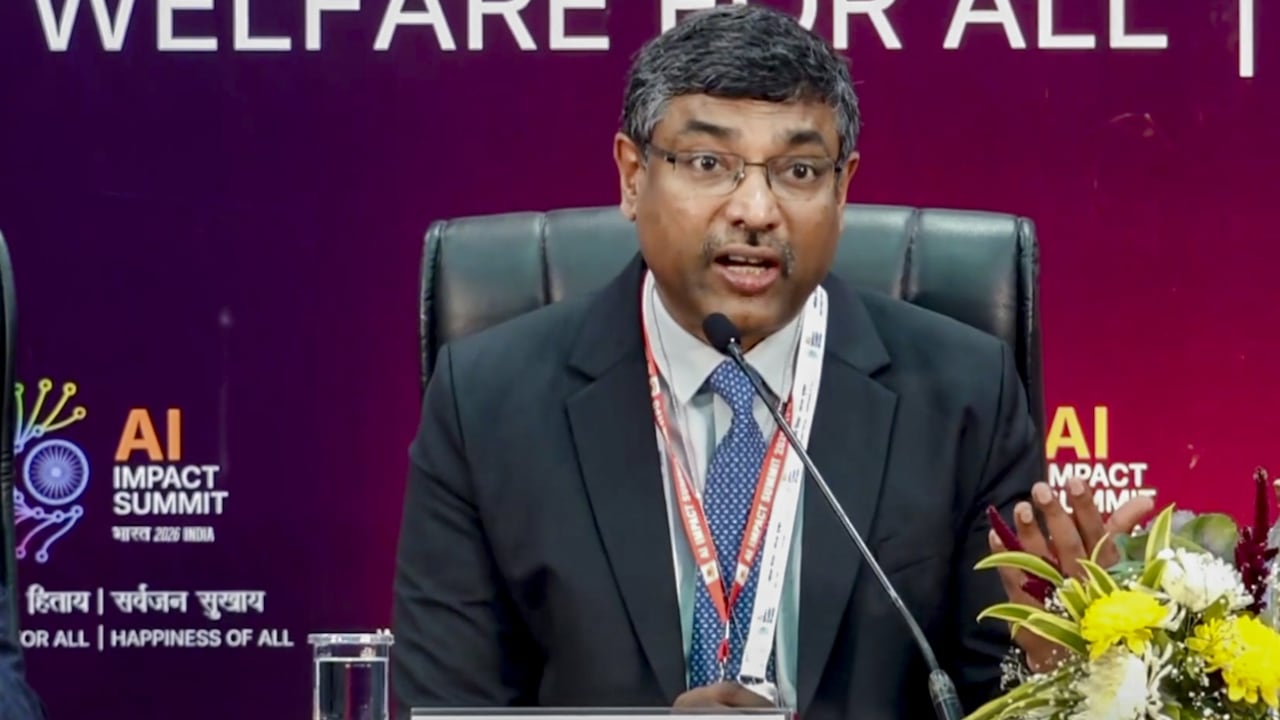
New Delhi, February 18: India's IT Secretary S Krishnan on Tuesday said that while artificial intelligence is advancing rapidly, humans must always remain in the decision-making loop to prevent unintended errors. Speaking at an event in the national capital, he also dismissed fears that mass AI adoption would lead to widespread job losses, arguing instead that the technology would create new opportunities, including high-end roles.
Krishnan, a Tamil Nadu cadre IAS officer, stressed the importance of human oversight. "We must ensure that there is always a human in the loop, to make sure that we don't accidentally get something wrong," he said. "And we do it in a way where using AI actually enhances the capacity of the person doing the job." His remarks come amid global debates over the safety and ethical implications of AI systems, particularly generative models that can produce human-like text and images.
The Secretary expressed confidence that AI could play a catalytic role in India's journey towards becoming a developed nation in the next two decades. He acknowledged that the government has improved governance but said much more needs to be done. "This is a constant and evolving challenge," he noted. "Governments are always resource constrained in terms of the number of people you can sit on some task, in terms of the funding that you have, in terms of how you can actually deliver better. AI gives us that opportunity of providing various governance services significantly better."
On the subject of 'sovereign AI', Krishnan said he prefers the term "strategic autonomy". He argued that India should avoid becoming overly dependent on any single country or company for AI technology. "We need to make sure that we don't become dependent on just one source or any one particular place," he explained. "You are interdependent. You will use inputs from a variety of sources, but you shouldn't become over-dependent or entirely dependent on any one source." He added that building trusted and diversified supply chains would reduce strategic dependence while keeping India integrated with the global AI ecosystem.
Krishnan also addressed the labour market impact of AI. "I, for one, certainly don't believe this is necessarily going to be entirely labour-replacing," he said. "I think it has the opportunity to create newer opportunities and different kinds of jobs, including jobs at the higher end." He reiterated that higher productivity driven by AI could help India move closer to its development goals.
Looking ahead, the IT Secretary described AI as a "once-in-a-generation opportunity" for India. "If we play this right, you have an opportunity to establish India as a country that builds AI-based applications and solutions for the rest of the world," he said.
On the question of a dedicated AI law, Krishnan said regulation will eventually become necessary. "Some kind of regulation will have to come in at some point in time... probably the time is now to start thinking about it," he remarked. His comments signal that the government is beginning to consider a legal framework for AI, even as it pushes for innovation and self-reliance in the sector.