Hayabusa2 to zip past asteroid Torifune at just 1 km on July 5
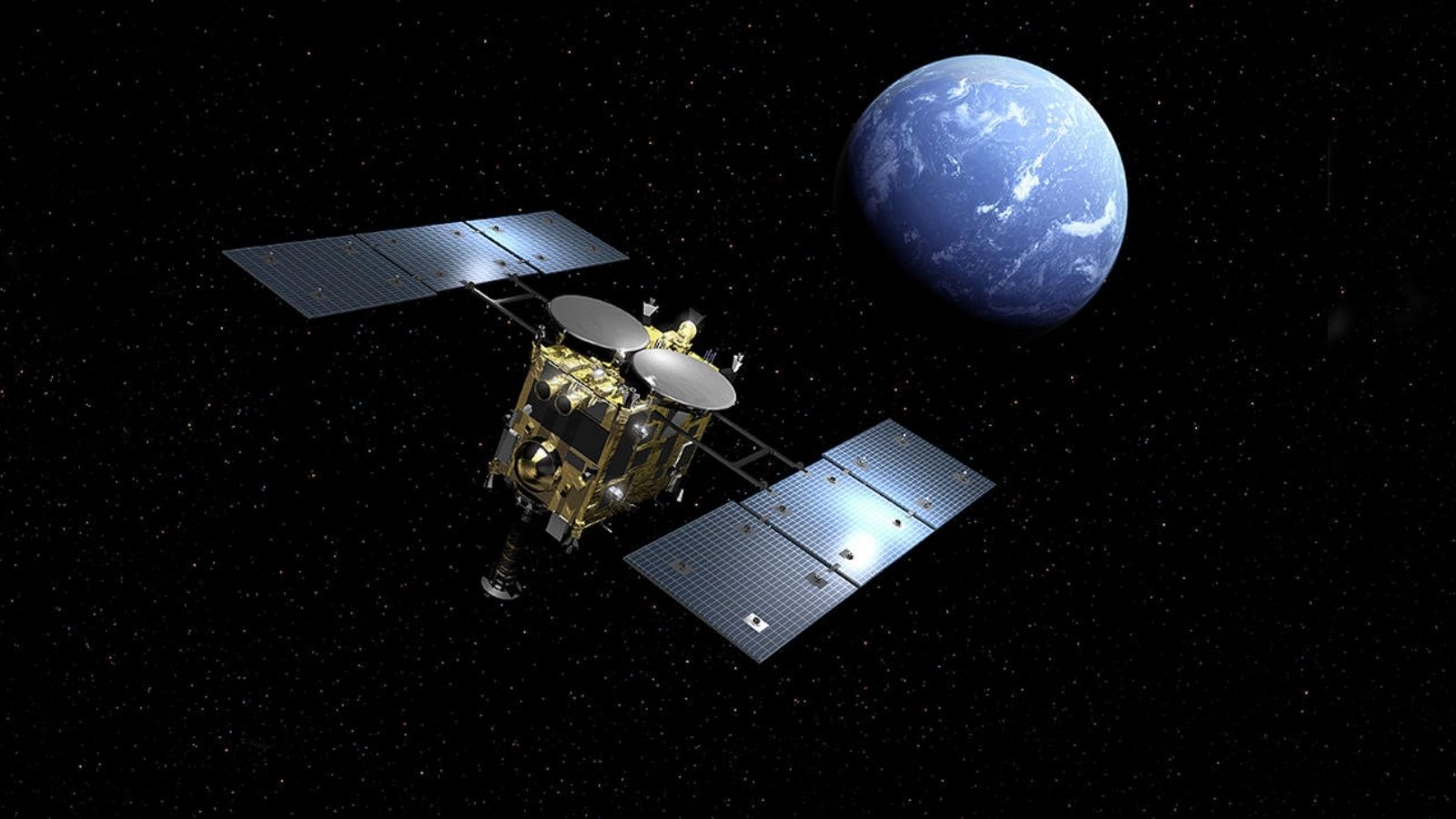
Japan's Hayabusa2 spacecraft is preparing for one of the closest asteroid flybys ever attempted, with a high-speed encounter scheduled for July 5. The mission will bring the veteran spacecraft within as little as 1 km of the near-Earth asteroid Torifune, offering scientists a rare opportunity to study a poorly understood space rock while testing technologies that could aid future planetary defence missions.
Hayabusa2, developed by the Japan Aerospace Exploration Agency (JAXA), was launched in 2014 and became one of the world's most successful asteroid missions after collecting samples from the asteroid Ryugu and returning them safely to Earth in 2020. Although its primary mission ended with the sample return, the spacecraft remains operational and is now undertaking an ambitious extended mission.
According to mission officials, Hayabusa2 will pass between 1 and 10 km from Torifune while travelling at around 5.3 kilometres per second. During the brief flyby, the spacecraft will use its onboard cameras and scientific instruments to capture images and gather data on the asteroid's composition, shape, and surface. JAXA's Satoshi Tanaka described the manoeuvre as one of the closest asteroid encounters ever attempted by a spacecraft in this category, speaking during a meeting of NASA's Small Bodies Assessment Group.
The mission relies on advanced autonomous navigation systems to guide Hayabusa2 precisely past the asteroid despite the extremely high relative speed.
Torifune, originally designated 2001 CC21, measures roughly 450 metres across but remains poorly understood. The asteroid was later named after a deity from Japanese mythology. Scientists believe it may resemble asteroid Itokawa, the target of Japan's first Hayabusa mission, but many uncertainties remain. Patrick Michel, principal investigator of the Hera mission and a member of the Hayabusa2 science team, said researchers may discover an entirely unexpected object. He noted that the asteroid's exact size and structure remain uncertain, adding that it could even be a contact binary: an object formed when two smaller bodies gently merged. Similar objects include Arrokoth, visited by New Horizons, and comet 67P/Churyumov-Gerasimenko, explored by Rosetta. "We're going to discover another beast to put in the zoo of asteroids," Michel said.
Because the spacecraft will be moving so quickly, scientists will have only a limited window to collect images and scientific measurements. Despite the short encounter, the flyby will also serve as an important demonstration of rapid asteroid reconnaissance techniques that could prove valuable for future planetary defence missions. Quickly assessing an asteroid's size, shape, and physical properties would be critical if humanity ever needed to deflect a hazardous object using methods similar to the Double Asteroid Redirection Test (DART), which successfully altered an asteroid's orbit in 2022.
The Torifune encounter is not expected to mark the end of Hayabusa2's journey. During its extended mission, the spacecraft has already conducted observations of zodiacal light and exoplanets while travelling through deep space. Its ultimate destination is asteroid 1998 KY26, which it is expected to reach in 2031. Measuring only around 11 metres across, it would become the smallest asteroid ever visited by a spacecraft. Mission planners are even studying the possibility of attempting a landing on the tiny rotating world. If successful, the extended mission will further cement Hayabusa2's place as one of the most accomplished asteroid exploration missions ever undertaken.







