Defence Minister Rajnath Singh terms Congress's Vande Mataram stand a 'very serious constitutional issue'

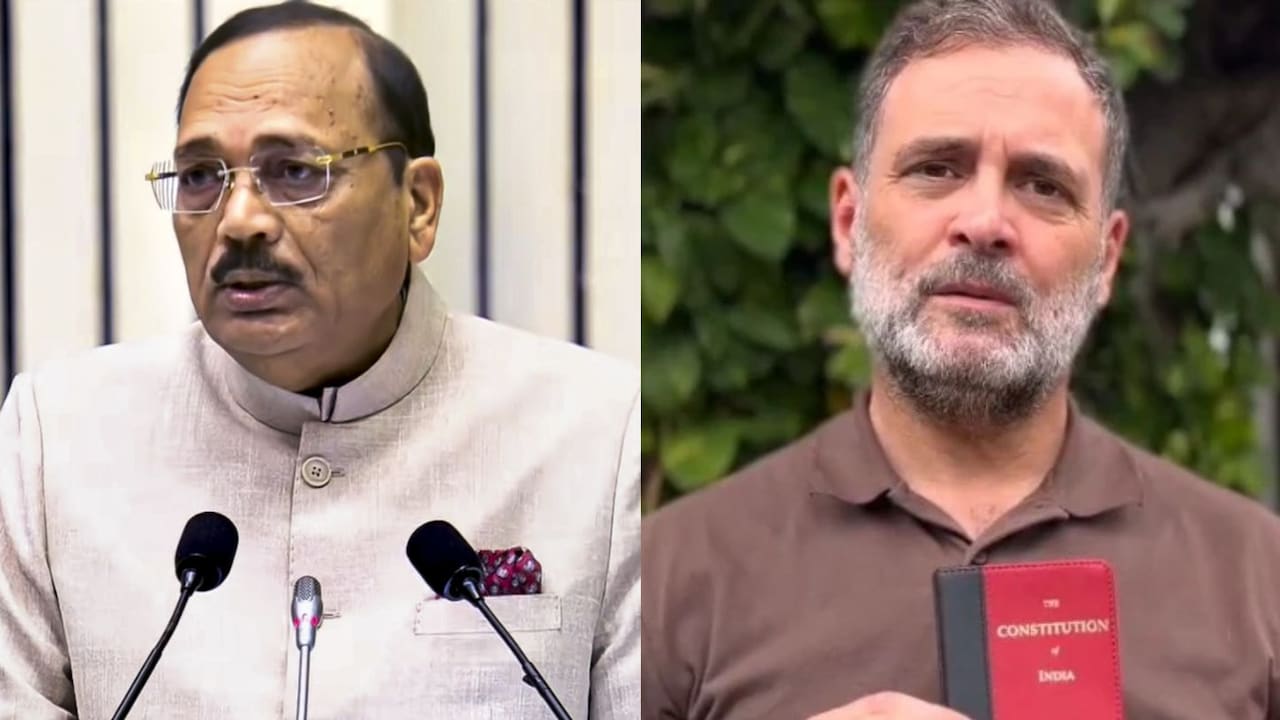
Defence Minister Rajnath Singh on Friday criticised the Congress party for its official position on the National Song, Vande Mataram, saying that the party's refusal to sing all stanzas of the song raises constitutional and political concerns.
Addressing a press conference in New Delhi, Mr. Singh said the Congress Working Committee's decision to sing only two of the six stanzas of the song at party events was a matter of deep regret. He described the stance as "extremely unfortunate" and a "very serious matter" from the constitutional perspective.
"The Congress formally refusing to respect Vande Mataram, and not merely refusing but directly opposing it, is extremely unfortunate," Mr. Singh said. "Parliament is the supreme institution of the country as per the Constitution, and any law passed by it is binding on every individual. If anyone refuses to abide by it, then certainly their allegiance to the Constitution comes under a cloud of suspicion," he added.
The Defence Minister further stated that refusing to respect the National Song brings into question a person's patriotism. He noted that the Congress Working Committee's 1937 resolution to sing only two stanzas was passed under pressure from the Muslim League's "extremist demands." He drew a historical connection, arguing that compromising with such elements had led to the Partition of India.
"Compromising before extremist elements has always proved disastrous for the country, and today, when the Congress is surrendering to extremist elements in the same manner, it is a sign of a serious threat to the future of the country," he said. Mr. Singh described the Congress's decision as "completely unconstitutional and condemnable" and warned that it could create a serious political crisis.
The controversy dates back to 1937, when the Congress Working Committee, in a resolution, decided that only the first two stanzas of Vande Mataram should be sung at party functions. This was done amid concerns raised by some Muslim leaders over certain references in the song. The song, written by Bankim Chandra Chattopadhyay in his novel Anandamath (1882), was adopted as the National Song by the Constituent Assembly on January 24, 1950, alongside the National Anthem, Jana Gana Mana.
Vande Mataram has historically been a unifying yet debated symbol in Indian public life. The Constituent Assembly's decision recognised the song's significance while also acknowledging that it does not have the same status as the National Anthem. Over the years, various political parties have interpreted its singing in different ways.
Mr. Singh's remarks come ahead of the next general election, where questions of nationalism and constitutional values are likely to play a prominent role. The Congress party has not yet issued an immediate response to the Defence Minister's latest statement. Party sources, however, have in the past defended the 1937 resolution as an act of historical accommodation, arguing that the first two stanzas hold the essence of the song.
The Defence Minister, without naming any individual, said that the Congress's approach reveals its "thoughtless and dangerous intentions" and that the party's position on the National Song reflects a deeper pattern of political convenience. He urged all political parties to respect the symbols of national identity as enshrined in the country's constitutional traditions.
This development adds to the ongoing political discourse over national symbols and their role in public life, with the government frequently stressing the importance of respecting the National Song and Anthem. Meanwhile, constitutional experts point out that the National Song, while not part of the Constitution's text, is recognised by a resolution of the Constituent Assembly. The legal and political implications of the Congress's position are likely to be debated in the coming days.