Christopher Nolan’s ‘The Odyssey’: India to screen digital version as analog IMAX projection faces hurdles
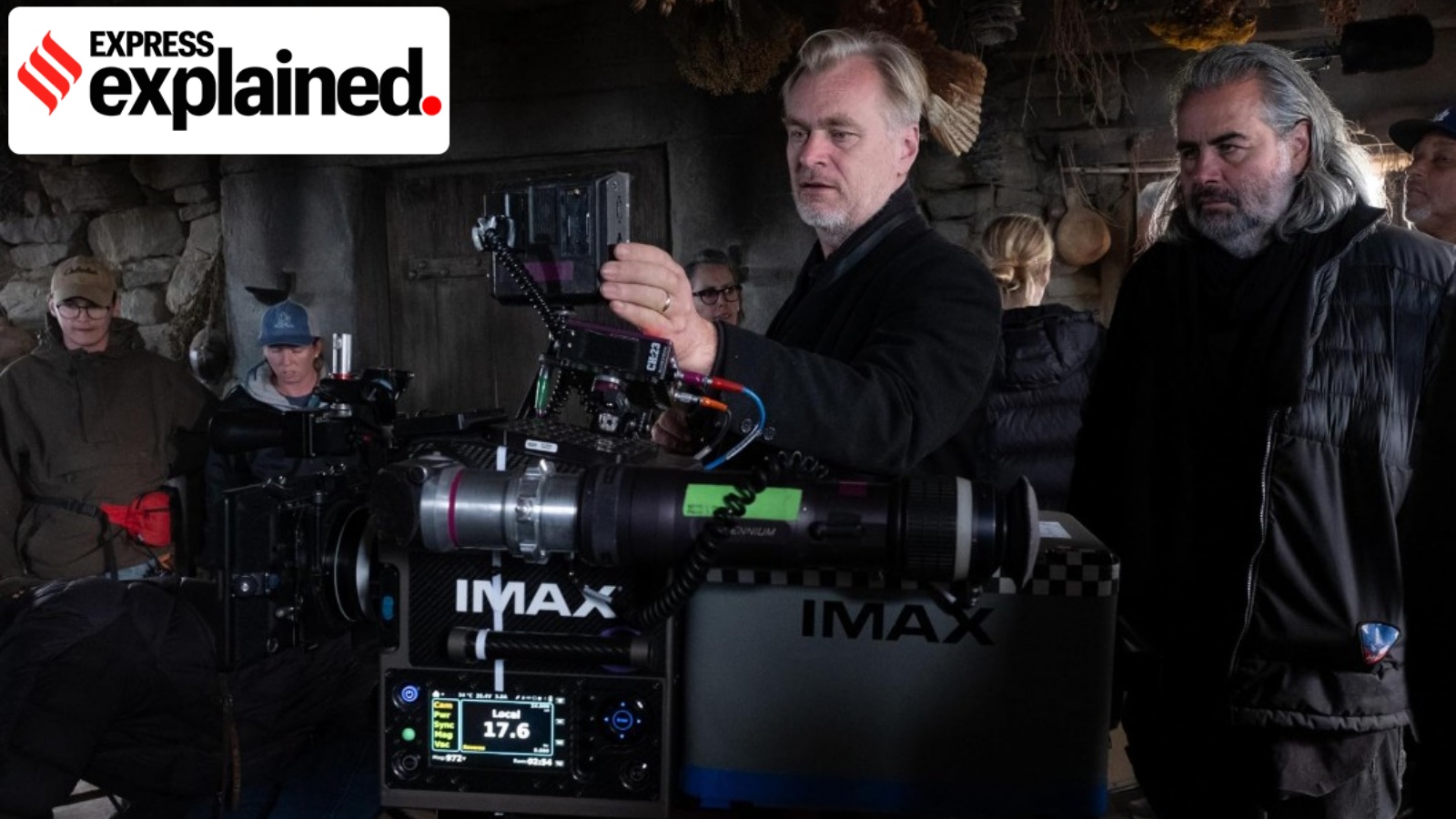
Christopher Nolan’s latest film, ‘The Odyssey’, makes its debut today, marking a landmark in cinema as the first full-length feature shot entirely on IMAX cameras. Nolan has long advocated for watching his films in the immersive 15-perforation/70mm film format, which delivers an image resolution equivalent to 18K and a 1.43:1 aspect ratio that fills the entire IMAX screen. However, Indian audiences will only have access to digital versions of the film, owing to technical, architectural, and economic constraints faced by multiplex operators in the country.
Understanding the IMAX analog format
The 15-perforation/70mm film reel refers to a physical strip 70mm wide, with 15 sprocket holes along its edge to advance the frame during projection. This format yields an image that is roughly ten times larger than a standard 35mm film frame, resulting in exceptional detail and clarity. The aspect ratio of 1.43:1 makes the image appear taller and more square compared to the typical rectangular screens in most theatres.
Using IMAX cameras presents challenges due to their size, weight, and loud internal motors. Nolan collaborated with the IMAX team to develop the ‘Keighley Camera’, housed in a carbon-fibre casing called ‘The Blimp’, which reduces motor noise by 30-50%.
The analog post-production process
‘The Odyssey’ used an analog-only post-production pipeline, with minimal digital intervention for visual effects. The original colour negative (OCN)—the film strip exposed inside the camera—was physically cut and spliced together by hand at FotoKem labs in Burbank, California. Andrew Oran, Senior Vice President at FotoKem, confirmed that all 70mm/15-perf prints were made from the original cut negative.
The process involves developing the raw film, digitising scenes requiring VFX, printing them back onto film, and then physically cutting and splicing the negatives. A photochemical colour correction is done using light tables and physical filters, followed by contact printing onto positive film stock to create release prints. Each 70mm/15-perf print costs the same to produce, says Oran.
Why India cannot show analog IMAX
Indian multiplexes are not equipped with the specialised projectors needed to screen 15-perforation/70mm film. The projectors are large, expensive, and require trained personnel to handle the heavy reels, which can be over 100 kilograms. Additionally, most IMAX screens in India are in commercial multiplexes designed for digital projection, with retrofit limitations. The cost of installing and maintaining analog projection systems, coupled with the limited number of prints available, makes it economically unviable for Indian exhibitors.
As a result, Indian audiences will view the film in digital IMAX or standard digital formats, offering a lower resolution (typically 2K or 4K) and the standard 1.90:1 or 1.85:1 aspect ratio. While the digital version will still provide an excellent experience, it will lack the visual fidelity and immersive quality of the analog version.
Nolan’s commitment to analog filmmaking underscores his belief in preserving traditional techniques. However, the realities of exhibition infrastructure in markets like India mean that many viewers will experience ‘The Odyssey’ differently than intended. The film’s release highlights ongoing tensions between artistic vision and commercial practicality in the global cinema landscape.







