China Deploys 11 J-20 Stealth Jets at Bases Facing India; India's Counter Years Away
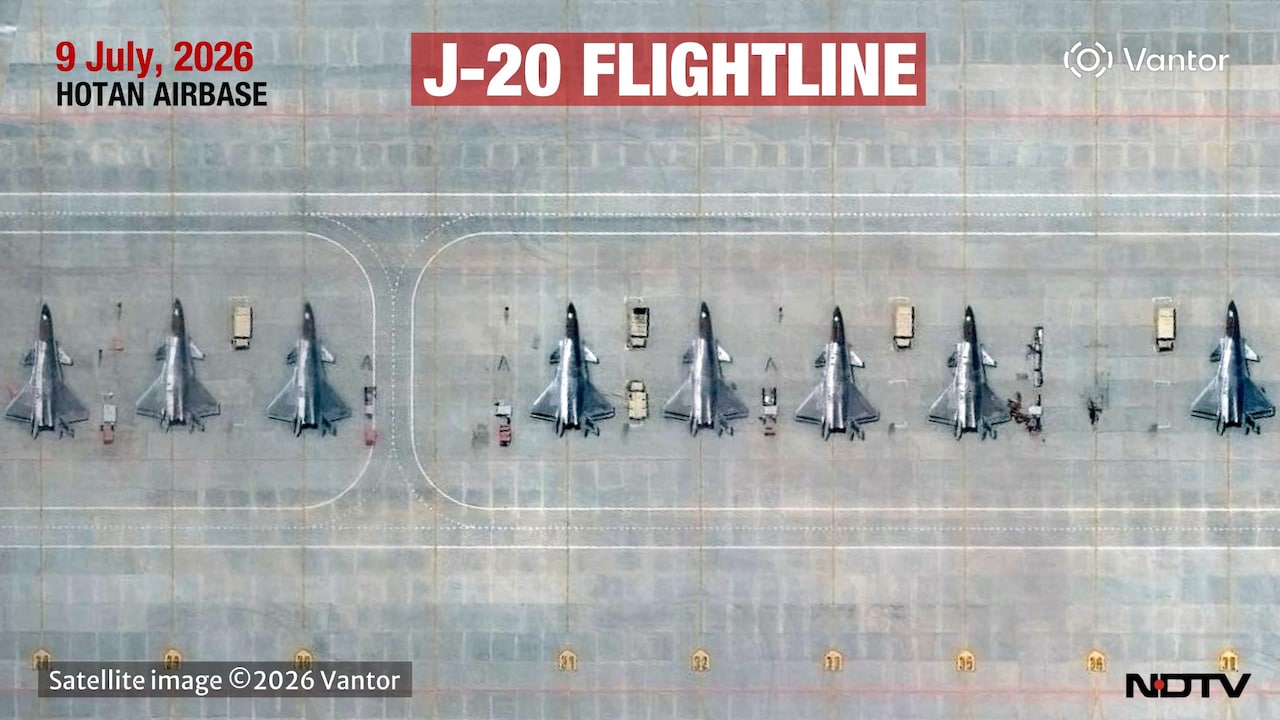
China has increased operational deployments of its J-20 'Mighty Dragon' stealth fighter jets at airbases positioned opposite India, according to satellite imagery analysed by Vantor and published on July 2025. The images show eleven J-20s across two air bases in late June and early July.
On July 9, seven J-20s were spotted on the tarmac at Hotan airbase in the Xinjiang Uyghur Autonomous Region. The base is located 389 kilometres northeast of Leh and 245 kilometres northeast of the Indian Air Force (IAF) airfield at Daulat Beg Oldie in north Ladakh. This is the largest number of J-20s sighted at any Chinese airbase in commercial satellite imagery to date.
A second image from the same period shows four J-20s on the flightline at Damxung airbase in the Tibetan Lhasa prefecture, 344 kilometres northwest of Tawang in Arunachal Pradesh.
Sameer Joshi, a former fighter pilot and co-founder of NewSpace, an Indian aerospace and defence R&D company, said: "Seven J-20s at Hotan and four at Damxung confirm that fifth-generation operations from high-altitude bases facing India are now routine for the PLAAF. For the IAF, a low-observable threat on the northern front is now the baseline, sharpening the urgency of counter-stealth sensors, integrated air defence and standoff strike capability."
The J-20's stealth characteristics give it a significant advantage over current IAF fighter jets, including the non-stealth Dassault Rafale. Its advanced shaping reduces radar cross-section, allowing it to dominate contested airspace.
India does not currently operate any stealth fighters. Its indigenous Advanced Medium Combat Aircraft (AMCA), expected to be the country's first stealth jet, is at least a decade away from squadron service, pending successful validation of key technologies in an extensive flight-test programme.
China's J-20 fleet has grown rapidly. According to a report in The War Zone, the number increased from roughly 50 in 2019 to about 200 by late 2022, with production estimates doubling thereafter. By late 2025, annual output was running at around 120 jets, pushing the fleet to an estimated 300–500 aircraft across more than a dozen PLAAF units by mid-2026. The UK-based Royal United Services Institute projects China could field around 1,000 J-20s by 2030.
Air Marshal Narmdeshwar Tiwari (retired), former Vice Chief of the Air Staff, said: "Having a capacity to produce 125 planes per year speaks volumes of their advanced manufacturing capability. They are producing it almost like commercial aircraft, which can only happen when the supply chain is fully integrated, very exacting manufacturing tolerances are met by all suppliers, and top quality human resource is available. In short, they envisioned a national roadmap, put an empowered team to execute it, and provided persistent support. It has been a national mission for them."
The deployment underscores the growing asymmetry in air power along the Himalayan frontier, with India yet to field a comparable stealth platform.