Bengaluru startup builds 'power bank' satellites to extend life of ageing spacecraft
BENGALURU: A Bengaluru-based space startup is developing a novel solution to one of the satellite industry's costliest problems: what happens when a perfectly functional satellite runs out of fuel. Aule Space is building small 'jetpack' satellites designed to dock with ageing spacecraft and take over their propulsion, potentially keeping multi-million-dollar assets operational for years longer.
For satellite operators, the end of propellant often means the end of a mission, even if the satellite's communication payloads are working perfectly. Geostationary communication satellites must maintain precise orbital positions to beam signals to Earth. When station-keeping fuel is exhausted, operators are forced to retire assets that may have cost over $300 million to build and launch, and which generate significant annual revenue.
Aule Space aims to change this with a concept its CEO Jay Panchal describes as a 'power bank' for satellites. Instead of attempting the complex and risky task of refuelling spacecraft in orbit, the startup plans to send a smaller, dedicated 'jetpack' satellite that docks with an existing communications satellite and uses its own propulsion system to maintain the satellite's orbital slot.
The challenge lies in docking with satellites that were never designed for in-orbit servicing. Most geostationary satellites lack standard docking ports. Aule's solution is to attach its spacecraft to the liquid apogee motor (LAM) nozzle, a common external feature found on most geostationary satellites. This approach allows the company to service a wide range of existing spacecraft without requiring dedicated hardware.
According to Panchal, a single docked 'jetpack' could extend a satellite's operational life by up to five years, allowing operators to continue generating revenue from assets that would otherwise become orbital relics.
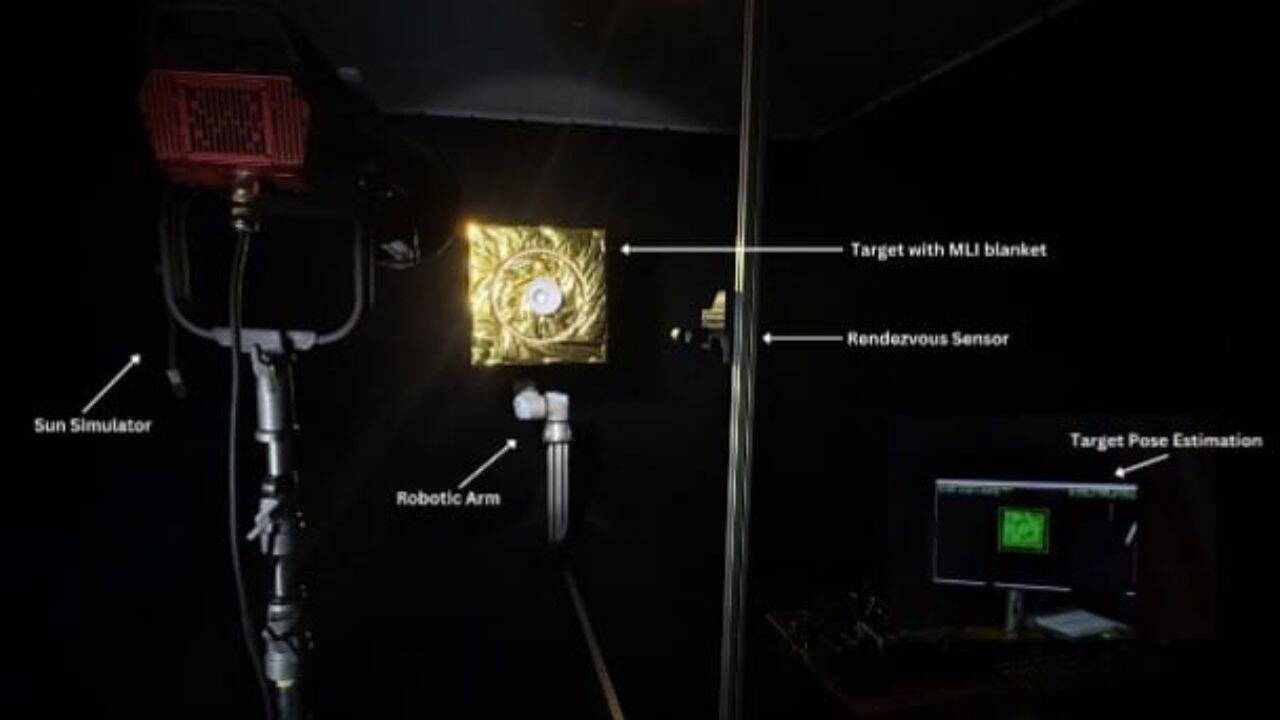
The company recently achieved a significant milestone by testing its camera-based guidance, navigation and control system at the Rendezvous Simulation Laboratory (RSL) at ISRO's ISITE facility in Bengaluru. This is the same laboratory where critical elements of India's SpaDeX docking mission were validated. Aule Space says it is the first non-government entity to access the facility.
'This is the best kind of on-ground testing we can do for these capabilities,' Panchal said, referring to the laboratory's ability to simulate on-orbit lighting conditions and target motion using a sun simulator and a robotic arm.
One of Aule's key differentiators is its reliance on computer vision rather than a suite of specialised sensors. While current docking systems typically use LiDAR, infrared cameras and other equipment, Aule's spacecraft will perform the critical final approach using a single optical camera aided by onboard artificial intelligence. The visual navigation models are trained using data generated in the startup's own facilities and validated at ISRO's testbed before deployment in orbit.
Looking ahead, Aule Space is targeting an in-orbit demonstration next year. The company plans to launch two satellites that will autonomously dock in low-Earth orbit (LEO). Panchal claims this could be the world's first private mission to perform non-cooperative docking in LEO using camera-only navigation. The mission will validate technologies that Aule ultimately intends to deploy around geostationary orbit, where most commercial communication satellites operate.
The development comes at a time when the global space industry is increasingly exploring in-orbit servicing solutions. With hundreds of geostationary satellites approaching the end of their fuel reserves, technologies like Aule's could play a crucial role in extending the life of critical space infrastructure while reducing the need for costly replacements.