Andhra Tribal Woman Carried 11 km on Cot as Poor Roads Block Ambulance
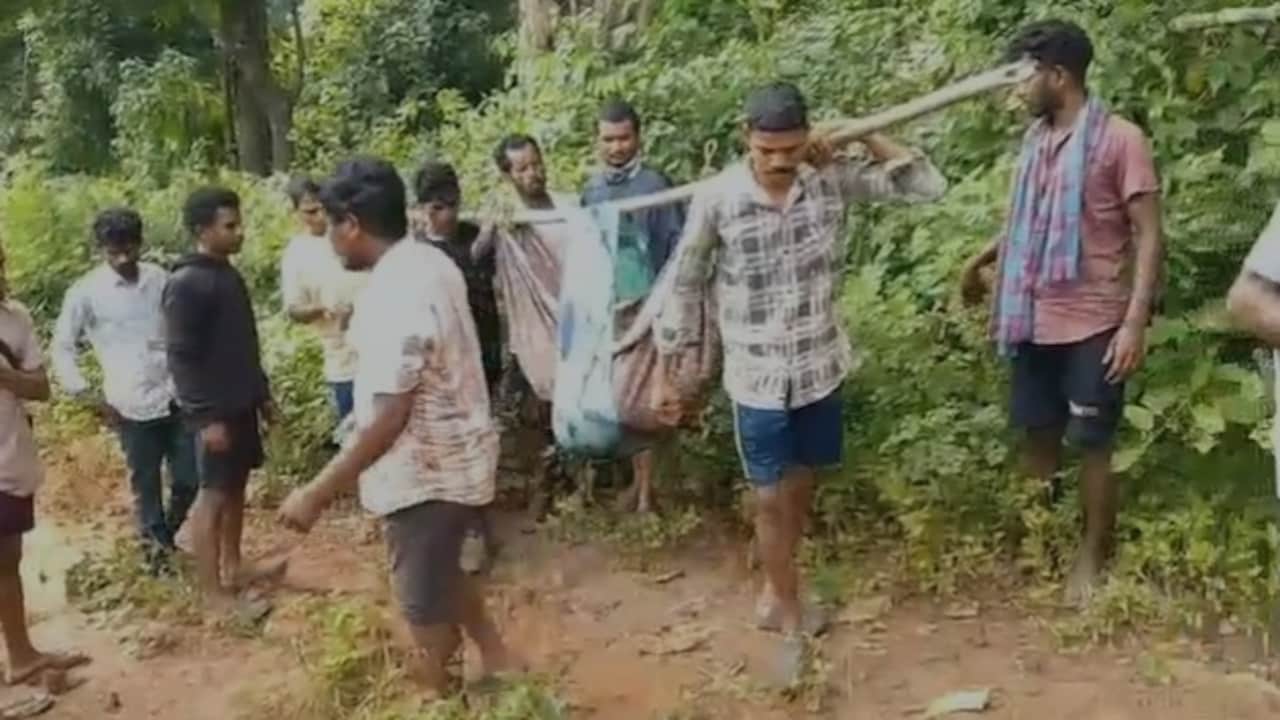
A tribal woman from a village in Andhra Pradesh's Koyyuru mandal had to be carried on a doli for nearly 11 kilometres to reach an ambulance, underscoring the severe road connectivity problem in the remote Alluri Sitharama Raju district.
On Sunday, Korrabu Padma fell ill and her condition worsened. As no vehicle could reach the village, family members and fellow villagers carried her on a doli from Marripakalu to Palakajeedi, covering the entire distance on foot. She was later shifted to an ambulance and taken to Y Ramavaram Area Hospital for treatment.
Villagers said the road from Marripakalu is in a severely deteriorated state, with rocks, potholes, muddy stretches, sharp curves and uneven sections. During the rainy season, the route becomes almost impassable, creating serious difficulties in taking patients to hospitals in time.
Residents said the village has been grappling with this road problem for decades. They have demanded that the government sanction and construct a proper tar road at the earliest. They also appealed to Deputy Chief Minister Pawan Kalyan and the state government to take immediate action.
The incident comes at a time when the state government has announced several measures to improve facilities in tribal areas. Chief Minister Chandrababu Naidu has said the government is working to ensure safe drinking water and housing for every tribal family by 2027. He noted that feeder ambulances, 108 emergency services and 104 mobile medical units are being arranged to reduce the need for patients to be carried manually.
The Chief Minister also mentioned that road connectivity is being improved in 2,336 tribal habitations, and that 905 km of roads have been laid under the 'Adavi Talli Bata' programme.
On August 29, the Chief Minister launched a drone-based medical transport service for remote tribal areas. According to Health Minister Satya Kumar Yadav, the drone health system began operations in January 2026 in Alluri Sitharama Raju district. Four drones have made more than 1,800 trips and travelled over 71,000 kilometres so far. More than 2,200 medical samples, including 596 sickle-cell samples, have been transported through this service.
The Health Department said the service has supported over 24,500 patients and enabled more than 9,000 tests. Drones are being used to carry medical samples, medicines, vaccines and other essential supplies to remote areas. Eight health facilities, including Paderu Government General Hospital, primary health centres at Lothugedda, Tajangi, Sunkarametta, Bhimavaram and Ananthagiri, Munchingiputtu CHC, and hospitals at Chintapalli and Araku, have been connected to the drone network.
The government says the system is saving travel time and costs and helping tribal patients access medical services faster. Additionally, more than 25 local and tribal youth have been trained to support drone operations.
While the introduction of drone services and improved road schemes reflects a step forward, the latest incident in Marripakalu serves as a reminder that much more needs to be done to ensure that no patient is forced to endure an 11-km journey on a cot to reach basic medical care.