Yamuna's floodplains in Delhi shrank by a third in a century, study finds link to higher flood risk
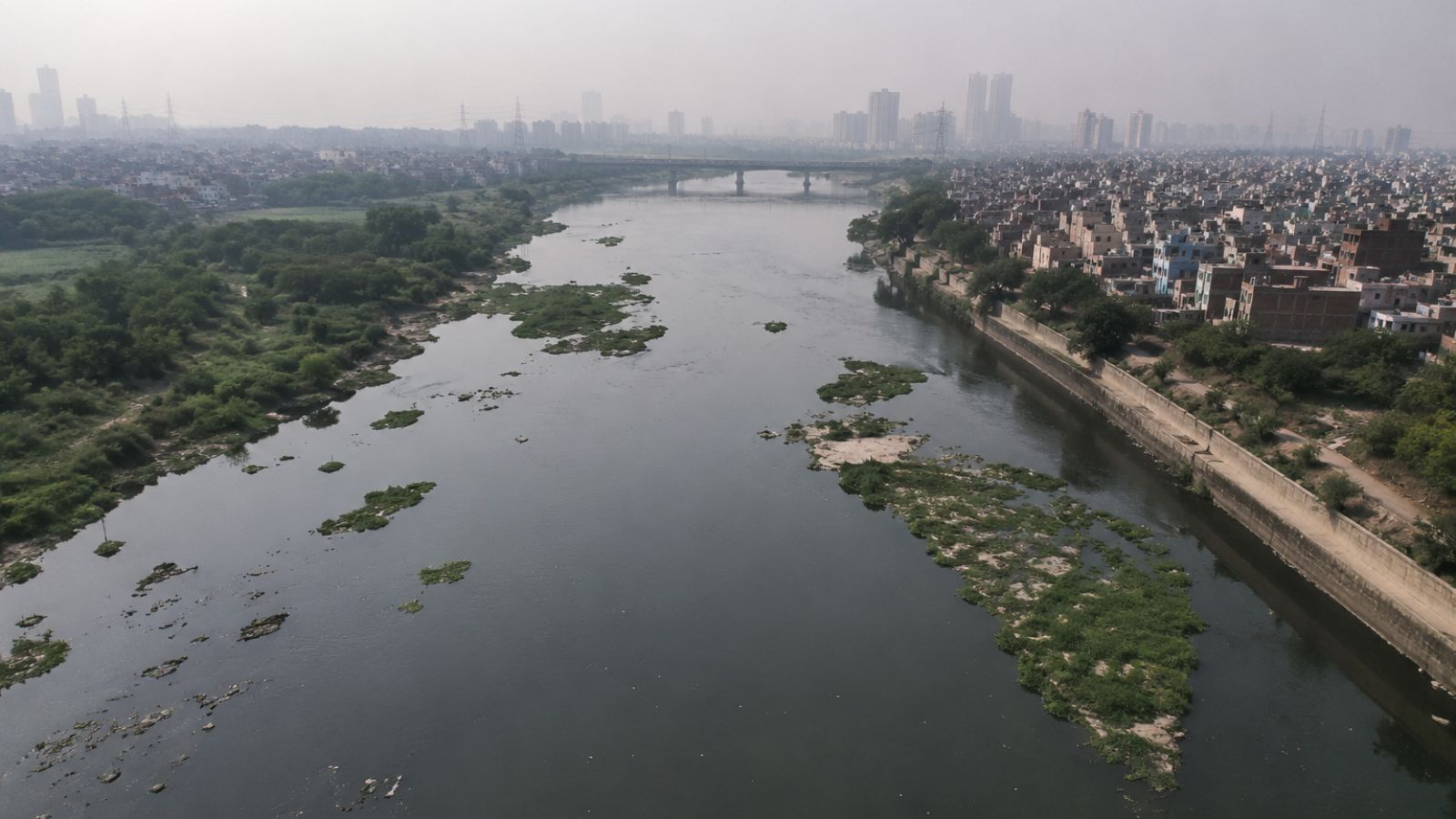
A new study has revealed that the Yamuna's floodplains in Delhi have shrunk by approximately one-third over the last century, a change that researchers link to increased flood vulnerability in the capital. The study, published in April in the Journal of the Geological Society of India, was conducted by scientists from the University of Delhi (DU) and the Indian Institute of Science Education and Research (IISER), Bhopal.
Using historical maps dating back to 1799, Survey of India records, and satellite imagery up to 2024, the team analysed a 50-kilometre stretch of the Yamuna flowing through Delhi. They reconstructed the river's evolution over more than two centuries, focusing on changes in its width, flow, and land use.
The study estimates that rapid urbanisation has narrowed the river's channel by about 68 percent and reduced its long-term channel-maintaining discharge — known as formative discharge — by nearly 89 percent. Formative discharge is the average flow that shapes a river's channel over decades, helping to remove sediment and maintain capacity to handle heavy rains.
Comparing floodplain maps from 1912 with current data, the researchers found that around 45 square kilometres, roughly one-third of the river's floodplains in Delhi, have been disconnected by embankments. These areas have since been used for agriculture, settlements, and infrastructure, reducing the river's natural space to spread during floods.
The construction of barrages — notably at Tajewala, Wazirabad, and Okhla — has been a key factor in altering the Yamuna's flow. Nearly 90 percent of the river's water is diverted at the Hathnikund Barrage upstream, leaving the Delhi stretch with little freshwater during the dry season. The study describes this stretch as 'an ideal example of an anthropogenically modified river reach.'
The research also documents a sharp decline in sediment deposits within the river, which shrank from about 20 square kilometres in 1985 to roughly 4 square kilometres in 2020. Much of this area has been converted for agriculture and other uses.
The implications of these changes became clear during the July 2023 floods. Although the 2023 flood carried less water than the major flood of 1978, the Yamuna reached a higher water level in Delhi. According to the study, embankments and urban development have constricted the river corridor, forcing floodwaters into a narrower channel instead of allowing them to spread laterally across floodplains. 'The consequences of these developments have reduced the natural buffer capacity of the Yamuna River corridor, thereby increasing the vulnerability to flooding events,' the paper states.
Vimal Singh, a faculty member at DU's Department of Geology and one of the study's authors, emphasised that the research estimates the river's long-term flow responsible for maintaining its channel, not recent discharges. He noted that ensuring environmental flows remains essential for sustaining aquatic ecosystems, but added that restoring the Yamuna can no longer be viewed solely through that lens.


