UN Welcomes Iran-UAE Meeting at BRICS Summit, Says India Can Be a 'Bridge-Builder'
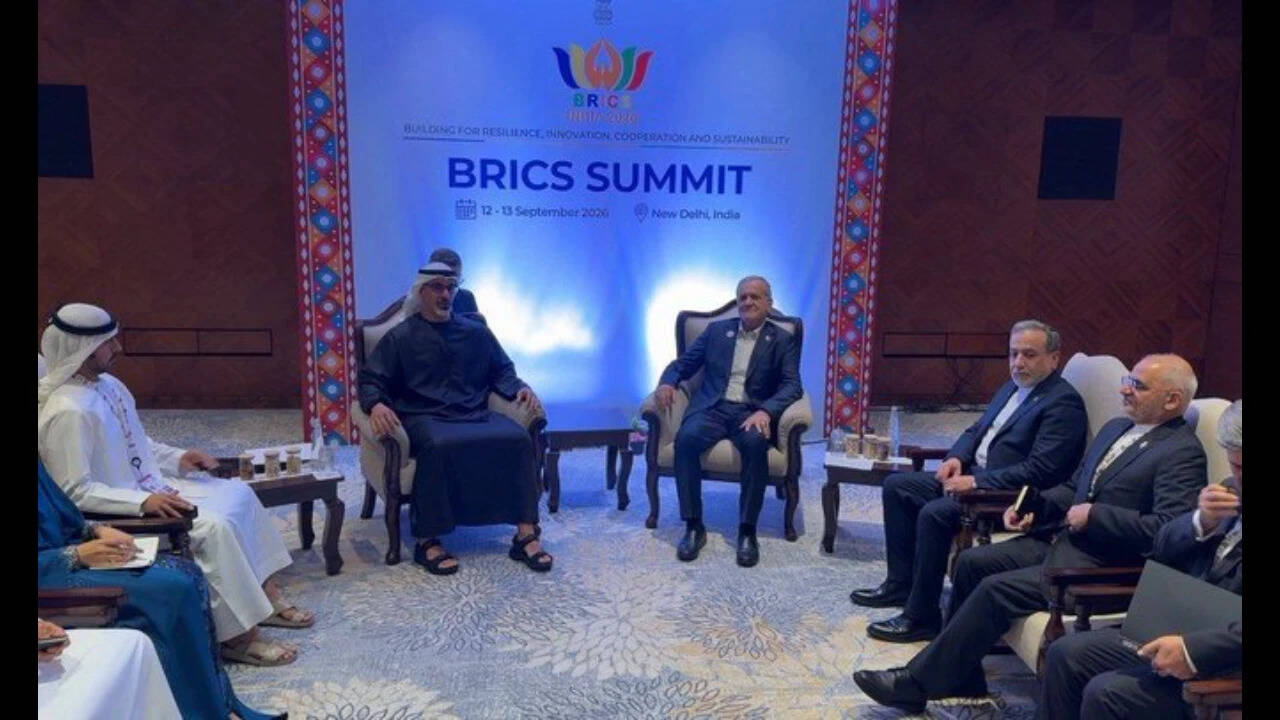
The United Nations has welcomed the meeting between Iranian President Masoud Pezeshkian and Abu Dhabi Crown Prince Sheikh Khaled bin Mohamed bin Zayed Al Nahyan on the sidelines of the BRICS Summit, describing direct engagement between parties in conflict as essential.
Asked about the encounter, Stéphane Dujarric, spokesperson for the UN Secretary-General, said on Saturday: "I think it is very important that they meet. Whenever there is a conflict, it is very important that parties that are in conflict meet."
Dujarric linked the contact to the wider diplomatic role India could play in the region. "I think it goes back to what I said earlier about the potential and role that India can play as a bridge-builder in trying to end this conflict," he said.
India, a founding member of BRICS, has long maintained independent ties with both Iran and the Gulf states and has consistently called for dialogue and de-escalation in West Asia. New Delhi has also backed a two-state solution to the Israel-Palestine question.
Both Iran and the United Arab Emirates became part of the BRICS grouping in January 2024, during the bloc's first major expansion since its formation. Their presence at the same summit, and the reported contact between their leaders, is notable for a region that has seen years of strain between Tehran and its Arab neighbours. Iran and the UAE moved to restore diplomatic ties in 2023 after a period of rupture, and the UAE remains one of Iran's largest trading partners.
Turning to Gaza, Dujarric urged all sides to implement a peace plan that, he said, had been put forward by United States President Donald Trump and endorsed by the UN Security Council. "There is a Security Council Resolution that has included a peace plan which is put forward by President Trump and endorsed by the Security Council. It is vital that all parties put into action this peace plan," he said.
He described the humanitarian situation in Gaza as "beyond words", adding that continuing instability in Gaza and the West Bank needed to be addressed. Dujarric stressed that the international community must not lose sight of the goal of a two-state solution.
Diplomats have frequently pointed to India's ability to engage with a wide range of actors in West Asia. New Delhi has publicly urged restraint, the protection of civilians and the delivery of humanitarian aid, while continuing its own engagement with Israel, Iran and the Gulf states.
UN officials have repeatedly cautioned that no single meeting can resolve the region's disputes. The significance of the Iran-UAE contact at the summit lies in its symbolism as much as its substance — a signal that channels of communication remain open at a time when they are scarce.
Whether such contacts lead to concrete outcomes remains to be seen. For now, the UN's message is that dialogue, however limited, is preferable to its absence, and that countries such as India, which maintains ties across divides, can help keep those channels open.