Trump's decoy flight underscores security fears in Iran conflict
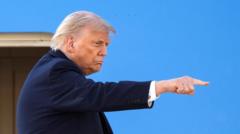
US President Donald Trump quietly used an alternate aircraft on his return from a Nato summit in Turkey last month, a move that has drawn attention to the personal security concerns surrounding the American military campaign against Iran.
The decoy flight, reported this week, saw the president depart separately from the media and most White House staff, who flew on the presidential Boeing 747, Air Force One. The president's use of a different plane is a known security tactic, but in the context of an ongoing war with Iran, it has been interpreted as a sign of the perceived threat against him.
The conflict began in February after an Israeli airstrike, conducted with US approval and co-ordination, killed Iran's Supreme Leader, Ayatollah Ali Khamenei, and other senior Iranian officials. In the days that followed, President Trump made a phone call to ABC correspondent Jonathan Karl, in which he said: "I got him before he got me. They tried twice. Well, I got him first." The remark drew a direct link between the airstrike and previous threats and alleged plots that Iranian elements had made against him.
Since then, Mr Trump has avoided repeating such comments in public, but Defence Secretary Pete Hegseth has echoed the sentiment. In March, Mr Hegseth said, "Iran tried to kill President Trump, and President Trump got the last laugh," adding that an Iranian who was believed to lead an assassination unit had been killed in US strikes. These statements suggest that senior US officials regard the conflict as having a personal dimension, tied to the president's safety.
The White House has not officially confirmed the reason for the alternate aircraft. However, the incident has prompted discussion among security analysts about the precautions taken during wartime presidencies. Using a decoy plane is a standard measure to reduce the risk of targeting, but it also signals that the threat environment is considered serious enough to warrant such steps.
The broader context is a six-month-old war that has involved sustained US military operations against Iranian targets. The conflict has led to significant casualties and has raised concerns about regional stability. The personal element, as highlighted by the president's own words and the security arrangements, adds another layer to an already complex situation.
The disclosure of the plane swap comes from a report by ABC News, which noted that the president left the summit separately from the press pool. Such arrangements are not unprecedented, but they rarely become public. The timing – amid ongoing hostilities – has led to renewed attention on the risks faced by US leaders.
Observers note that assessments of Iranian intentions are based on intelligence that is often incomplete. The claims of assassination plots have not been independently verified, and Iranian officials have denied such designs. Nevertheless, the administration's actions indicate that it takes the threat seriously.
The war itself remains a subject of debate within the United States and internationally. Critics have questioned the legality and wisdom of the campaign, while supporters argue that it was necessary to address what they describe as Iranian aggression. The personal safety of the president is one element of that larger policy debate, but it is not the primary justification offered by the administration.
As the conflict enters its seventh month, the use of a decoy plane serves as a reminder that the human costs of war extend to leaders as well as ordinary citizens. It also underscores the high stakes involved in the confrontation between two nations with a long history of mutual suspicion.







