Trump signs order to reduce childhood vaccine schedule, split MMR shots
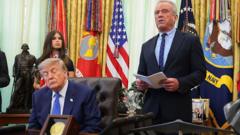
Washington: President Donald Trump has signed an order that seeks to reduce the number of childhood vaccines recommended by the federal government and calls for splitting the combined measles, mumps and rubella (MMR) shot into separate injections.
The order, signed in the Oval Office on Monday, directs federal health agencies to revise their official vaccine schedules to include only 11 core immunisations. These cover measles, mumps, rubella, diphtheria, tetanus, pertussis, polio, Haemophilus influenzae type B, pneumococcal disease, human papillomavirus and varicella (chicken pox).
Speaking at the signing, Trump said that “decades ago, children received only a small fraction of the vaccines required today” and claimed that “in those times, people were much healthier and of course the high rates of autism now observed did not exist.”
This assertion runs counter to the overwhelming body of scientific research. Multiple large-scale studies, including analyses of millions of children, have found no link between the MMR vaccine and autism. The original paper that suggested a connection was retracted, and its author was found to have acted unethically.
The executive order also recommends that vaccines be administered over a longer period, with single shots given in separate visits rather than combined. This would mean, for example, that a child would receive the measles, mumps and rubella vaccines separately rather than in the standard MMR combination.
However, the federal government does not have direct authority to change school vaccine requirements. In the United States, vaccination mandates for school attendance are determined by individual states. The executive order can only alter federal recommendations, which guide healthcare providers but do not override state laws.
Public health experts point out that splitting the MMR injection does not reduce the number of doses a child needs, but it does increase the number of clinic visits. This could lead to children missing some doses and becoming vulnerable to these diseases in the interim.
The administration has not yet specified how the recommendations will be implemented or how soon the changes would take effect. Federal agencies such as the Centers for Disease Control and Prevention (CDC) would need to revise their official schedules, a process that typically involves advisory committees and public comment.
Supporters of the order argue that fewer vaccines in early childhood may reduce the risk of adverse reactions, although health authorities say severe reactions are extremely rare. Critics, meanwhile, warn that any reduction in vaccination rates could lead to outbreaks of preventable diseases like measles, which was declared eliminated in the US in 2000 but has resurfaced in recent years due to falling immunisation coverage.
The order is part of a broader push by the Trump administration on vaccine policy, which has repeatedly questioned the safety of routine immunisations despite scientific consensus. It remains to be seen whether state governments will follow the revised federal recommendations or maintain their current requirements.
Historically, the CDC’s recommended childhood vaccine schedule included more than a dozen vaccines, including hepatitis A and hepatitis B, influenza and rotavirus. The new order does not explicitly list these, but officials said the intent is to pare the list down to only the most serious diseases. The exact impact on federal purchasing programmes and insurance coverage is still unclear.
Legal experts note that the executive order cannot force states to change their vaccination laws. In the event of a conflict, state law would prevail for school attendance, though federal recommendations often influence clinical practice and parental decisions.
The administration’s repeated focus on the discredited autism link has drawn sharp criticism from medical associations, including the American Academy of Pediatrics, which has called the claim dangerous. The order does not cite any new evidence and does not alter the scientific consensus on vaccine safety.